 |
Home | Game | Rules | Theme | Strategy | FAQ |  |









































|
Game designPart 1 - The beginningWhen I was a kid back in the eighties, there was Monopoly and there were monopoly clones. Naturally, my first design attempt was also a Monopoly clone, namely Cartel. Cartel was still based on the Monopoly core mechanic roll-and-move, where properties were replaced by oil companies and rents were replaced by direct trade between the players. However, there were also some novelties such as a map, where products were transported between companies, and a stock market, where the players take control of companies (and this was long before I heard of concepts like pick-up and deliver and 18XX). I've also wanted to revisit this game and see if it could be modernized into something more akin to today's boardgames. The initial idea of the game flow was as follows:
The game was intended to simulate a globalized economy where local production gradually shifts to raw material imports and then the relocation of factories as production and costs increase. The fun part was that I got to dust off old economic knowledge from my student days. The hard part was that it seemed to require a lot of calculations of different scenarios to balance strategies over time. This was the heaviest game I've worked on so far, but since I like playing heavy economic games, I wanted to try designing one of those too at some point. Part 2 - The basic modelThere are probably as many ways to start a game design as there are designers. I usually start by developing a basic model of the game that summarizes the flows and that I can use as a starting point when I choose the direction for the game. This model usually only exists in my head and possibly in scattered notes, but if I were to draw it, it would look like this for Cartel. What do you guys think, do your lines of thought follow the same pattern or does it sound completely crazy? 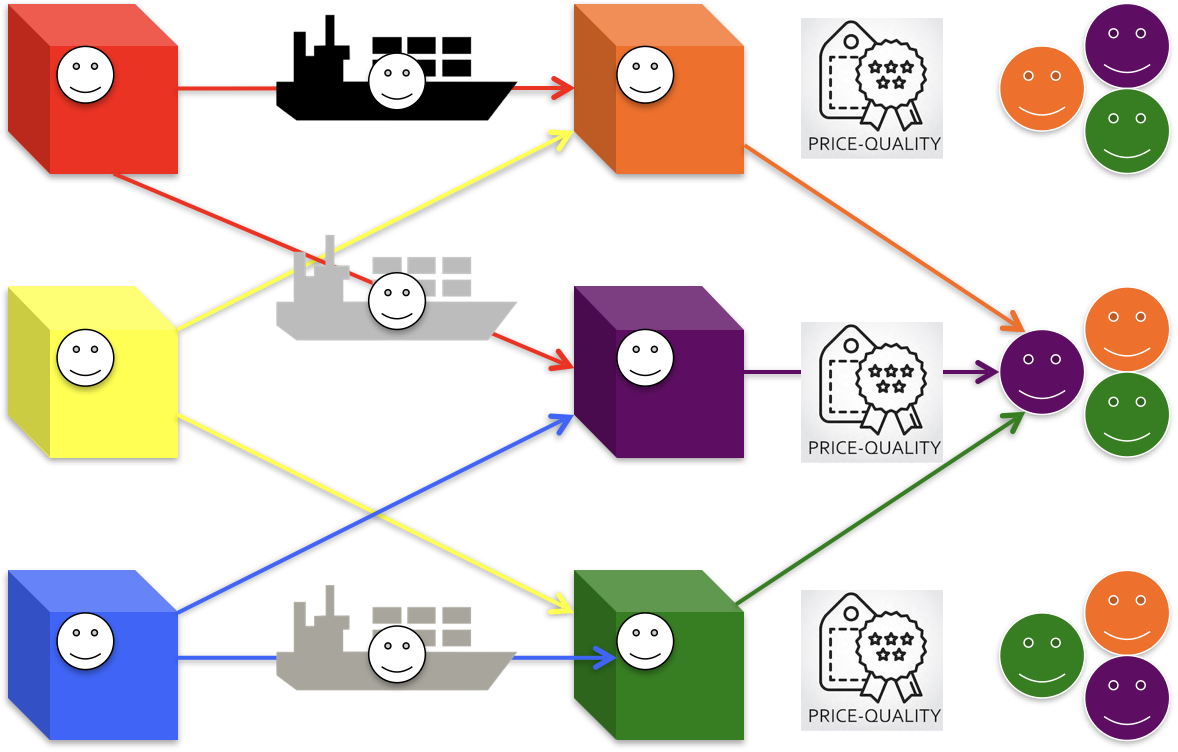
What the model says is that three different resources (“red”, “yellow” and “blue”) are produced in mines by workers, loaded onto ships by workers and shipped to factories (“orange”, “purple” and “green”). There they are combined into final products that compete on price and quality to satisfy customer demand, a demand that is in turn influenced by how many workers have jobs. (“Purple customers prefer “purple” products but can switch brands if the price/quality is much better.) This model is probably enough for a light, almost abstract, game and many of my games don't go beyond that. Now, however, I wanted to move on and make a heavier game with more choices and possibilities for the players. What options were there to move forward?
Yes, that's more or less what my thought process looked like. Now I "only" needed to put preliminary numbers on all this so that I could start simulating and eventually testing the whole thing... Part 3 - Calculate, calculate, calculate!Cartel now entered a phase where the creative process was becoming more like a “real job”. The game was meant to be an economic game that abstracted real business decisions. Just as economists calculate returns for different decisions, I had to do the same for the decisions in the game. According to my design philosophy, this was necessary for several reasons:
Of course, this wouldn't guarantee a good game, but I could at least reduce the risk that the game would be broken before putting it in the hands of game testers. I know that many people recommend that you start testing as early as possible, but personally I think it's a bit disrespectful to the testers not to do the groundwork first. Furthermore, it is an axiom in my quality assurance profession that testing can only find bad quality, not create good quality. For this kind of calculation work, Excel is an excellent tool. I usually start with as small numbers as possible to make it manageable and then scale up if necessary. In Cartel, I assumed a profit of 1-3, where 1 was a sign that it was time to find better deals and 3 was a sign that other players in the chain should raise their prices to get a share of the pie. In USA, the birthplace of the automotive industry, the calculations could look like this:
In addition to decisions about location, players could make investment decisions about machines (+1 production per worker), automation (replacing workers), marketing (+1 demand) and quality (+1 price). I would have to calculate balanced costs for those investments later in the design process. I won't bore you with all the numbers and calculations behind these calculations, but overall my simple model looked like it would hold up for different simulations. With that, I felt ready to move on to the next more fun but significantly more difficult challenge: finding decisions and mechanics that would give the players a FUN GAME in this model. The book You said this would be fun actually gives a lot of really good tips for moving forward with this and I will probably come back with many references from it. However, I can't help wondering whether professional designers are as analytical as me or simply trust their intuition more. Admittedly, I have heard of games that have Excel sheets at the core to ensure balance and it is certainly no coincidence that the good Knizia is a mathematician, but still. How much do you others sit around and calculate in their game designs? Part 4 - Where to go from here?My game design process typically starts in a high tempo, where many "great" ideas have to be formulated, evaluated and often rejected, hopefully leaving some that are worth pursuing. This is then followed by a slower period where not much happens, at least not on the surface. Cartel was no exception but I was also busy with pitches for older games and a well needed vacation. On the other hand, it is usually good to let ideas marinate for some time. To continue the food analogy, I eventually boiled down the game model to three possible game designs to choose between.
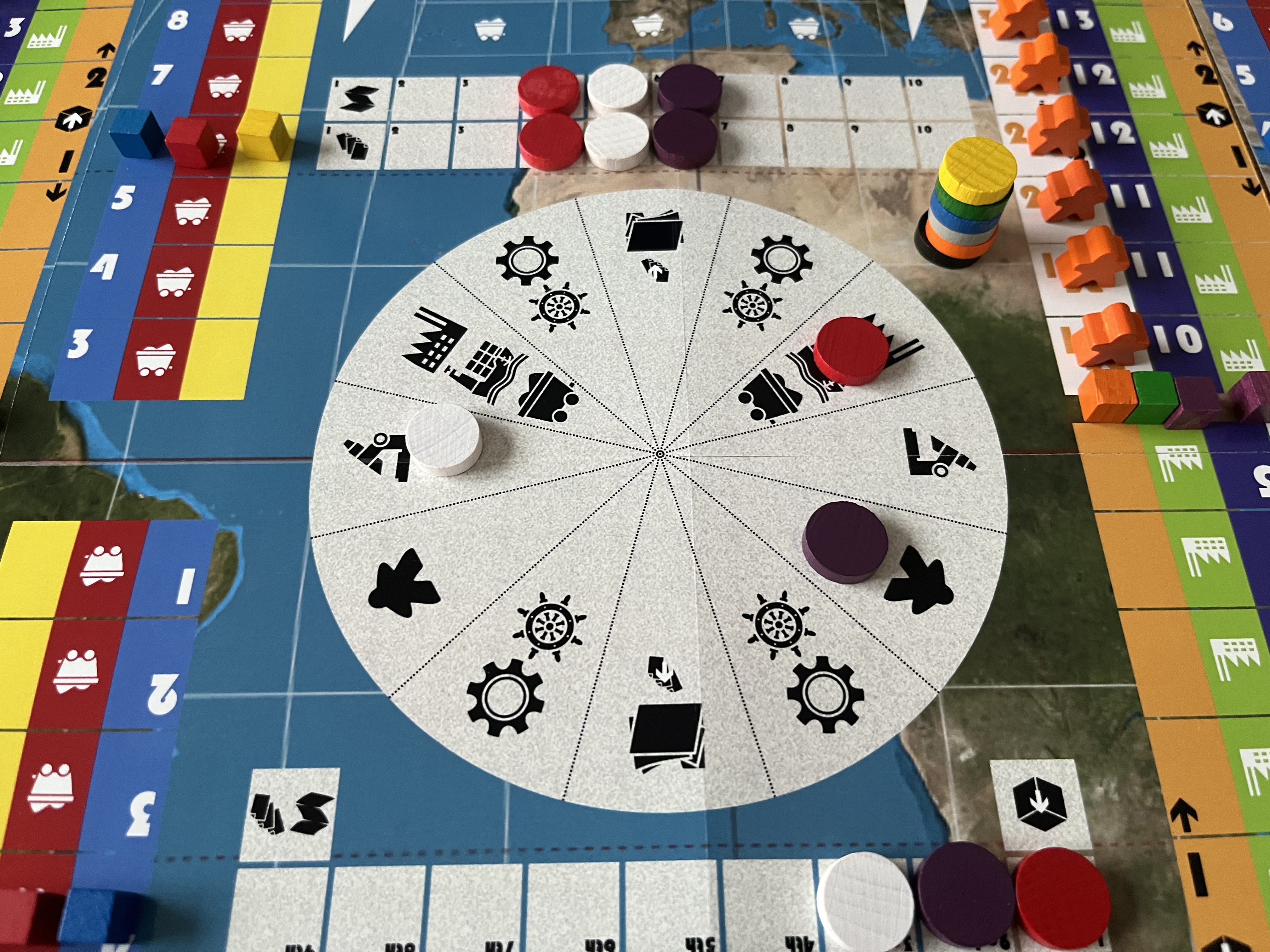
I concluded that I would have to test all three "design tracks" and also to play the above-mentioned games to learn more about their pros and cons. Fortunately, I owned all of them except City of the Big Shoulders, which I could play at Boardgamearena. Needless to say, I wasn't sorry about having to play those fine games. Finally, this is what my first draft of a component looked like: the game board for North America with resource markets on the left, space for companies in the middle, and the labor market with associated wages and consumer prices on the right. 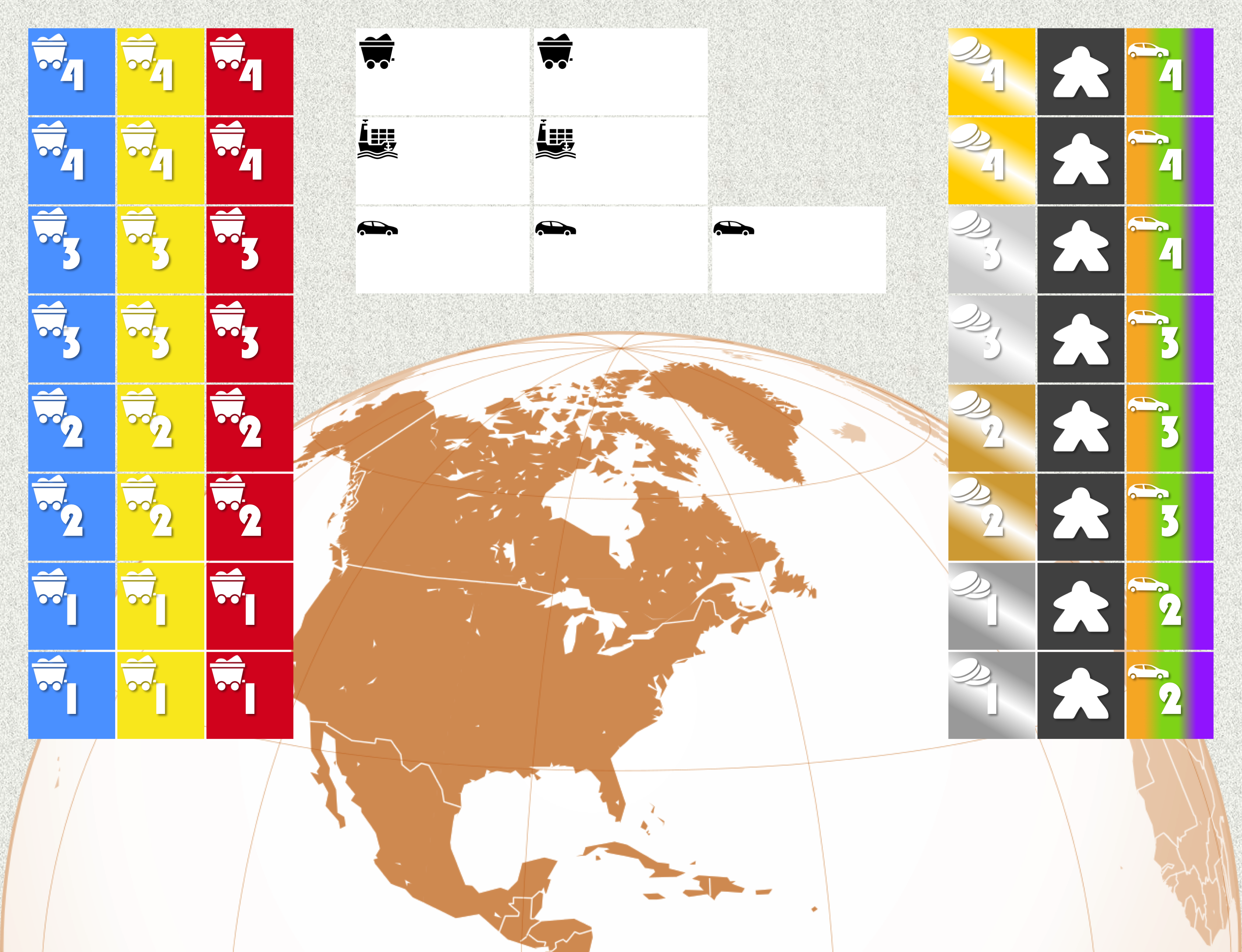
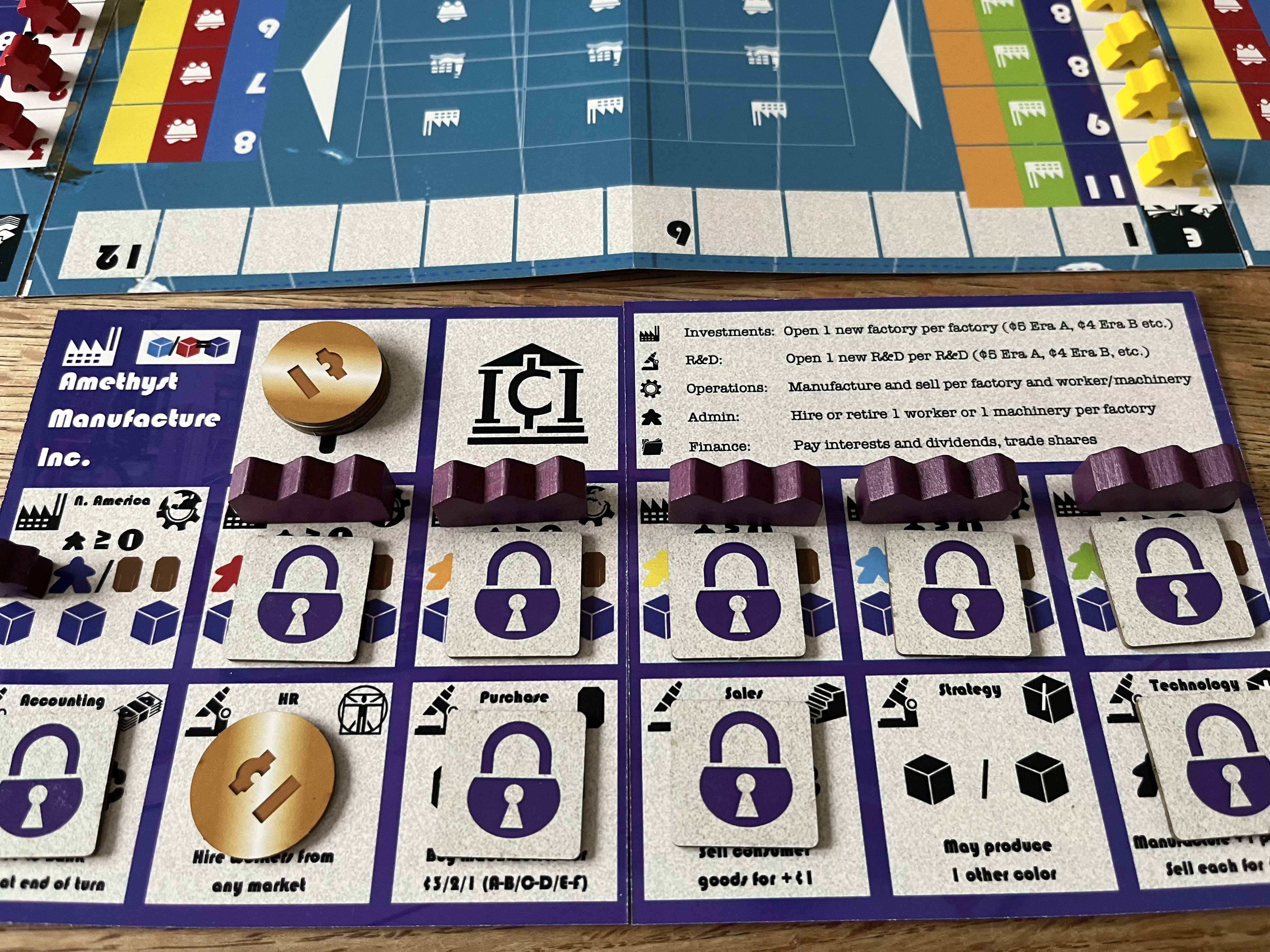
Part 5 - Old and new ideasIn the last update, I considered three possible tracks for the game design; the Winsome track, the Arkwright track and the hybrid track. This was followed by many iterations and rollbacks. Wasn't it Oscar Wilde who said "I spent all morning putting in a comma and all afternoon taking it out"? In parallell, I worked on other game projects, not because I couldn't stay focused but because it broadened my mind and helped me look at Cartel from other perspectives and bring new ideas. One such idea did actually find its way to Cartel. I my civilization game Peoples - Civilizations, I had considered the famous unlockable abilities board from Hansa Teutonica. The idea had been to to give each civilization a board, from which buildings could be taken to unlock abilities beneath. Some were quantity abilities (more actions) and others were quality abilities (better actions). I had liked the elegance of this mechanic but in the end felt that was more restrictive and less interesting compared to the more traditional card mechanic, where a player can combine various cards to create a unique civilization. However, it might work in an economic game. Of the three "tracks" for the game design, I eventually chose the Arkwright track, since I wanted the decisions to consist of building up companies and adapting them to changing market conditions. To this track I added a company board inspired by the civilization board above. Each company would have abilities that could be "double unlocked" by putting a component into play AND making an underlying ability available. Those abilities would strategic choice between quantity (more actions) and quality (better actions). For example, a player could choose between placing another company manager (=more actions) or another factory (=more production per action). However, I didn't completely give up on the stock track. I admit I was a bit put off by City of the Big Shoulders, where a large part of the game time is spent buying and selling shares solely to lower the value of the opponent's company. Granted, this is the effect of 18XX "unnatural markets" where price movements depend on speculation rather than underlying values. But why not try "natural markets" instead? In such a game, a company CEO could issue shares when they need capital at a price set according to what the other players value the shares at? In practical terms, this could be implemented through hidden bids that the company CEO either rejects (and buys at his own bid) or accepts (whereby anyone who wants to can buy at that price). In addition to stock dividends, shares could then be assigned a value at the end of the game based on how much capital the company has at that time. Such a mechanic would not only be faster but also more realistic. Another thing I thought about was how I would "reset" the markets so that, for example, markets that have been sold to are emptied of goods. In Arkwright, goods are sold simultaneously and removed afterwards, but I also wanted to include the challenge of different companies selling at different times and competing to sell at the right time. The solution was event cards that are drawn every game turn and randomly adjust different goods in different markets in small steps. I hoped this would give what is called a "healthy randomness" to Cartel. In addition to market adjustments, the cards could contain thematic events, such as strikes (=higher wages) and embargoes (=blocked markets). After all this brainwork, I "only" needed to finish the last components to get a playable prototype, not least the 144 unique event cards... Part 6 - Writer's blockMy first games only took a couple of weeks from idea to prototype with finished rules and components. Of course, I have later returned to them for further development, but the basic principles have still survived the more critical gaze of hindsight. But Cartel kept giving me a writer's block and several weeks could pass without much progress. I couldn't blame the game, only myself, since I hesitated too long in choosing a mechanic instead of just release the brakes and start testing. I'm not referring to the many event cards that I struggled with last time. Sure, the game had over a hundred unique events, but since most of them were duplicates where only the continent and/or resource differ, the events were really no more than a dozen with different variations. No, what got me stuck was one of the most important resources in many games, not least Cartel: time. In a game that is about timing resource transports and market fluctuations, players need to feel like they have control over time. But “normal” turn-taking rules turned out to have too many problems. A raw material company that is ahead of another mining company would always be able to sell at better prices. A manufacturing company that buys raw materials from a long distance would have to wait several turns to be able to convert them into products. One idea to solve this was to draw the companies’ "CEOs" randomly to vary the turn order and let the transport time tick regardless of which company takes its turn. But this became even more uncontrolled and directly unfair if a company had several of its CEOs drawn in a row, as the companies often depended on other companies acting in between. (The raw material company wants manufacturing companies to buy raw materials from the market before they produce more raw materials, etc.) As so often, the inspiration for a solution came from another game. The game in this case was Olympos, which uses the well-known time mechanics from Thebes in an interesting way. By allowing different actions to take different amounts of time, companies could advance along a time track, with the turn going to the company that is currently furthest behind. Raw materials that need to be shipped could thus be placed further along this time track and “picked up” when a company CEO passes them. This mechanic would fit in perfectly with other mechanics such as the choice between short-term production and long-term development (not just a question of money but now also of time) and event cards at regular intervals (the first player on the time track could trigger the next event). With that, I finally felt confident enough to start an alpha test. The first auction round started tentatively as players had to assess the value of the companies based on both market prices and order of turns, but once the first company was started, the other pieces of the puzzle fell into place. A raw materials company in North America attracted another, which attracted a manufacturing company to use the raw materials and a transport company to eventually buy cheaper raw materials from abroad and/or export products. The first operational round ended with all companies doing equally well (my calculations were correct - no company was "overpowered" at the beginning) and thus having the same amount of cash to start choosing alternative strategies. The alpha test had only begun, but the difficult first step had finally been taken! Part 7 - PrioritizationsUnfortunately, the slow first step was followed by even slower steps. I've always found it difficult to focus on one idea at the time and during the work with Cartel there was an unusual amount of other competing ideas. Smaller games like the family game The Mara about safari and the work game Butik 0238 about the daily work at a store of Systembolaget (where I was working at the time) sped ahead. Older games were revisited in preparations for game conventions, such as Politeia for Fastaval and Cosmoclasm for Smashcon. Another old game, Bellum se ipsum alet, caught the attention of a publisher. I even took on testing assignments of external games like Crusader Kings. In addition, I played and reviewed a number of games to get more inspiration. The only attention I gave poor Cartel was the renamning to Globalization. The reason for this was that the word cartel nowadays is more associated with drug cartels than collaborating companies while globalization. But when all those game projects were behind me, I could finally return to Cartel/Globalization with with new and fresh ideas. One challenge that the alpha test had revealed was thematic but unwieldy time mechanic and I now decided to replace it with a simpler rondel mechanic. To do this, I first run the new mechanic through my Excel simulations and after some modifications I came up with the following expected “game arc”:
(The key to achieving this is the simple rule of diminishing returns so that players naturally seek new markets when their existing markets are saturated.) I was satisfied with the outcome of the Excel simulations and finally able to sit down and write down the rules according to my principle that an obscurely written rule leads to an obscure game. After many rewrites, I arrived at a set of rules that still makes Globalization a heavy game but hopefully logical and intuitive enough for it to flow well. Of course, there was still a lot to test, but I finally felt satisfied enough to order a prototype and start the beta testing. This test would tell whether Globalization succeeds not only in simulating globalization but also manages to give players a fun experience with interesting decisions. Part 8 - Prototype and beta testAnother busy year passed but a welcome summer vaction gave me tile to start the long overdue beta test of Globalization. The prototype had a bigger table presence than any of my other games with its large game board and up to nine company boards, and it took a while to set up the goods and labor markets on the six different continents. Once the test got underway, however, it turned out that I only needed to balance a few variables to make it flow. The biggest change was a faster start by allowing new companies to have a factory and a development instead of starting from scratch. So what does the game flow look like? As usual in my own tests, I simulated four different strategies:
The initial company auction gave the commodity player the CEO position in two commodity companies, the product player in one product company and the transport player in one transport company. The fourth player managed to get shares in all three company types. After a tentative start, where I often reverted moves to find reasonably optimal tactical decisions while performing the above-mentioned balancing, the game got up to speed. North America with its high prices became the natural starting continent for all companies. The commodity player chose a development that gave high production and quickly lowered the North American market, then moved on to factories in Africa and Asia and did the same there. The product player invested in machine development instead of being able to automate production and save on labor costs, which delayed production but gave her low commodity prices once she got going. The transport player invested in more efficient logistics but did not have time to cover the commodity player's needs and therefore chose to take out more loans to finance an expansion to Africa. Low commodity prices and high transportation costs (which become more expensive if there are no transport companies on a continent) slowed down the commodity player's expansion rate and she was forced to export the surplus of raw materials to the still untouched and profitable markets of Europe and Oceania. She thus managed to pay out enough dividends from the companies to be able to start a third commodity company and consolidate her dominance in the that market. The good supply of commodities encouraged the product and transport players to also pay out dividends and they sought out the seemingly promising European market. The portfolio player shared their opinion and invested their capital in these companies. Unlike the commodity player, they also chose to issue new shares to finance continued streamlining of their old companies. I looked very much forward to seeing how the different strategies would pay off. The test game resulted in many modifications, not least for the product companies who needed to calculate product revenues, commodity costs, transport costs and salary costs, but thanks to my Excel simulations I could quickly assess the outcome. I used poker chips in the test game, which helped reducing the playing time, but I still expected a full game (72 turns in total divided into up to 9 companies controlled by 3-6 players) to take 3-4 hours. Thus, Globalization was by a good margin my heaviest game so far. As much as I loved heavy economic games, I had a hard time seeing Globalization becoming more than a prototype. Designing and testing the game was fun, though, and that was enough to keep me going! 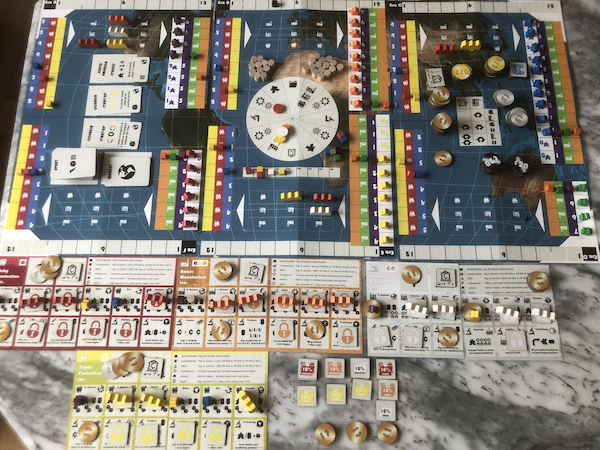
Part 9 - Simplification and agencySometimes ideas come along that are so simple that you wonder why they took so long. The first idea concerned the operational part of the game. A basic idea in Globalization is that each transaction involves two units where the companies at the end of the chain need to “buy and mix” two different colors to produce their own color. Since each transaction also involves transportation and wages, there could be quite a few variables in the equation, even if it was just addition and subtraction. It worked well on paper, but when I sat down with the physical components, it occurred to me that you could halve the transactions by simply having them involve one unit instead of two. The companies at the end of the chain still have an interest in “buying and mixing” because the color they buy increases in price and makes the other color cheaper the next turn. However, it required a lot of reworking of prices and other elements in the game, but as often as before, I benefited from my documented playtests. By simply entering the new conditions and rerunning the test, it turned out that the end result was largely the same, but that the path to it was much easier! The second idea concerned the stock part. I had an idea for a realistic stock market where companies issue shares when they need capital and where players set the price through bidding. A simple and often common mechanic for valuing resources in games, but in Globalization there was a catch. In an economic game, you don't want to let money sit unused in the cash register but invest it as quickly as possible. In 18XX, there are therefore operational rounds, where you earn money, and stock rounds, where you invest money. Globalization, on the other hand, has an action rondel where companies themselves choose what and when they want to do things. A company's capital needs therefore rarely coincide with other companies' share dividends. Could this be solved without breaking up the entire action mechanics? Yes, 18XX did actually have an answer after all. In a simplified description of Globalization, I likened the game to a mix between Arkwright and 18XX. When I thought about this more closely, I realized that the 18XX stock market is more sophisticated than the one in Globalization because shares in the former game are bought and sold regularly, while in the latter game they are only issued at the initiative of the companies. Could a more sophisticated stock market in Globalization be able to bridge the “time differences” so that players can come later and buy shares once they have the capital? Maybe, but how would the market price be determined if not through bidding? I don’t think the 18XX mechanics where stock dividends increase the share value is that realistic. Instead, I thought about having the CEO set a list price, assuming that it would be in the CEO's interest to set a price that was neither too low, nor too high. However, I quickly ruined that mechanic by having the CEO set a list price that was too high and then selling his entire holding at a premium. But 18XX had more tools that I could be inspired by. In the games, a distinction is made between the list price, which is set by the company, and the market price, which is affected by the players' transactions. The CEO could set a fixed list price for shares bought from the company while the bank could trade shares for a market price. All players could then sell to and buy from the bank for this market price, which is sometimes above the list price and sometimes below the list price. This means that a CEO must have a good feel for pricing. A list price that is too low gives away value to opponents, while a list price that is too high does not bring in any capital at all. It also opens the door to dumping your holdings in 18XX style if you manage to cheat on some poor overvalued stock. I quickly realized that the "sandbox rules" allowed for even more stock transactions. In the first iterations, it was only the company's profits that, via dividends to the players, created capital for the purchase of new shares in new companies. It was a realistic but somewhat slow mechanic. But why not let companies sell shares not only to the players but also to the bank (at market price, not list price) to raise capital faster? OK, but won't the dividends be smaller if the players share them with the bank? True, but why not let companies buy back their own shares? This gives companies more freedom to decide on their surpluses. Short-term dividends so that players can quickly invest in other companies? Buyback of shares so that players can get bigger long-term dividends? Or simply keep the capital for investments and a higher final value? Just as many rules but more room for creative decisions! But if companies are allowed to buy their own shares, why not let them buy other companies' shares too? Suddenly I had given players the opportunity to build corporations with the companies' money instead of their own money and thus use financial means for operational goals, such as gaining control over production chains or monopolizing markets. I did have to challenge the rules and try to break the game to identify gaps that could be abused (which, although realistic, may not be very fun in a game). Such a gap was the possibility to take huge loans, pay it all as dividends and then sell all the shares - something that was prevented through a loan limit. Nevertheless, giving the players a simplified framework within which they have a lot of agency was very promising!
To be continued.
Game components
|
Annotated gamesIf you like those game mechanisms, I can also recommend:

|