Home Game Rules Theme Strategy FAQ


Rule Summary

The players take on the roles of investors, buying and selling shares in global Companies seeking market opportunities across the world.

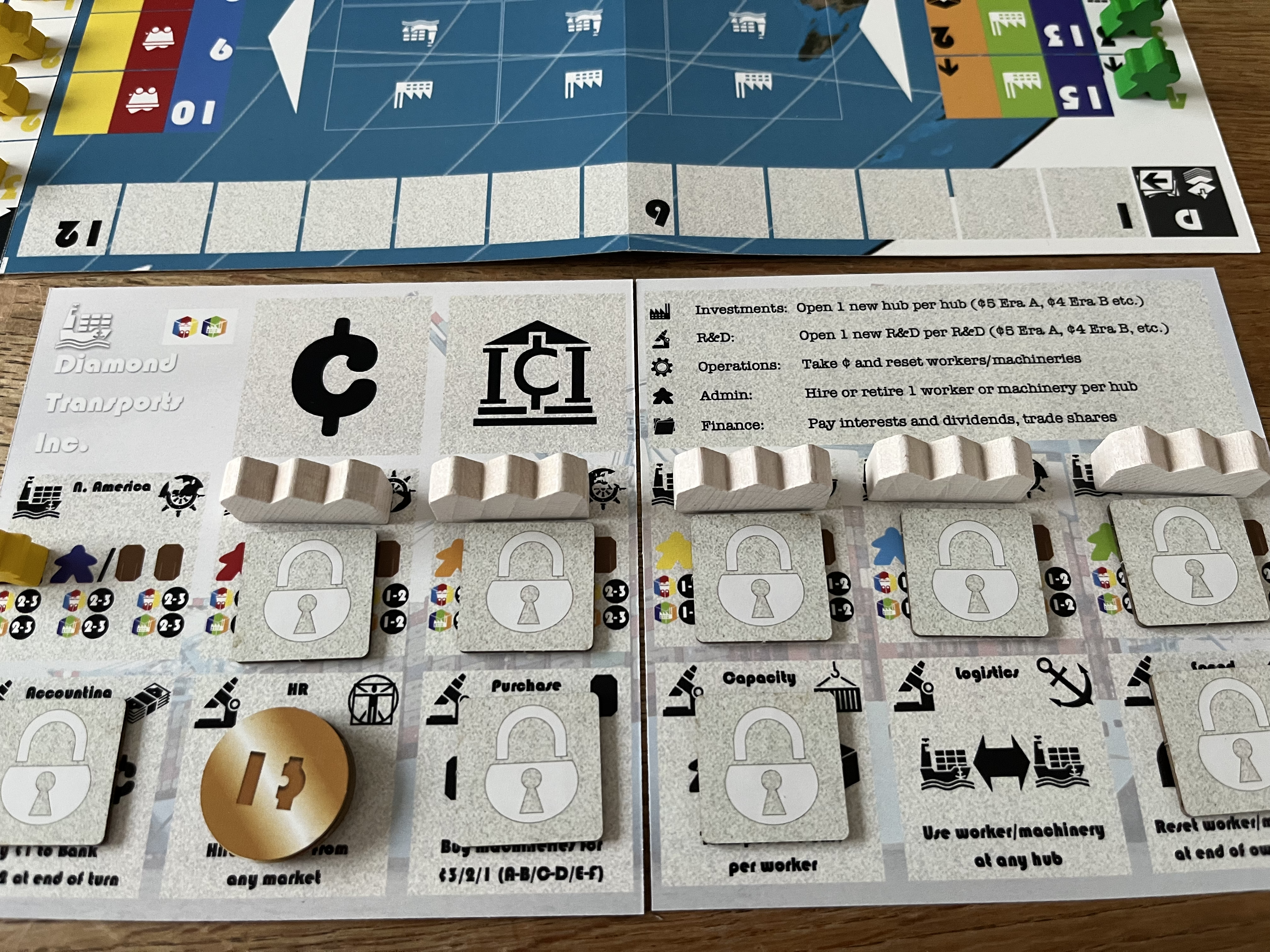
Each company is run by the player with the most shares (the ”President”). One group of companies produce resources, another group manufacture them into consumer goods, and a third group provide transports between the markets around the world.

Using a rondel selection mechanic, the President issues shares or take loans to raise capital, invests the capital in facilities, workers and R&D, and operates the company to maximise the profits for the shareholders.

By investing in a company, you provide capital for investments and profits. When the game ends, the player with the most shares in the most profitable companies wins.

Version History

  • 0.98: Overseas transports require two companies instead of fixed cost
  • 0.97: Liquidation costs to balance "cash only" strategy, gradually bigger investments and R&D
  • 0.96: Rebalanced market prices, transport costs linked to worker track
  • 0.96: Stock market actions at end of company rounds
  • 0.95: Stock market actions at new eras (for player trades, where Bank also buys shares), Finance actions at rondel (for loans, dividends and Company trades)
  • 0.94: Variants for shorter games
  • 0.93: Share prices divided into list price (set by President) and market price (set by trades)
  • 0.92: Operatives produce 1 instead of 2
  • 0.91: 1 free factory and R&D at start
  • 0.9: Salary-driven market resets, locked facility and R&D spaces
  • 0.8: Rondel mechanic instead of time track, return of two resource levels and player transports
  • 0.7: Time track with time cost for actions, three resource levels and neutral transports
  • 0.6: Supply and demand-driven markets both for resources and shares, card-driven market resets
  • 0.5: Supply and demand driven markets both for resources and shares
  • 0.4: "Hybrid iteration", mixed focus of shares and operations
  • 0.3: "Arkwright" iteration, focus on operations
  • 0.2: "Winsome" iteration, focus on buying and selling shares
  • 0.1: First draft with resources being transported from resource companies to manufacture companies

The complete rules are available in the PDF file to the right. In the following sections, I will describe how they came to be.

Implemented Rules

To be completed.

Rules (Video)


Rules (PDF)


... and Rejected Rules

To be completed.