 |
Home | Game | Rules | Theme | Strategy | FAQ |  |






































|
Annotated Games: Version 1.2, 4 playersThis game was played during the game testing of Bellum se ipsum alet. For test purposes, the players followed pre-defined strategies.
The gray numbers indicate city supply, the black numbers rounds left of a siege and the white numbers rounds left to a revolt. Supply tokens have a minus sign if tilted. Start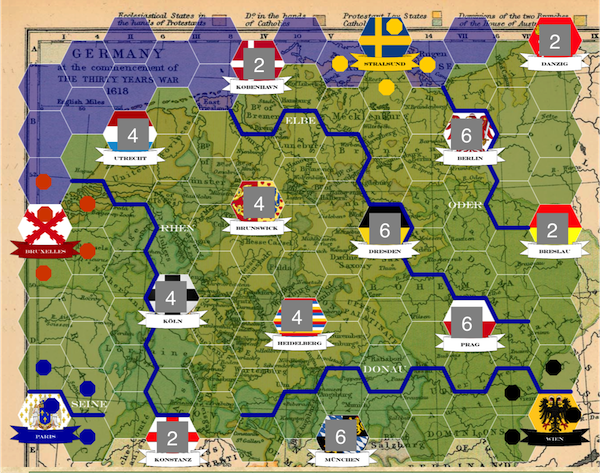
Sweden starts the game followed by Austria, France and Spain. 1618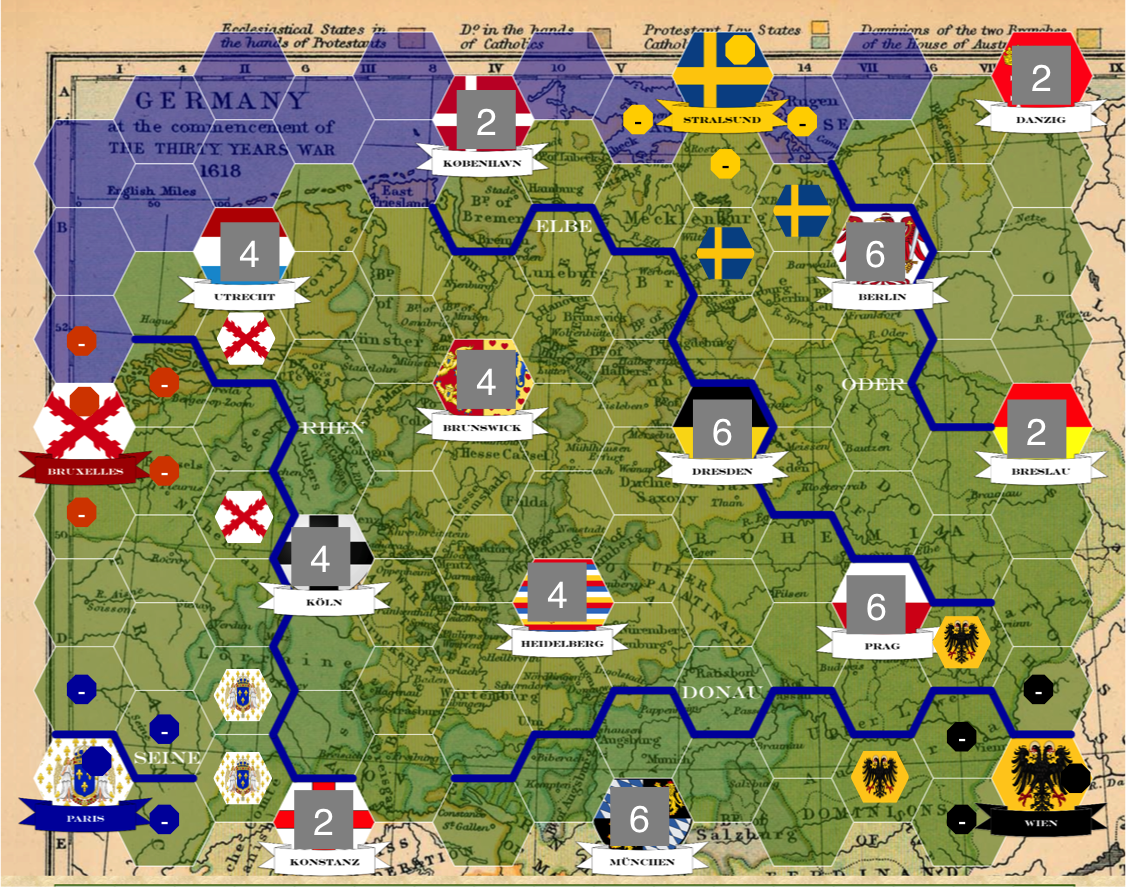
Sweden moves towards the major cities of Berlin and Dresden. Austria does likewise towards the other two major cities in the game, Prag and München. France advance towards Konstanze and Köln while Spain targets Köln and Utrecht. With less than 6 starting influence tokens, all major powers decrease their strength by 2. So far a standard opening. 1620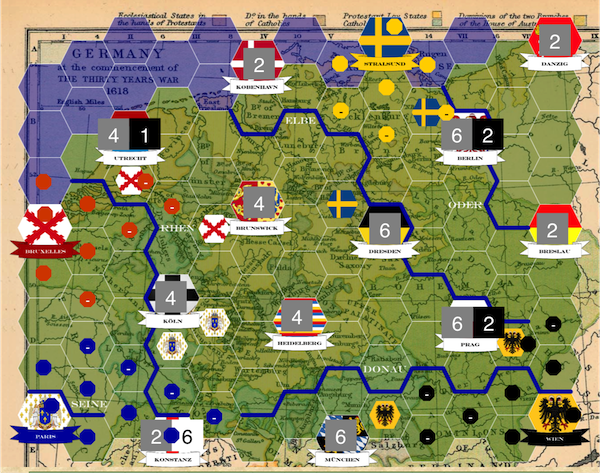
Sweden lets one leader besiege Berlin while the other proceeds to Dresden. Austria does likewise and beiseges Prag with one leader and letting the other move to München. France occupies Konstanz immediately (since the city is minor) and moves both leaders to Köln to deter the lonely Spanish leader there. Spain gets the message and moves the leader to Brunswick instead. The other leader starts the siege of Utrecht. 1622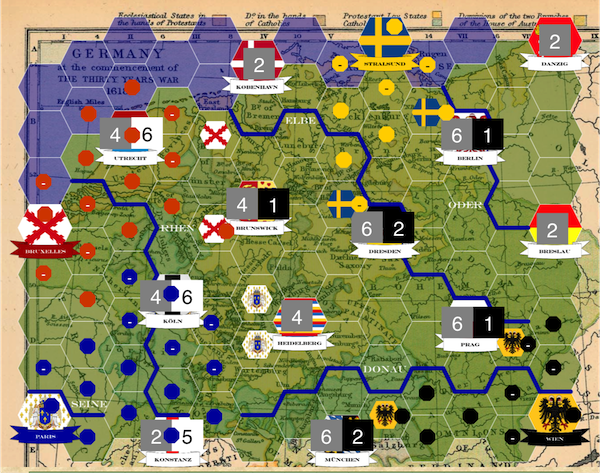
Sweden starts the siege of Dresden and Austria starts the siege of München. Köln falls to France and the French leader move on to Heidelberg. Utrecht falls to Spain and the Spanish leaders move on to København and Brunswick. 1624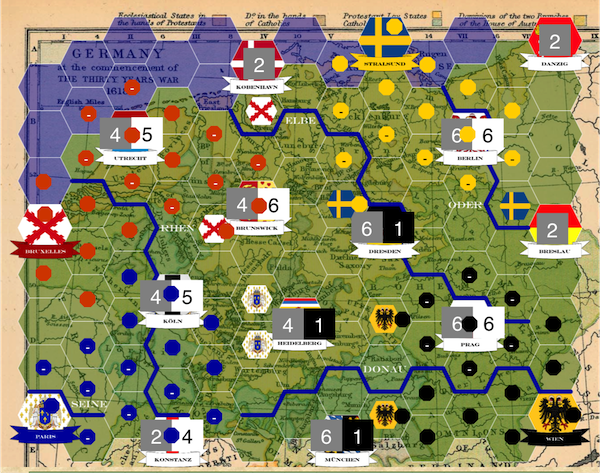
Berlin falls to Sweden and Prag to Austria. The Swedeish leader targets Breslau next while the Austrian leaders positions himself between Dresden and Heidelberg. France and Spain besiege Heidelberg and Brunswick respectively. 1626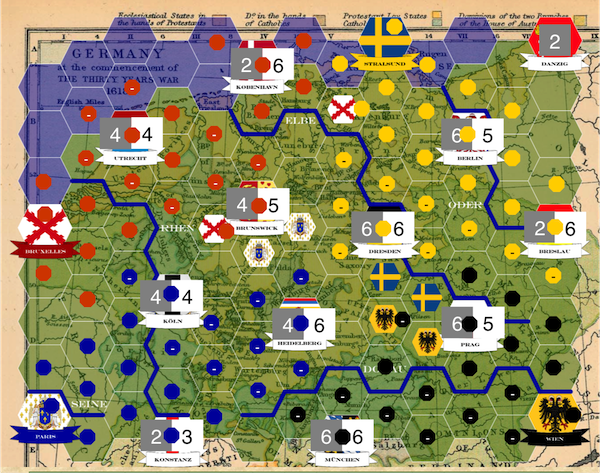
Dresden and Breslau falls in the same turn, freeing both Swedish leaders for a surprise move to Prag. However, München also falls so the two Austrian leaders return to Prag together to meet the Swedish threat. Meanwhile, France completes the siege of Heidelberg and use their new strength for an attack on Brunswick while Sweden and Austria are engaged. Spain leaves one leader to defend Brunswick while the other sneaks towards the Swedish headquarter of Stralsund. 1628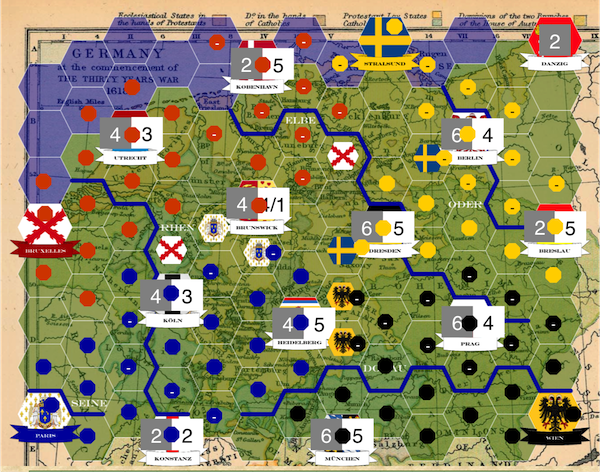
Sweden can't fight both Austria and Spain and retreats towards Berlin and Dresden. Austria decides not to follow but to move towards the French city of Heidelberg instead. The French leaders suddenly find themselves at risk to be cut from retreats and attack the Spanish leaders with full strength. France commits 8 strength and adds 2 for having both leaders, knowing that Spain can only commit 8 + 2 for the city defence. Spain decides to save the army, commits 0 and retreats towards Utrecht. Brunswick is left for the French to besiege but the cost in strength was high. The Spanish leader near Stralsund also retreats, fearing to be cut between the Swedish leader and the Baltic Sea otherwise. 1630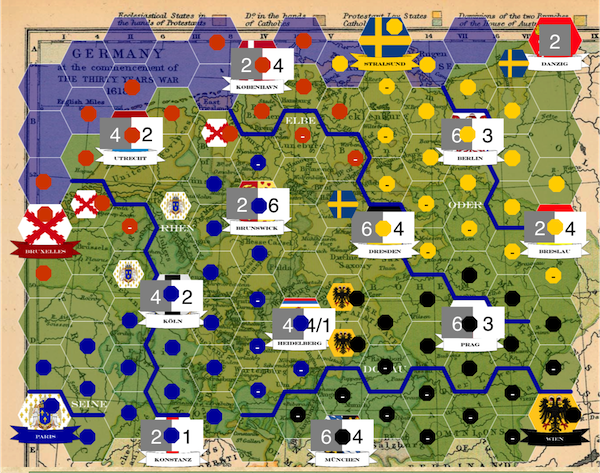
Sweden finds herself short on influence tokens to flip for strength and decides to expand towards the only remaining neutral city: Danzig. Austria takes the opportunity to start a siege on Heidelberg. France risks another battle against Spain to save Köln from a siege and wins with 4 committed strength (+1 for having both leaders) against 4. Spain retreats towards Bruxelles and France, having successfully occupied Brunswick, moves both her leaders towards the Spanish headquarter to end the war. 1632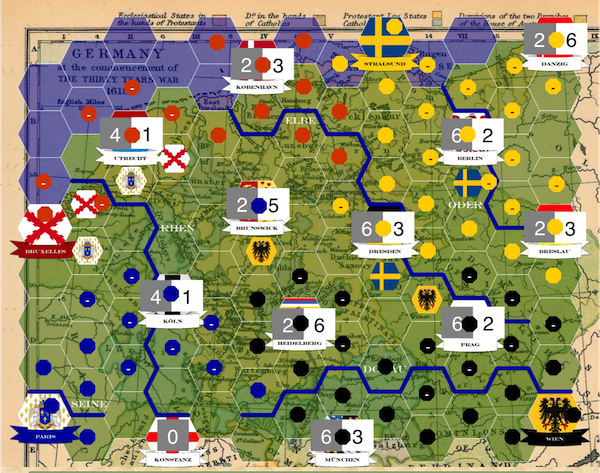
Sweden occupies Breslau and returns to the centre. Austria occupies Heidelberg and lets one leader proceed towards Brunswick and the other defend Prag. France sends both leaders towards Bruxelles, hoping to capture the defending Spanish leader, and Spain withdraws the other leader to support him. Sweden and Austria now dominate the map and have higher supply levels so a confrontation is now inevitable. 1634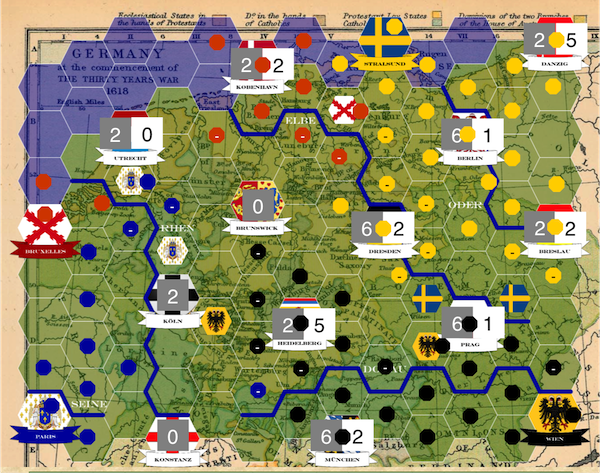
Sweden battles Austria and wins with 8 versus 4 committed strength. With that, both her leaders join outside Prag for another push against Wien. Austria gambles and leaves only one leader for the defence while the other moves towards Köln. France' low supply level will deny her the victory, should she occupy the Spanish headquarter of Bruxelles. Nevertheless, she battles Spain, hoping to capture a leader. Indeed, she does so, since Spain gives up her headquarter returns eastwards in search of other cities for her critical supply. In return, France agrees to join forces with Spain against the otherwise winning Sweden and Austria. 1636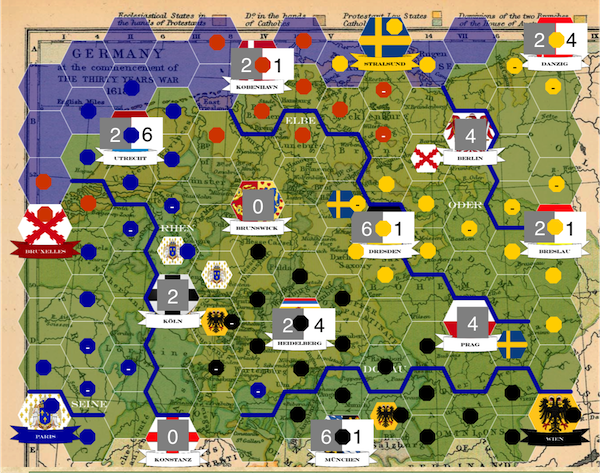
Sweden wages another battle against Austria but this time but only commits 1 strength this time. Austria commits all 6 with the result that the Swedish leaders retreat, one to the north to besiege Dresden once it frees itself and one to the south to return and besiege Wien, with higher strength than Austria. Austria decides to abandon Prag and besiege München once it frees itself. France occupies Utrecht and gathers her leaders to meet the Austrian threat against Köln. Spain hurries towards Berlin, the only city close enough to save the supply from falling to 0. 1638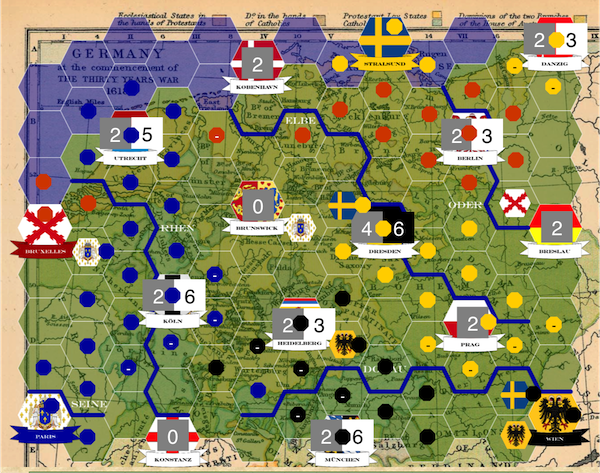
Sweden bets all on one card by besieging Dresden but storming Prag to be able to proceed towards Wien immediately. Austria storms München and gives up Köln to be able to return to Wien's defence immediately. France takes the opportunity to move towards the Bruxelles with one leader and Dresden with another leder. Spain storms Berlin to prevent the supply from falling to 0 and proceeds towards Breslau to recently revolting city of Breslau. The game was interrupted here, since Spain's cause seemed hopeless. For version 1.3, new end game conditions and a rule for pillaging to compensate for lack of supply was tested. |
Annotated GamesIf you like those game mechanisms, I can also recommend:
|