
 |
Home | Game | Rules | Theme | Strategy | FAQ |  |
































|
Version History
The complete rules are available in the PDF file to the right. In the following sections, I will describe how they came to be. Implemented RulesThere are many ideas that came to live in Bellum se ipsum alet - the Board Game©. On this page, I would like to present some of them and explain the reasoning behind them. The game boardWhen making an abstract tactical game, there is choice between a symmetrical game board (such as chess and go) and an asymmetrical game board (such as my favourites Tigris & Euphrates and Samurai). I chose an asymmetrical game board as this add a geographical dimension to the tactics and also connects it more closely to the theme. The cities are placed so that their area of influence are not overlapping and the rivers so that some cities are protected by them (cities may not be besieged across rivers) and some are not. (The price for this was to place some cities and rivers slightly off their real locations - reality does not always offer perfect game conditions.) Special attention has been given to the starting postions to ensure that the major powers are equal and that there are no given openings. Each major power can reach one, and only one, city in the first move and another one in the second move. While the first city is usually given, there is still the question of how fast to capture it, whether to send both leaders or have the second to go for another city, when to challenge an opponent and whom and so on. But that's part of the game. The supply and strengthThe idea of linking an army's supply with its strength originates from old RISK and War & Peace games, where I found the ability to lie low and grow without limits to be a bit unrealistic (although I didn't expect to use the idea in an abstract Euro game). In Bellum se ipsum alet, a player will never be stronger than its base - the supplying cities. As an extra challenge, I also chose to have two restrictive elements between supply and strength. The first element is a temporal one, a lag time between supply and strength so that an army does not immediately gains or loses strength when cities are gained and lost. In this way, an army deprived of its base will still have some time to recover and an army winning a victory will have to consider the time after the victory to let the army grow again. The second element is a spatial one. Supply is only the first condition to get strength. The second is influence tokens placed in the hexes outside the cities and which may only be used every second round. The number of influence tokens on the countryside that may be used is limited by the supply from the cities. In this way, a commander must balance between city conquests and countryside conquests and make sure not to be cut from any of the two. The leadersDon't get me wrong, I do like purely tactical games like Napoleon at Leipzig, but moving stacks of units across hexes is cumbersome. Initially I thought of having units on the board equivalent to the army's strength but then I realized that this was pointless. Your strength has a number so why do you need to repeat the number on the board? Why not simply have one unit representing the full strength? The leader representing the army was born! Continuing the thought, I evaluated how many leaders to have and settled with two, giving the player the option to either consolidate the forces against a specific goal or to spread the forces for rapid expansion. Two clear option, no more and no less were needed. The influenceThe idea of influence originates from the classic games of chess and go. Moving pieces to capture other pieces is one simple but brilliant idea. Placing stones to capture territory like in go is another. For Bellum se ipsum alet, I wanted combine those two and also make the game dynamic by letting territories being subject to both capture and loss. The solution was to simply lett leaders spreading influence tiles as they pass hexes. Almost as simple and brilliant as chess and go! But such an abstract idea requires a lot of testing to find the right balance. The citiesI already had cities in mind for supplies so letting them having influence as well was a small step. Initially all cities would fall when leaders passed them and free themselves again a certain time afterwards. The introduction of major, medium and minor cities (with different strength) added more variation without adding complexity, and rules about siege and storm added a time dimension as well. Is a city's value worth the time and effort to take it? The number of 12 cities was chosen to give the players 4 cities each, 2 more than the leaders can defend. Should a leader reoccupy a city that has revolted or attack another city instead to deprive an opponent of a city? All tactical choices have advantages that must be balanced against the disadvantages. The movementsIn most tactical games, you have a movement phase first and a battle phase afterwards but not in Bellum se ipsum alet. Here you move last in your turn and don't battle until next turn. Why is it so? The first reason is that I wanted to mimic the careful maneuvers of the armies, where each sides try to find the best positions before waging battles. With movements last, you can't bring all your forces to a weak point AND strike at the same time as the defender will have time to bring reinforcement. Secondly, this actually results in a LESS passive game. How can that be? To answer that, let's first consider a common problem with multi-player tactical games that all RISK players know about: why should I start a fight when I can wait until the others have fought one another off? This tactic may still work in Bellum se ipsum alet, but with the movement last rule, it gets more risky. Imagine that you are waiting for two other players to battle and then advance against the (now weaker) winner. That player will now have time both to withdraw and to consolidate. In addition, the winner may even trigger a game end in a strong position and you can't do anything about it since it will take you two turns to fight him or her, one to move and one to fight. Of course, you can move into position before the other player's battle but then they may decide to fight you instead! Scorched earthA rule that lets the players loot hexes to prevent other players from feeding on them seems natural to a game like Bellum se ipsum alet. Unfortunately such a rule isn't very elegant, since it would require a fourth hex status ("looted" in addition to "influenced, not used", "influenced, used" and "contested"). While the three first statuses may be tracked with untilted, tilted and removed influence tokens, a fourth status would require another component. On the other hand, scorched earth does allow a player without cities to survive long enough to catch up. Scorched earth was thus introduced but as an optional rule with special "pillage tokens". The endHow should a game about a starving war end? With starvation of course! By making the supply level inevitably decreasing (the headquarter decreases every round and the cities decrease after every revolt), the game is turned into a race to the bottom, where the player furthest away from the bottom when another player hits zero supply or strength. This gives a basis for a long term strategy: make your supplies last! But such a rule calls for an opposite short term strategy option and that's why besieged headquarters may lead to instant victory (or at least provide a bonus score if not all opponent headquarters are besieged). Should you go for rapid but short-lived expansion or a slow but lasting expansion? There is no definite answer to that question. |
Rules (Video)
Rules (PDF)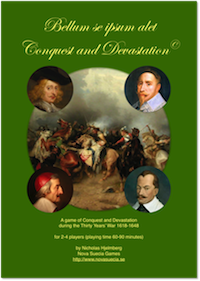
... and Rejected RulesThere are of course also ideas that did not make it and here I explain why. Non-war areasWhen the first map draft was completed, I had some redundant territories, such as the sea hexes in the North and the Hungarian areas in the East. One idea was to use them as a refugee area where only one major power could enter, move quickly and reenter at another place. Sweden could for example choose to land somewhere else on the Baltic coast. But what would such a rule add? Chicken play? Less interaction? More uninteresting moves? No, it was better to just cut off the Eastern part of the map and keep the sea hexes for visual effect only. Winning warAn initial design philosophy of mine was to allow the game to win. In Bellum se ipsum alet, this was implemented through a rule that all players lose if more than half of the cities are turned into ruins. However, I subsequently became aware of the challenges with "semi-cooperative" game conditions where a player may tank the game to prevent another player from winning. Nevertheless, it's still possible for all players to lose by reaching supply or strength zero in the same round. Scorched earthA rule that lets the players loot hexes to prevent other players from feeding on them seems natural to a game like Bellum se ipsum alet. However, such a rule isn't very elegant, since it would require a fourth hex status ("looted" in addition to "influenced, not used", "influenced, used" and "contested"). While the three first statuses may be tracked with untilted, tilted and removed influence tokens, a fourth status would require another component. In addition, such a rule would reward passive players too much. Scorched earth is still a possibility in the game: by feeding the army from hexes that are about to be conquered, the enemy will received them as "influenced, used" and not be able to feed from them until a round later. |