 |
Home | Game | Rules | Theme | Strategy | FAQ |  |




































|
Game designI fell for it again. Although I had promised my old games to focus on promoting them instead of designing new ones, I couldn't resist the contest Survival Challenge. The requirements included a survival theme and the size of a small box and such a game must be simple and quick to design, right? My first ideas for Apokalypsis' game mechanisms were simple enough: move meeples from a central city tile to a coastal edge tile, where a ship can be used to sail to safety. Add to that the Tre Kronor Infernum mechanism of drawing coordinate tiles, to determine which ones that will disappear, and a cooperation element, where players may cooperate to help each other up from disappearing tiles or even build bridges to cross them. The only printed components I needed were some terrain hexes. The game shouldn't take more than a week to complete. Why do I never learn?
My initial concept testing showed that the idea was too simple to work. Moving meeples from A to B was too repetitive. Drawing coordinate tiles had too little room for strategy and tactics. Cooperation was rare and (literal) runaway leaders were frequent. But having come this far, I didn't want to accept that the idea couldn't work and started iterating various elements.
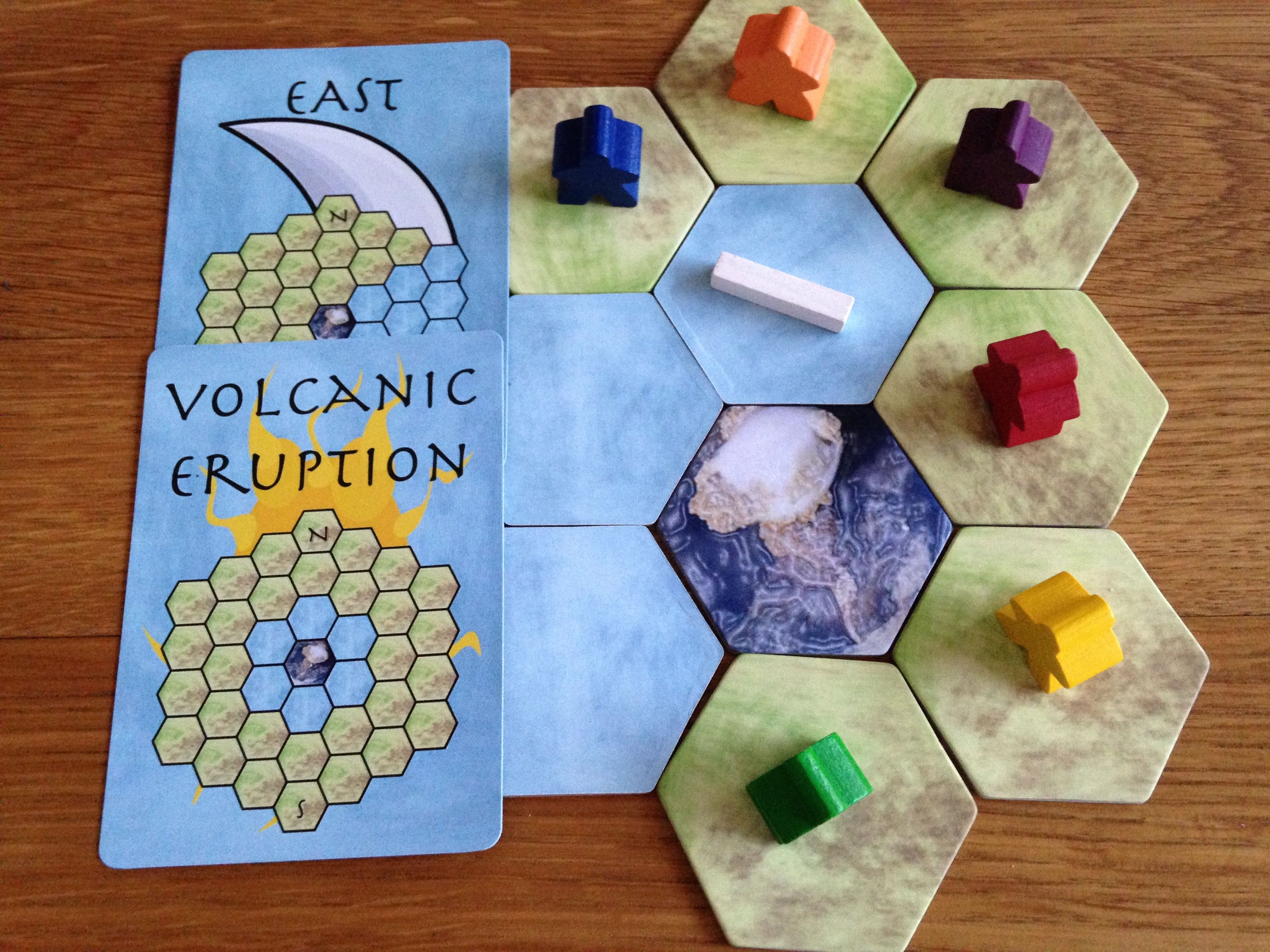
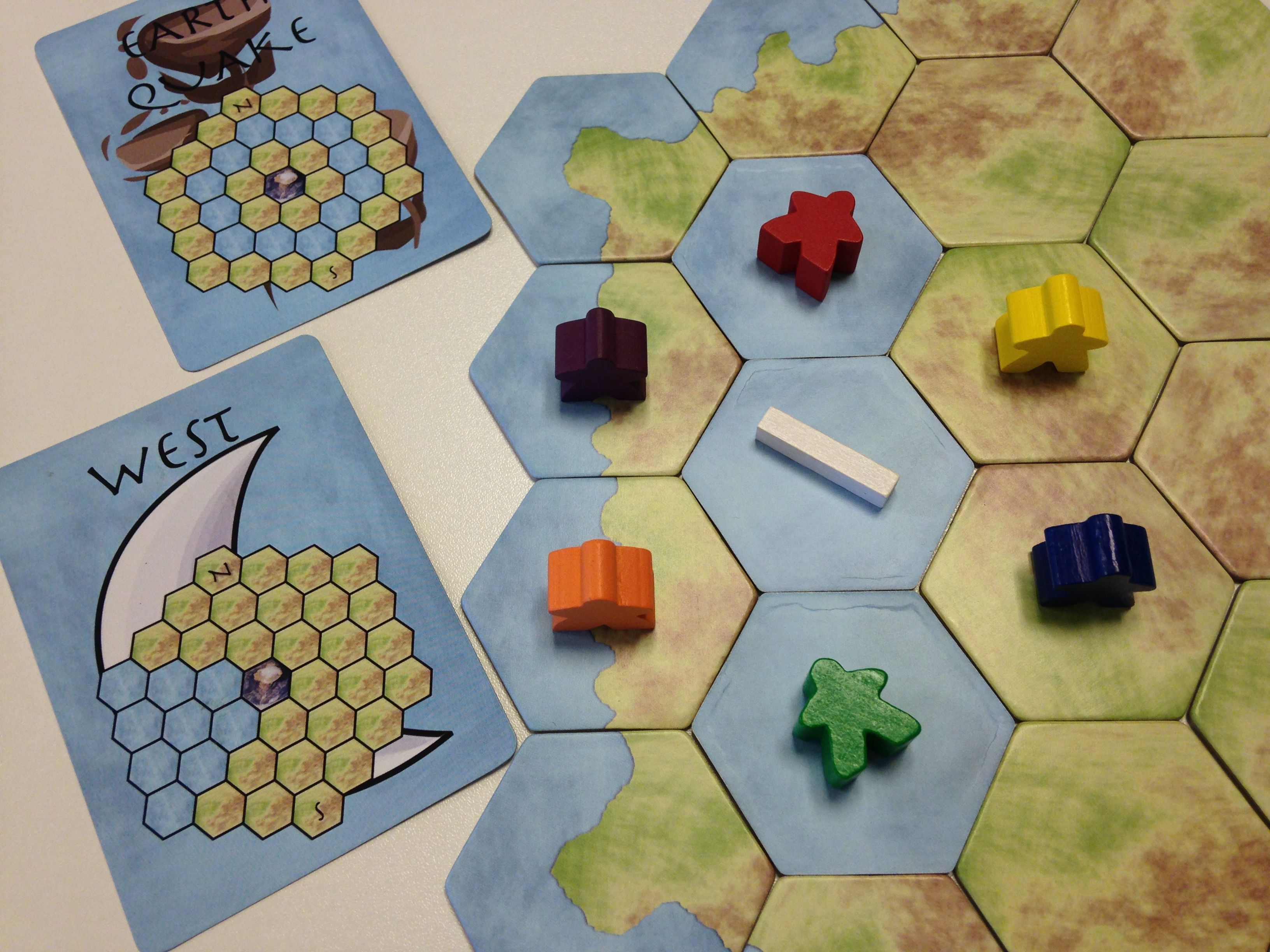
Square tiles are excellent for coordinate mechanisms, since all tiles can be named with a letter and a number (A1 etc.). However, they make movements clunky, particularly when tiles can disappear and players have to spend twice as many moves to move around a missing tile (instead of moving A1-A2-A3, you have to move A1-B1-B2-B3-A3). Hex tiles allows more flexible moves and were a natural choice. However, hex tiles work less well for coordinates. It requires more time to identify which tile that is referred to by a specific set of coordinates and some combinations of letters and number do not appear at all. Instead, I turned to overlapping areas instead. Some areas could be based on compass points (North, South, East and West) and others on distances from the center (inner, middle and outer circles). Thematically, this made more sense than coordinates, particularly when I translated the distances into cataclysms (volcanic eruption strikes the inner tiles etc.). Still, even with hexes the gameplay of moving meeples from a central city to coastal ships became repetitive and I also got a (literal) runaway problem, as the first player to be blocked by a disappearing tile would have to rely on all the other players being blocked twice to get in the lead. The simple solution was to let the players stay on the island and move around to avoid the disappearing tiles. Not only did this offer more variation but also equal winning chances, as I could let the winner be determined by the last survivor rather than the most refugees, giving all the players a chance to win as long as they have at least one meeple left. Nevertheless, more work was required regarding the movement. The early iterations only allowed 1 meeple on each hex, something that offered blocking opportunities in a "escape game". However, since I wanted to have more flexible movements, I couldn't have too many blocked hexes and instead tried a push mechanism. This gave the players not only more ways to move to safe land but also a way to move other players to unsafe land. An excellent take that mechanism! By increasing the limit to 2 meeples on each hex, I made movements even more flexible, while still allowing blocks if both the hex moved to and the hex pushed to are full. So far so good when it comes to the meeples but what about the tiles? In Tre Kronor Infernum, the players select coordinates and when they happen to intersect, tiles are affected. This works, since there are only 3x3 coordinates for the 9 rooms in the game. However, Apokalypsis' bigger board requires more than that so I started by letting the players draw random cards to determine which tiles to disappear. This was according to the theme of letting the players react to things outside their control but removed too much control from them. How to return the control? One intriguing idea, that kept being included and excluded, was the idea of defying the Gods. By letting the pile of affected tiles grow until a player decides to reveal them by "defying the Gods" (and draw the wrath of the Gods upon the island), I added a gamble mechanism where players could move their meeples in safety first before causing the other players' meeples to be lost. In reality, this didn't turn out that way as the players got an incentive to defy the Gods every turn. The attempt to add a cost (at least 1 lost meeple to the player defying the Gods) didn't help either as the players now got an incentive to wait too long to ensure that all other players lose more than 1 meeple. The simple solution was to let the players draw 2 omens and choose 1 while returning the 2nd to the bottom of the pile. This gave them two levels of control. First, they could choose which tiles disappear later in the game (and move to those more safe tiles). Second, they could choose which tiles to disappear earlier in the game (and move away from those less safe tiles). Also, each player's movements could be observed by the other players in an attempt to deduce which omen was chosen and which was discarded. After all those changes, my "simple and quick game" was still simple and quick but considerably different from the game I started with!
The only thing that didn't change during the design was the theme. Not only was it determined by the contest requirements but it also fit in the series of games set in Ancient Greece that I had started working on recently. Like the other games Demokratia and Politeia, Apokalypsis was given a Greek name and the true (?) island behind the Atlantis myth, Therea, contributed with the historical setting. Although I had never played any Atlantis game, I realized that the theme could be a worn out one, but I felt that the game was different enough from games like Survive and Atlantis. (While searching, I also found the interesting and very different game Atlantis, which proves how little a theme tells about how a game plays. I'm surprised it hasn't been commercially published yet.) The rest of the design became a rushed affair due to a pleasant surprise: an order of 5 copies of Find the Bug!. To include the prototype of Apokalypsis, I worked hard to complete the components. The tiles were already completed, using basic map colors for the land side and water colors for the sea side. The omen cards were simply small scale maps, showing which tiles that are affected, and the box reused the template from Demokratia, since both games belong to the same series. The rules were not completed but wise from earlier attempts, I order my prototypes without rules and print them myself later when they are finalized. I also went for a a bigger medium box, partly to make it the same size as Demokratia and partly to fit meeples and wooden bridges. The contest version had to make do with discs and tile bridges to fit in a small box but that's another story. So how did the story proceed? Well, the game didn't win the contest but was picked up by a local store so all is well that ends well (unlike the historical Thera that was completely destroyed).
Spurred by the success of the first edition (and by a component upgrade at The Game Crafter, that allowed more tiles for the same price), I started to think of improvements for the second edition. One idea, suggested by a buyer, was a larger island but then I would need more omen cards for the new areas. Or? The omens of the first edition did not trigger an apocalypse if two similar cards turned up, something that sometimes confused new players. But what if similar cards would trigger an apocalypse in those new tiles? Two storms could strike stormy areas and so on. Thus, the island tiles outside the coastline were born. Another idea originated from the idea of defying the gods. How about certain areas that were either protected by the gods or targeted by the gods depending on their mood? Thus, the temple tiles and their corresponding temple cards were born. For the rest of the tiles, I simply added mechanics that would create a more unpredictable island. The castle tiles could be accessible to some meeples while the mountain tiles could go through the stages inaccessible-accessible before finally turning into water.
In addition to the extra tiles, I also started to look more critically at the game. With only six meeples per color, the score ranged from 0 to 6, something that made draws and tie-breakers frequent. Could that score range be increased somehow? Yes, by giving the gods a bigger role in the game! Instead of playing a people trying to survive, the players could play gods trying to save one people (and score for survivors) and eliminating another (and score for casualties). This would also add a hidden color dimension, successfully implemented in games like Clans. Thus, the open "people variant" and the hidden "gods variant" were born. But the hidden variant highlighted another issue. With 12 meeples to save/eliminate, 2 actions weren't enough. More actions would not only increase the downtime but also make it even harder to keep your colors hidden. Besides, the concept of only moving 1 meeple at the time was not consistent with the theme of panicked crowds escaping for their lives. The solution was so obvious that I blame myself for not seeing it at once. Instead of focusing on the individual meeples, the actions should focus on the tiles and all meeples on or around them. Thus, the evacuate and rally actions were born. The second edition of Apokalypsis clearly shows that even a game that appears to be ready can be improved.
Nevertheless, even the second edition had some issues that kept occupying my mind. One was that some (but certainly not all) players felt that the hidden omen cards gave them too little control and even felt random. Another one was that the game was quite expensive because it used two sheets of tiles instead of only one sheet in the first edition (when the sheets had a size of 36 tiles). Both issues seemed impossible to solve. Open omen cards would make the game decisions obvious while less tiles would ruin the symmetry of the island.
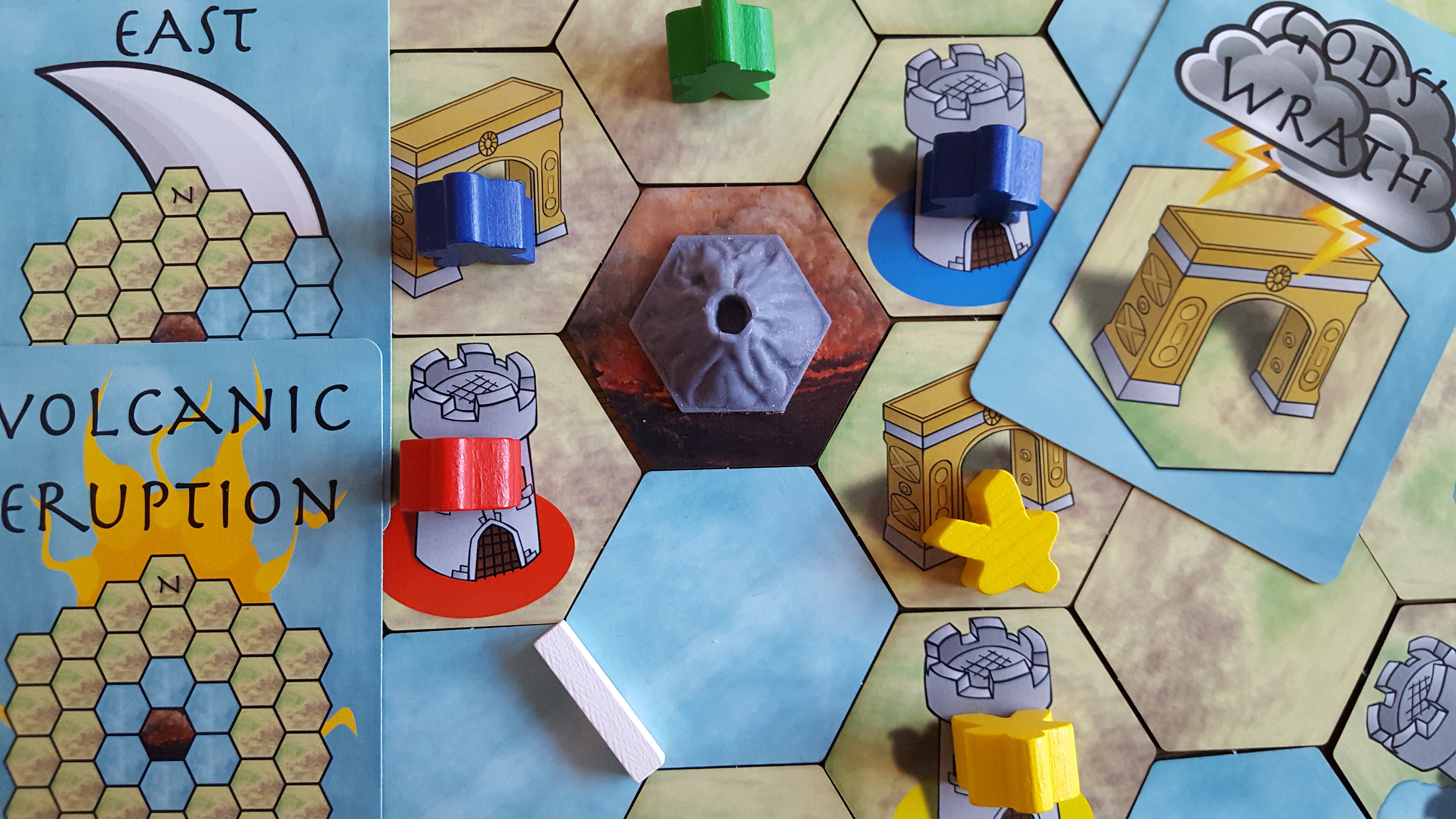
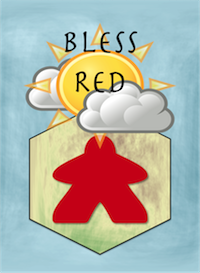
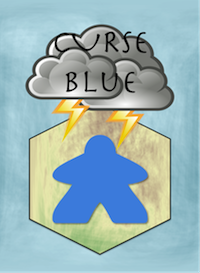
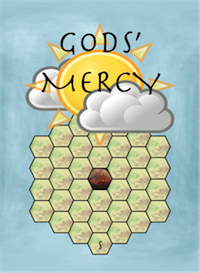
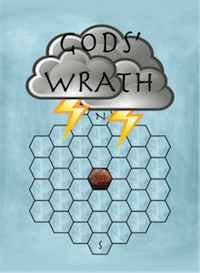
While thinking of solutions, one game kept returning to me, namely the brilliant The King is Dead. In this game, the action cards are also open but it works because every player only has a limited set of action cards. I had tested some similar rules for Apokalypsis, where the player in turn would have to choose between moving his or her meeples or choose among the open cards to trigger an apokalypsis BEFORE moving, but stumbled upon several problems. What would happen when all of a certain card type have been played (and the tiles in that can no longer be flipped)? What's the point of keeping a certain card as a "safe" area if all the other players will simply move their meeples there as well? Wouldn't the players be able to check each other so that draws are even more prone than in The King is Dead (but without its clever tie breakers)? Thus, the idea seemed as doomed as the island of the game but suddenly I got a Heureka moment. What if I simply combined the original idea of drawing and discarding cards from an omen pile with the new idea of open omen cards? In that way, the players would still have some hidden information, namely the omen cards that they keep on the hand and return to the bottom of the pile. It didn't solve all the problems but was an important first step and now the remaining ideas came pouring. First, I needed to make the card playing more interesting. A growing omen pile would eventually force a player in turn to trigger an apokalypsis so that the next player won't get even more choices. The solution came from my first advanced idea: Gods' Mercy and Gods' Wrath. Their new use would be to be placed under previously played omen cards to prevent (Mercy) or force (Wrath) that card to be chosen in an apokalypsis. Now a player would be able to turn an unsafe area into a safe area and vice versa if he or she is unable to flee to or from that area.
Second, I needed to make the meeple actions more interesting. Some kind of delayed flipping of tiles had been suggested by some testers and I now refined that idea to a delayed discarding of meeples. By spending an action to rescue an adjacent meeple from a newly flipped tile to a land tile, a player would get more opportunities to keep his or her meeples safe. But what if the land tile would already be full? Spend an action to push! This rule was abandoned because it didn't reward good maneuvering and blocking on the island but was returned again thanks to the idea of support. To push (or to protect yourself from being pushed), you need to have adjacent meeples to support you. Thus, both offensive and defensive maneuvering was enabled!
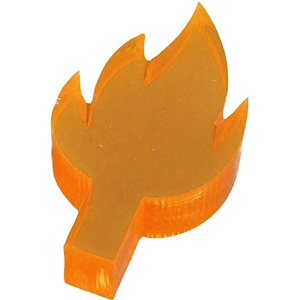
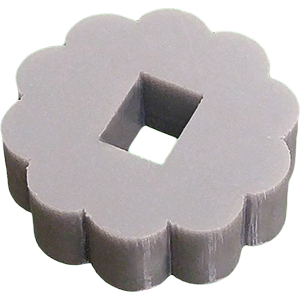
Third, I needed to reduce the number of components. Here I got a pleasant surprise from the latest additions to The Game Crafter's components, namely flames and flame bases. Finally I had a component that could replace some tiles and reduce the number to 32. The fact that I had to introduce more impassable areas in addition to the volcano was merely a bonus, since it created chokepoints on the island. How about the hidden omen cards? Yes, that idea survived. With the removal of all the now redundant advanced rules, I could afford to keep this as the one and only advanced variant. Will I prefer the open or the hidden variant? I think both have their merits and deserve a place in Apokalypsis! Game components
|
Downloadable 3D Volcano Tile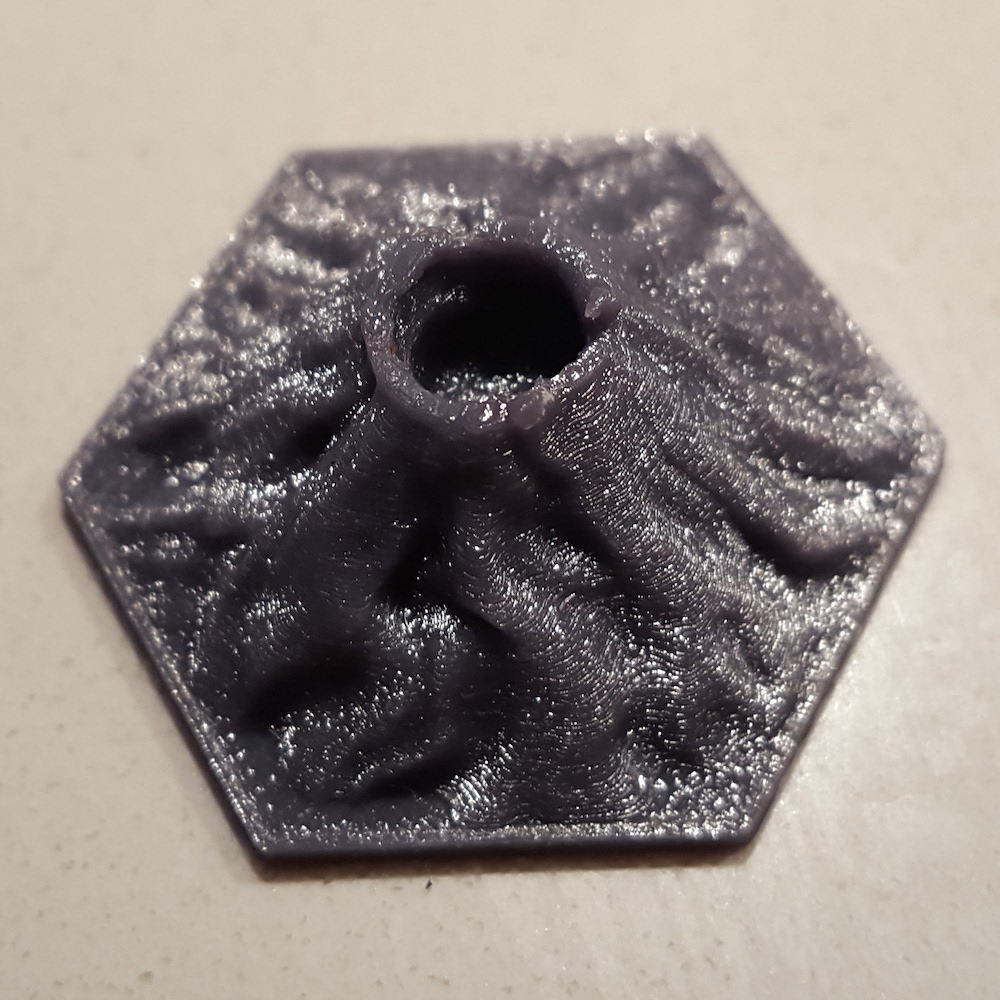
Annotated games
If you like those game mechanisms, I can also recommend:
|