
 |
Home | Game | Rules | Theme | Strategy | FAQ |  |


















|
The Historical BackgroundThe origin of the the Swedish rail networkThe history of the Swedish rail network started in 1856, when the first three lines for steam locomotives opened. In 1862, the Västra stambanan ("West Mainline") between Stockholm and Gothenburg opened and two years later, the Södra stambanan ("South Mainline") between Stockholm and Malmö opened. The government built the important lines but many lines were built by private limited companies, particularly in the south. By the end of the nineteenth century, about two thirds of the rail network were privately owned. Some rail networks were nationalized for different reasons (financial problems, military needs etc.) but proposals to nationalize all of them were rejected. However, from the 1920s and onwards, the private companies suffered from the competition with the automobiles and this led to mergers and nationalizations of several networks. In 1938, after several proposals and investigations, the Parliament voted in favor of a complete nationalization under SJ (Statens Järnvägar, "Public Railways"). After the Second World War, several tracks were upgraded and the speed increased to over 100 kilometers an hour. However, there were also less trafficked tracks that were closed. The game uses 1988 as the starting year, although the deregulation was a process that would continue for the next few decades. The deregulationBy the 1980s, SJ was considered inefficient and with a lack of customer orientation, the opinion shifted towards deregulations. In 1988, the track maintenance was divested from SJ to Banverket, and in 2001, the goods traffic was divested to Green Cargo. Private operators were gradually allowed to compete, first for the goods traffic in the 1990s and then for the passenger traffic in the 2000s. Tågkompaniet (later Vy) started operating in Northern Sweden 2000 and Connex (later Veolia) started operating in Southern Sweden a year later. In 2007, the goods traffic was completely deregulated, followed by the passenger traffic in 2010. The competitorsIn the game, SJ and Banverket are among the companies that the players may invest in, although they are public. This is a game-technical consideration aimed at creating a balance between public and private interests. Nevertheless, the main gameplay is provided by the private and more 18XX-like companies. They consist of a mix of the state companies Green Cargo and the private companies Arriva, Blå Tåget, Flixtrain, MTR, Transdev, Veolia and Vy. The mainlinesThe original term "mainline" was used for the railways that were supposed to be built by the government according to a parliamentary decision 1854. However, additional lines were nationalized over the years and mainline is not an official term today. Nevertheless, there are five lines that have "mainline" in the name.
In addition, the following important lines have been included in the game.
There has been an ambition to use existing lines in 19XX. For game-technical reasons, some modifications have been accepted to provide opportunities for interesting line connections. The addition of the not yet built Götalandsbanan adds value to the connection point Gothenburg and it can be extended via the prolonged Sydostlänken to Malmö and add value to this connection point as well (and sorry, Älmhult, for using Malmö instead of you as the connection point). The railroad developmentThe Swedish network also saw major developments during this time. The building of Hallandsåstunneln started in 1992 to increase the railroad capacity (although it didn't open until 2015), the building of Öresundsbron started in 1995 to connect Malmö and Copenhagen (open in 1995) and there are even plans for a connection to Finland through Kvarkenbron. There are also plans for high-speed rail for 250 kilometers an hour but the building has yet to start. The non-train competitionOne major reason for the weak train market in Sweden is the competition from cars and domestic flights. Since 19XX is a train game, this was deliberately excluded. However, there is a small element in the game that can be attributed to this alternative way of transporting. The closure of mainlines is bad for minor cities (value 10) and this is shown in the game by closing the city as well, since a city's value is a direct function of the number of lines to it. This is a win-win situation for Banverket and SJ, since the former gets less maintenance costs and the latter gets less unprofitable cities to pay for). Major cities (value 20 and above) are usually not affected and this is shown in the game by letting them keep their value. Game-technically, they should get a lower value, but this would be fiddly and make closures less interesting. Thematically, it can be explained by goods and passengers being transported through other means along the closed line. The market developmentThe game adds mergers and acquisitions as a game mechanic and this was happened during the deregulation as well. Connex assumed the name of its owner Veolia, which in turn merged with Transdev, and Tågkompaniet was rebranded to Vy. Other companies like Arriva and Blå Tåget gave up their operations and left the market but new and stronger competitors like Flixtrain entered. In some regions, new private monopolies are rising, just like in the game! |
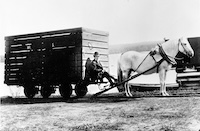
Horse-driven railroad, 1879 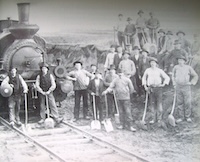
Rail workers, 1900 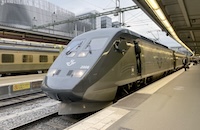
Modern X2000 train |