 |
Home | Game | Rules | Theme | Strategy | FAQ |  |










































|
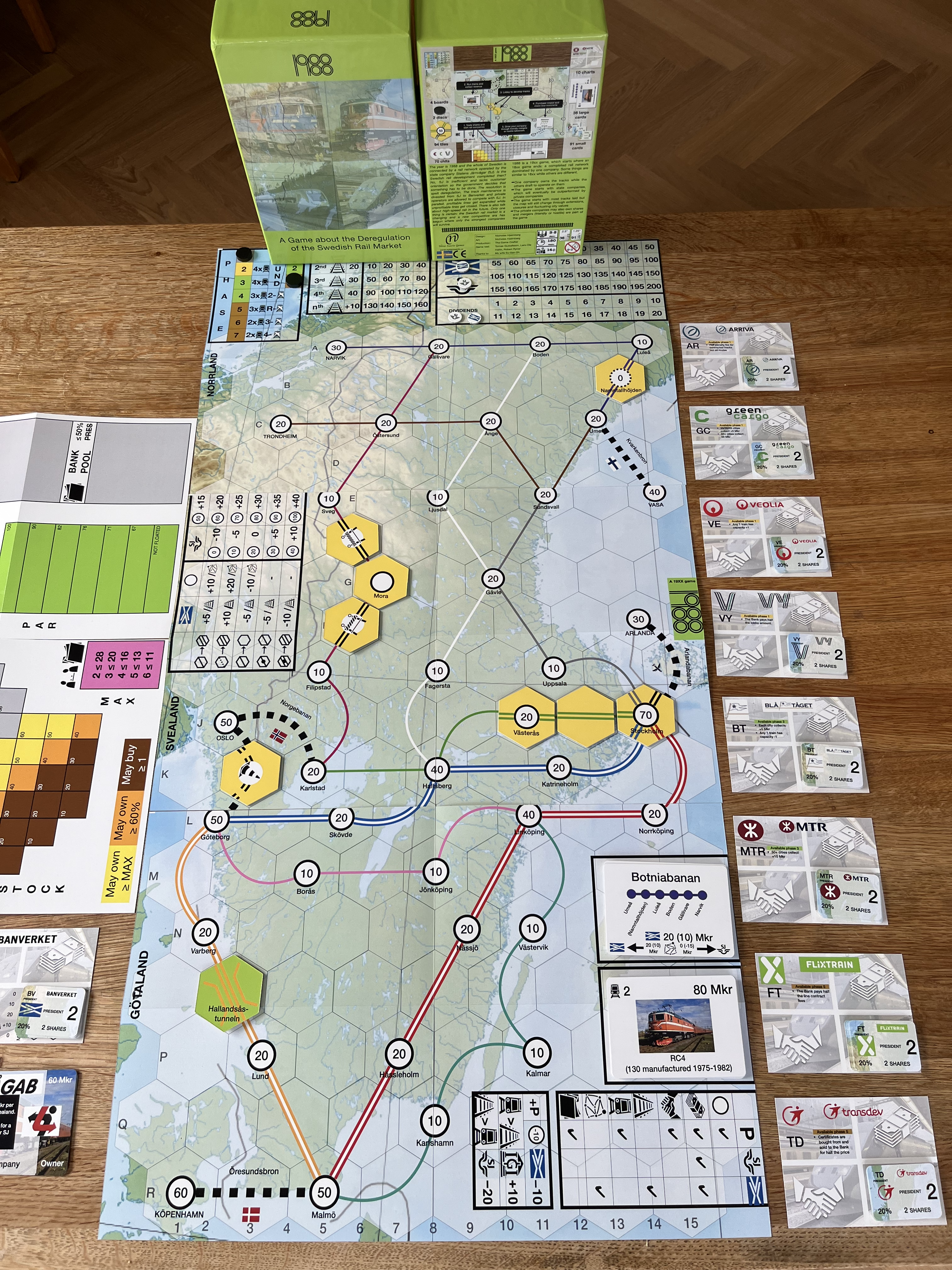
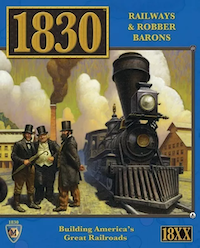
Game designA new game genreThe idea to create a new game genre has a long history. One of the driving forces for my game designing has been the curiosity of game mechanics and what better way is there to explore a mountain than to actually climb it? One recent project was Peoples - Civilization, where I tried to design a civilization game. The civilization genre is well reputed and comparable perhaps only to 18XX genre (which, incidentally, has the same father: Francis Tresham). Wouldn't it be natural then to take on the challenge of designing an 18XX game? One would think so but in spite of this, I failed to muster inspiration for such a game. One reason is that I'm more of a civilization player than an 18XX player, another that there are so many different 18XX games already. Where would I be able to find new ground to break? But somehow I got the idea of turning things upside down. How about a game not about constructing a big railroad network but rather about deconstructing it. The idea wasn't that far-fetched. When it comes to deregulated railroads, two countries are often mentioned: Sweden and the United Kingdom. I grew up in Sweden during the deregulation process 1988-2010 and happened to move to the UK when the deregulation process 1994-1997 was completed. In both countries there were debates about how the companies cherry-picked the most profitable lines while less profitable ones were left to the old national companies or even shut down. But there were also complaints from the private companies that it was difficult to compete fairly with the national company and that they ran the risk of losing their contracts and ending up with no return on their train investments. Surely there was a game here somewhere? The first stepsWith the big game project Globalization completed, I finally got the time to take on a new project. Usually when I start a new game design, I focus on the core mechanics and build the game from there. However, with 1988 I could start from existing core mechanics and let the theme decide what to keep and what to change. I started by studying my subject. I had a basic knowledge of the Swedish deregulation history but there was much more to learn. From the Swedish railroad history, I learned about the old main lines that were constructed to connect cities and regions and they served as a good starting point for the map. The first "map" was only a spreadsheet, listing the lines vertically and the cities with their values horizontally. I used some parameters from 1830 as a starting point (starting money similar to 1830, a stock market similar to 1830, city values in increments of 10, six train types priced as in 1830 and so on). After all, if they work in such a well reputed game as 1830, I would need strong arguments to change them in my own humble game. The initial alpha tests indicated that the game economy worked but it was clear that I would need a more detailed map with more detailed rules to get more meaningful test results. To accomplish this, I started listing the main rules of 1830 so that I could identify which "18XX rules" to remove and which "19XX" rules to add. It didn't take long to identify the main question: how to handle track laying. The operational game18XX games are sometimes divided into two subgroups: stock and operational. In the latter category, laying tracks and optimizing routes is the core gameplay. How would this be translated into a 19XX game, where the main tracks are already laid? One initial idea was to let the companies expand their networks by placing stations in the cities they operated in. Companies with many small branches from a major city would be able to include the major city's value in all its operations while companies with few long branches to other major cities would eventually be able to include several major cities in its operations. That would be a classical balance between short term and long term profit. Following this idea, once a company "proves" that it can reach other major cities, that line would be "deregulated" and open for competition for all companies with stations in the end points. The more operations that would reach a city, the more new stations slots would be opened and the more the city value would increase (but the less the share for each station would be, mainly to the disadvantage of the old state monopolist SJ). I also played with the idea that companies could operate on SJ's lines without stations and trains by acquiring licenses and renting trains from SJ. I liked the idea but struggled to make the mechanics smooth and eventually thought it was more similar to Railways of the World than to 19XX. In particular, I missed the second state company: the track-owner Banverket. A core mechanic of 19XX is the separation of track operations and track ownership and not having Banverket as an active company would lose a lot of that. The more profitable tracks there are, the more the private companies are willing to pay to operate on them, so there is a shared interest here. To get more focus on this part, I changed the game arc from the private companies' own rail network expansions to the all the companies common development of the overall rail network.
With those changes, the games was more about using the state companies (track laying, initial income etc.) to build private companies with synergies (connected lines, optimal mix of trains etc.). Some things were still missing, though, and for this I started looking at the stock game. The stock gameIn the stock game, buying and selling shares is the core gameplay. In 1830, the stock game is limited to the player actions but other 18XX let the companies trade shares as well (and I did successfully add this mechanic in my recent game Globalization). Could this work in 19XX as well? It can and it should. I mentioned above that the goal of the operational game was to build private companies with synergies but what do you do if your company failed to get that contract that would connect all your lines and let a few trains run across the whole map? Well, if you can't beat them, join them. Mergers and acquisitions are common on the Swedish rail markets so it was easy to add them to 1988 as well.
Those rules did another layer of complexity but they do open up plenty of opportunities for creative gameplay. The mapThe map took quite some time to complete. One challenge was the Swedish geography. It's a big country with unevenly distributed railway lines. Thematically, I didn't like the idea of excluding Northern Sweden but mechanically, it wouldn't make sense to have a map with too many empty spaces. I finally settled with a map that includes all the cities but with the Northernmost cities crowded. Next, I struggled to select the lines. The old main lines ("stambanor") were given, except the Northwest mainline ("Nordvästra stambanan"), which runs in one region only and wouldn't be long enough on my map. For the other lines, I had to pick and choose among the many different lines that often overlap each other and cover as many empty spaces as possible. Finally I had to pick cities and choose among the cities along those lines to ensure that each connection between two cities consisted of one track only. Finally, I had to make some own judgements as to whether the line network would allow creative connections between lines to achieve the synergies that the companies should aim for. I did consider giving the players the agency to lay new rails and link existing lines to new lines but concluded that this would get quite fiddly. How should a new line be visualized? How should the minimum bid be calculated. What would happen to existing lines? The idea may be something for an expansion or for another 19XX game with more focus on operations but for 1988 I had to settle with fixed lines. However, there is room for new rails through the extension of end-points, such as Öresund bridge to Copenhagen. One thing that required more time than expected was to "balance" the map. I wanted to get a good distribution of city values (both starting values and potential values) and tracks but what would a balance look like? I added all numbers in a spreadsheet to experiment with different combinations and finally came up with a map I could accept. On this map, the SJ reduced city value was 0, the number of starting tracks 45 and the number of potential tracks 100 (counting double tracks as 2). The maximum SJ reduced value would 280 and the maximum Banverket cost would be 275 (5 for each of the 55 tracks that may be laid). Are those figures balanced? Still hard to say but I thought they were a good starting point and the spreadsheet would help me assess future change quickly. The componentsThe map was the most important component of the game but of course not the only one. The tiles were simple to complete once I had the map with the only decision being at which phase the different upgrades should be available. The trains followed 1830's pricing without the diesel trains but with high-speed trains from phase 3. The first line contracts simply listed its cities but I realized they needed a minimum bid as well to prevent offers so low that Banverket would prefer closing all lines. To be exact, such a bid would have to be recalculated every time any of the line's city value change, but using the above mentioned spreadsheet, I came up with a simple formula. For the interested, the minimum bid is calculated so that the two state companies share the net profit from a fully developed line: (SJ max reduced value - Banverket rail cost) / 2. A less mathematical approach was used for the private and regional companies. Since private companies aren't geographically restricted on a deregulated market, I had to add other advantages and disadvantages. After some considerations, I came up with abilities that would promote certain strategic directions and help differentiate the companies from each other. Their abilities included abilities like preferences for big or small cities, bidding advantages, lobbying advantages, share discounts and so on. I also added regional companies and they were given geographical abilities to promote changes across the map. Their abilities included preferences for less development in Southern Sweden, more development in Northern Sweden, and the building of the project tracks Öresund bridge and Arlanda Airport line. It's unusual in my game designs that I add rule-breaking exceptions, but since they are common in 18XX, I took a step outside my comfort zone and accepted this extra complexity. The rulesWith the map and the components completed, I could finally start the beta testing. I often want to write draft rules first but with 1988, I hoped that the 18XX framework would allow me to do exploratory testing and clarify the rules on the fly. My lesson from this experiment was that 18XX rules are more complicated than 18XX fans admit. There were many concepts and edge cases that needed to be clarified and simplified before the testers could even form a strategy and the rule book ended up bigger than any of my previous game rules. I decided to follow the the 1830 structure for the rules, partly to facilitate for 18XX players to understand the game and partly for myself to understand the differences between 18XX and 19XX. It worked quite well with the main differences concerning 19XX specific concepts (mainly regarding the state companies) and the rules for mergers and acquisitions. As with my previous games, the effort of doing so was paid off during testing as I could assess all ideas for rule changes in terms of how they would fit the general rules and increase/decrease the rules complexity. The testingThe testing of 1988 turned out to be quite time-consuming, since 19XX, similar to 18XX, turned out to be a sandbox game with many different aspects that had to be balanced. For the initial testing, I put together a spreadsheet to keep track of the many transactions back and forth and I found myself constantly rewinding the test, changes a parameter and replay the test to assess the outcome. Sometimes I was very engaged in the different strategies, sometimes I was just fed up with all the calculations and had to let the game rest for a while. The parts that gave me the most headache were, perhaps not surprisingly, the parts that distinguished 19XX from 18XX. Some things were solved by choosing the simple way. An early version of the lobby board where a player chooses both amount and number of tracks with a simple amount choice, of which the player may pay as little or much for development. Exponential penalty fees were replaced by a simple flat rate penalty fee. An exit mechanic to accommodate for companies stuck with no money or contracts was replaced by a simple rental fee to earn a (albeit small) revenue for unused train capacity. Other things were solved by choosing the fun way. The unique abilities of the private and regional companies were necessary to make the choices of which companies to start interesting but which abilities should they have? The answer was the abilities that provide fun and interesting decisions. Some regional companies benefit from little track development in their areas and others from much track development, and some private companies benefit from many small cities, other from few large cities and so on. But what required the most testing and tweaking was the concept of state companies. An ordinary 18XX company makes no revenue the first round and faces a fall in share price but it doesn't matter much since the initial offering price remains the same. Thus, a player can't wait until the second round and buy cheaper shares when the company starts paying dividends. A state company on the other hand is already running when the game starts. Thus, a player investing in a state company in the first round will earn dividends and be better off than a player investing in a private company in the first round. Take an example where player 1 invest 100 in a state company, earn 5, sell for 100 and invest 100 in a private company. Compare this with player 2 investing 100 in a private company. Both players will have shares for 100 in the private company when it starts paying dividends but player 1 will have 5 more. Thus, it will always be better to invest in a state company first and wait for others to invest in private companies. The final solution was actually simple if you approach it the "18XX" way. If the state company share value falls in the first round equal to the dividends, the choice between state and private company will be a zero sum game. In the above example, player 1 will only sell for 95 and the two players will be equal.
But that was not my only headache. Which contract fees and other fees should the private companies pay to the state companies to make them balanced? Initially, I tried to find a "logical" algorithm but realized that I couldn't deduce a "true" algorithm but had to induce the most balanced algorithm through testing. The final algorithm calculates the operating state company's bid based on the upgraded city values of a line. If no private company bids this, the providing state company gets this bid and the private company gets an amount equal to the number of line tracks multiplied by five. But that did not solve all my problems. I wanted the private companies to outperform the state companies in the long run but they came to outperform too early. I considered lowering the train capacity to force the private companies to invest more but this only slowed the game. I also considered increasing the contract fee but this would only improve the providing state company, not the operating state company. The solution turned out to be simple, at least if I had applied an 18XX mindset earlier: I simply halved the initial share price. Nevertheless, one final imbalance was remained and revealed itself in the long run. In most 18XX, shares in the bank pool pay dividends to the company treasury. I understand the reason for this is that if a player dump shares in an 18XX company, the remaining shareholders will indirectly benefit from a financially stronger company. This is all well for a 19XX private company, where the money stays with the company. However, since my 19XX state companies pay the treasury as dividends, the money will eventually go to the player shares. Thus, the fewer shares that are owned by the players, the more dividends the shareholders will get. The simple solution was to have different rules for private and state companies and although I hesitated initially, I was convinced that this solution was more in line with the 18XX game philosophy. Eventually the changes got fewer and I spent more time working with strategies than rules. I encountered several interesting turns, where players started new companies to speed up the train rust of old companies and then first take over their contracts and later turn them into cheap subsidiaries. So far 1988 seems stable but only tests with other players can tell what the different player metas may look like. One interesting late change was the mechanism for matching companies and contracts. Initially, the game used an auction system, which I imagined could lead to fierce competition and risk of losing all contracts. This didn't matter much in the early game, since the market demand and supply was fairly balanced and the private companies could avoid devastating price wars. However, as the competition grew, I got aware of the many risks with such an unstable mechanic. What if a company bids high with the intention not to win but to make competitors pay too much? Or if all companies bid so high that only Banverket is profitable? A Banverket president could even start a company and spend all its money on high bids so to transfer the money to themselves through the Banverket dividends. What I had hoped could be an interesting player meta could if worse came to worse break the entire game. To be honest, this is how I imagined how the Swedish deregulated rail market works based on criticism from companies forced to exit. However, this is only one aspect of it. Regions may indeed issue requests for proposals to private companies for the regional rail operations. But this is mainly done for less profitable parts of the rail network. For the profitable parts, all companies are basically allowed to operate provided that they can agree on the allocation of time slots. Did this mean that the core idea of the game, the private companies' competition to cherry-pick the Swedish rail market, was neither mechanically, nor thematically, possible to implement? Not necessarily. I could suddenly dust off the old idea of a game where competition increases the total revenue but decreases every competitor's share. I simply replaced the auction with an allocation, where the companies take turns to make or withdraw an request to operate a line until all are satisfied with the allocation. The more competitors on a line, the less the city value per company (-10 per competitor) and the less the contract fee (-10 per competitor). Simple, balanced and still plenty of interesting gameplay as the presidents either have to agree on a fair allocation of enter a chicken race for the most profitable lines. I haven't seen this mechanic elsewhere so what started as a problem ended up as an innovation! To be continued. Game components
|
Annotated gamesIf you like those game mechanisms, I can also recommend:
|