
 |
Home | Game | Rules | Theme | Strategy | FAQ |  |













































|
Version History
The complete rules are available in the PDF file to the right. In the following sections, I will describe how they came to be. Implemented RulesThere are many ideas that came to live in 1988. On this page, I would like to present some of them and explain the reasoning behind them. GeneralSince 1988 is intended to start where an 18XX game ends, I decided to proceed from the rules of the mother of 18XX games, 1830, and modify them where applicable. By doing this, I quickly realized that 18XX rules are far from easy, no matter what 18XX fans try to tell you. There are many concepts that need to be clarified regarding controlling and operating the railroads, interpreting and understanding the components, and initializing and modifying the stock market. Actually, it's not until page 14 (when most modern rules end) that the gameplay with operating rounds and stock rounds is explained. Nevertheless, I did follow this structure to facilitate for 18XX players to understand the game and started with a detailed game overview, including a sequence of play summary. I also added a list of the main differences between 18XX and 19XX, emphasizing the concept of state companies owning the railroad and private companies bidding for line contracts. I then proceeded to explain the map (tracks and cities) and the companies (regional, private and state) before moving on to the detailed gameplay. Some 18XX parts could be removed, such as track laying and stations, while others had to be added, such as lobbying, line auctions and share trading. In the end, 1988 got more rule pages than any other Nova Suecia game. Hopefully, the actual game isn't more difficult than an ordinary 18XX game. The companiesPrivates/Regional companiesI must admit that I didn't understand the small private companies when I first learned 1830. Why making it difficult for new players by adding an auction for small companies that won't last the whole game anyway? Why not starting with the big companies immediately and let the players learn slowly as the companies grow slowly (which, incidentally, is how Francis Tresham's other masterpiece Civilization plays out)? But what I had failed to understand, the test succeeded in showing. Without private companies, there were no initial differences between the players, and by following each others, their conditions would remain similar for quite some time, causing the entire first part of the game to feel pointless. Fortunately, the theme helped finding suitable private (or regional, since this is a better description of them) companies. Similar to 1830, the regional companies provide income (to create income differences), shares (if exchanged) and/or board changes (by adding tracks). By creating shared incentives, such as linking income to board changes, they came to offer many interesting strategic paths.
Corporations/Private companiesThe corporations of 1830 differ from each other due to their geographical opportunities and constraints. However, the private companies of 1988 are driven by risk capitalists, ready to invest wherever there is a profit to be made. Adding artificial starting cities wouldn't work either, since that would remove the nation-wide competition for the lines. Instead, I challenged myself by adding variable company powers. This is something I usually dislike in games, since I want the players to vary their strategies on their own. Nevertheless, I accepted it in 1988, since it is the companies and not the players that variable powers and the players are free to choose the companies that best fit their strategies. In addition, this would make many different strategies viable and avoid a meta game where only one strategy is used and then deemed over-powered because it was used by the winner.
State companiesBesides their thematic importance, the state companies have important mechanical purposes as well. Banverket is needed to get the tracks developed (with lobbying from the private companies) and their goal is to balance the increased line contract fees against the increased track costs. SJ is needed to provide a baseline for the private companies to prevent too low bids and their goal is to take advantage of private company failures. Nevertheless, the state companies are more passive than the private companies and don't even need a president to be operational. This is a design decision where the private companies are meant to outperform the state companies in the long run so it wouldn't make sense to force them upon players. They may be a good investment in the early game but should be disposed of in the late game (unless, of course, the deregulation fails and the private companies go bankrupt). The phasesSimilar to 1830, the phases are linked to train purchases and direct the color of tiles which may be laid and the number of operation rounds. I saw no reason to change this in 1988. The stock marketThe stock market numbers can be tweaked and tuned forever but why not just trust the honorable Francis Tresham and reuse his stock market grid? This also helps seasoned 18XX players to assess the stock market. One change is still worth mentioning, namely the concept of groups where a company may become the leading stakeholder in another company and even merge with it or take over it. Mechanically, this is important since a company does not grow through its rail network as in 1830 but through its rail operations and the bigger the group, the more trains and line contracts can it have. Thematically, I also found it appealing that one big state company would eventually be replaced by one big private company. The stock roundsThe stock rounds follow the sell-buy-sell sequence of 1830. The main difference between 18XX and 19XX concern the operations, not the stocks, so I saw no reason to change it. The operating roundsThe operating rounds also follow the 1830 sequence, with running trains and collecting revenue before purchasing trains. However, 1988 adds three more operating activities. Lobbying and constructing tracksWhereas the private companies construct their own tracks in 18XX, it is the state company Banverket that does so in 1988, leaving the private companies with lobbying as the main tool for getting the tracks they want. After some iterations, it was clear that the tracks should be constructed after the revenue has been collected, since the companies need money for the lobbying. Similarly, the tracks should be constructed before the lines are auctioned, so that the companies know what they bid for? But how should the lobbying actually work? Since the operations of the private companies and Banverket are separated with one company finishing its operations before the next one starts, direct payments wouldn't work. Instead, I came up with a lobby board for indirect payments, where companies could pay for a number of tracks in advance and negotiate which lines should be developed. This would give the companies the freedom to choose whether to contribute to the development or, if market conditions have changed, save the amount for later. But would it make sense to pay for a track on a line that you may lose to another company? Wouldn't there be a free-rider problem, where the companies wait for each other and no tracks are laid at all? To avoid this, I added the "discount rule", where a company's lobby amount give a discount on future line contract fees. The company still has to pay money in advance for lobbying, ensuring that it doesn't get too powerful, but it now has a tool to influence the rail development and, in the long run, its own profit. Allocating line contractsThe line contract allocations are the heart of 1988. This provides conflicting interests, where Banverket wants to offer profitable lines to get many operators while the private companies want to avoid competitions on their lines. From the sideline, the other state company SJ wants the allocations to fail so that they may operate the lines themselves. This required some considerations.
Share tradingThe share trading rules balanced between two opposites. On one hand, I didn't want the private companies to be able to form groups too early, hence the rule that they can only buy shares from the Bank. On the other hand, I did want them to do so later in the game, hence the rule that they can agree to a friendly merger with another company and offer to buy player shares for hostile takeovers. Some words about cost and revenueWith three company types, two of which operate on big networks, simple rules were necessary for the revenue collection. Linking city values to single and double lines was simple and intuitive. Coming up with a reduced city value for SJ (starting with -5 for small 10-cities and then adding 5 for each additional 10) was also simple. (Thematically, SJ operates less efficiently than private companies.). For Banverket, it was natural that their line contract revenue should be offset by rail costs - the more rails, the higher both the revenue and the costs. The map was also balanced so that both SJ and Banverket would start with a net revenue of 0. But would this revenue have to be calculated every revenue for such a big network? No, an easier solution was required and hence the cost and revenue table was born, where changes to the initial costs and revenue could be tracked. The special rulesAn interesting aspect about 18XX games is that special rules are common and accepted while other game genres strive to eliminate them to make the gameplay as smooth as possible. This is because the special rules are usually rooted in the theme and help distinguish 18XX games from each other. This is the reason why special tiles like the Halland ridge tunnel and the Arlanda line were included. The Halland ridge tunnel was notoriously difficult to construct while the Arlanda line operations are run by one single private company and hence less deregulated than the rest of the Swedish railroad. The high-speed rails, which have been debated for decades in Sweden, also worked well with the theme. They are expensive to construct and may never even be constructed in some games, since only companies with the capacity to connect high value cities from several lines will benefit from their ability to skip lower value cities. |
Rules (Video)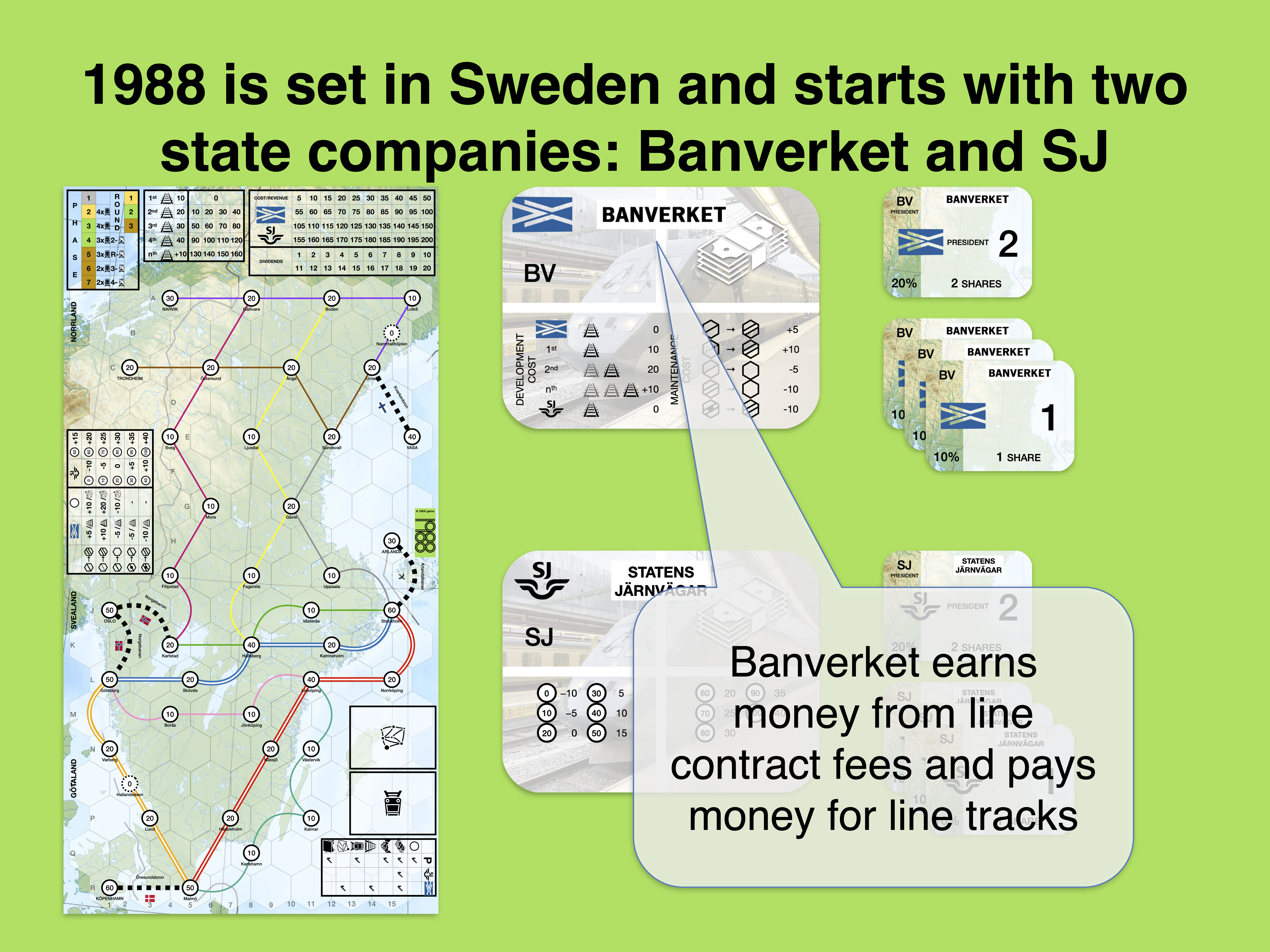
Rules (PDF)
... and Rejected RulesFrom regional to nationalOne original idea was inspired not from 18XX but from Railways of the World, namely to let the private companies start locally, expand their networks at their own pace, and once they reach other major cities "open" a line for competition. I thought this would add an interesting balance between operating locally (with many short connections to one valuable city) and operating nationally (with few long connections between several valuable cities). However, this is not at all how private companies entered the Swedish deregulated markets. They enter the market by bidding on entire lines immediately so I had to find other means for opening lines for competition, hence the lobbying rules described above. Nevertheless, the idea of small local companies managed to return as the regional companies, also described above. StationsSince the tracks are owned by a state company in 1988, it wouldn't make sense to let the private companies own stations. Besides, what mechanical purpose would a station serve when it's line contracts and not stations that determine where a company may operate? Operational city valueOne idea related to stations was to link the city values to the number of operators, as shown by its stations. Once a new company operates in a city, the city's total value would increase but it would be shared equally among the operators, making each operator's individual share less profitable. (A city could offer value 20 for one operator, 15 each for two operators and so on). Mathematically, this sounds like a good idea but it would probably result in a different arc. Instead of a few valuable cities linked by long high-speed tracks, there would be many average cities linked by short regional tracks. Perhaps I'll revisit the idea in a future trading game but for 1988 it's not suitable. LicensesIt's not uncommon that SJ lets other companies pay a license fee and rent trains to operate on their contracted lines. Mechanically, this could help private companies raise enough money to buy a train and bid for own line contracts. This idea does have a thematic appeal but would probably be too fiddly to offer gameplay value. Every single line would have to be offered for licensing and since no trains would be required, every private company would want the license, bringing license costs up and profit margins down. In the end, licenses would only be much ado for nothing. Diesel trainsIn most 18XX games, the diesel trains are the ultimate goals for the companies, since they can now reach all the cities and stations in their networks. This could have worked in 1988 as well and benefitted companies which manage to win bids for several contracts with linked lines. However, they wouldn't work with the high-speed rails, the benefit of which is to skip lower value cities (and why would you want to do that if you can run to an unlimited number of cities?). The decision between reusing an existing mechanic and adding a unique one was easy. |