
 |
Home | Game | Rules | Theme | Strategy | FAQ |  |











































|
Version History
The complete rules are available in the PDF file to the right. In the following sections, I will describe how they came to be. Implemented RulesThere are many ideas that came to live in Christina Regina - the Board Game©. On this page, I would like to present some of them and explain the reasoning behind them. The game boardThe more symmetric a game board is, the more focus may be placed on the pure tactics. The chess-like board of Christina Regina does not contain any special areas that are better or worse than other areas but instead, and just like in chess, the tactics reaches a higher level. The influence tilesA challenge with a symmetric game board is to create variation. This is accomplished through the influence tiles. Since they are randomly placed on the game board, it ensures that each new game is unique. The actionsThe movements along the game board's influence tiles are enough for a tactical game. However, to add some more choices and give opportunities both to disrupt other players' agendas and reveal own agendas, the actions were introduced. The actions are simple (agitation to remove tiles, manipulation to switch tiles and assassination to over-throw agendas) but their tactical impact is vast. The last of the actions, the assassination, is the essence of the game - to guess your opponents' agendas without revealing your own. The scoringIt is important that all players benefit from an influence tiles, otherwise it would be too obvious which faction a player represents based on which tiles they move to. Now, a player that moves to a blue tile may play the blue faction. But perhaps he or she plays the red faction and simply wants blue to be taken before the red (and rank less). Or perhaps it is a bluff to provoke failed assassinations? You really have to take all the players' moves into account, as well as putting them into the context of the other players' moves, before you can guess the agenda. The daggersA successful assassination paves for the successful game but if done openly, the other players may guess the colors of the player involved. Say that blue player assassinates red. Whether successful or not, green player will know that the villain is neither red nor green. The solution was the hidden exchange of dagger markers and faction cards. Now, only the assassin will know the victim's true color (and that won't help since, after the assassination, she will not be able to conduct a new assassinations against the same victim). |
Boardgame Rules (Video)
Boardgame Rules (PDF)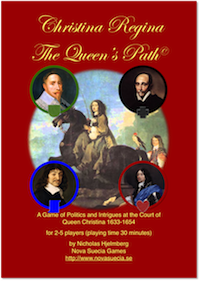
Cardgame Rules (Video)
Cardgame Rules (PDF)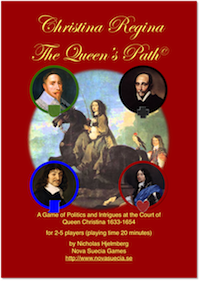
... and Rejected RulesThere are of course also ideas that did not make it and here I explain why. Change of colorsInitially, I thought an assassinated player should return with a new color and even give the assassin an opportunity to change colors. The reason would be that the other players might get an unfair chance to guess their colors otherwise. However, that would also mean that a player with plenty of influence tiles may be worse off after a successful assassination and vice versa. Also, I didn't like the idea of two players having the same color. The solution was the daggers, much simpler and more elegant. Rewarded assassinationsA successful assassination should be rewarded but how? One simple idea was to give the assassin extra points (or the victim, in case the assassination fails). However, this added a risk of unintended kingmaking, as one player's bad assassination would benefit only one other player, namely the victim. The reward was replaced by a punishment instead - by assassinating someone, you would remove a court tile to decrease that player's score and hence increase your own relative score (as well as the score of all other players). In addition, by assassinating someone, you would also deny the victim the ability to assassin and hence protecting yourself (as well as all the other players). Tiles as currencyOne common designer idea is that every action should result in some kind of "kick", which may explain why a fellow designer suggested that non-colored tiles should give something instead of simply being discarded. The solution was to use them as currency for action cards but this short-term goal distracted from their intended use: the long-term goal of steering the Queen to a certain path. However, the idea did survive in another and more appropriate form: the common set collection of non-colored tiles, which result in an action card to the lucky player completing one. |