 |
Home | Game | Rules | Theme | Strategy | FAQ |  |
























|
Game designThe ideaUsually when I design a game, I start with an idea that I feel is unique enough to explore and see where it takes me with no particular goal in mind. This idea may come from just about anywhere but very often from contests. The challenge to design something complying with certain criteria in a limited timeframe really triggers my creativity. Thus, the current contest Social Deduction Challenge Contest at The Game Crafter didn't catch my interest at first. There are many social deduction games out there and I've already spread my wings in this area so what would be left to explore? But then it occurred to me that I could take advantage of the work I've already done on my previous games and design a game towards a specific goal. The design goalsThe goal in this case was to find out if my three microgames Comrade, Gulag and Politburo could be combined into a unique game.
The mechanicsWhat would a game combining all those elements look like? How about a semi-cooperative game with double objective layers where a player belongs to a secret team AND has secret personal objectives? Using the Politburo terminology, one team could have the objective of repression but one team member could score relatively more if Economy is repressed, another if Military is repressed and so on. If all areas get repressed, the team as a whole wins, but if only some areas are repressed, only some team members win. In addition, if one team is too obvious, any member of the other team (the "reformers") could reveal them and - if successful - secure the victory for his or her team instead. The themeSuch a game sounded unique enough to pursue further and I started to look into a suitable theme. The three previous games were all set in the totalitarian regime of the Soviet Union - a suitable setting for a game of paranoia where you can trust nobody - so it was fitting to set this game there as well. But why not add a twist to it and add a third objective layer where all the players would work to save the regime, although with different objectives ("repressers" vs "reformers")? The votes could then be related to regime crises, such as strikes where the players may choose between economic reforms and military repression. The settingThis was a good example of how theme and mechanics work together to bring the game design forward so the next question was to choose the exact setting. Having seen the brilliant movie The Death of Stalin recently, I considered the power struggle after the dictator's death, where some wanted to continue his politics while other pleaded for a destalinization. Another option was the very foundation of the Soviet Union: the power struggle between bolsheviks and mensheviks during the Revolutions of 1917. An opposite option was the coup attempt of 1991 that resulted not only in an end for the repressionists but also for Gorbachev's reforms and the entire Soviet Union. This third option opened up the possibility of an all players lose condition, whereby both reformers and repressers fail to save the Soviet Union. This in turn opened up the possibility of a traitor, benefitting from the Soviet Dissolution. Perhaps the game could be called "Secret Yeltsin"? But now the setting started to dictate the theme and the mechanics so I returned to those to let them decide which of the setting options that would be most appropriate. Putting it all togetherThe game of the gameThe three microgames which Glasnost built upon are all short games with limited components (15-30 minutes playing time, 18 cards) whereas the contest requirements (up to 90 minutes playing time, component cost up to $59.99) incidated that a bigger game was expected. But the main "game" in a social deduction game happens in the interaction between the players so any additional components and playing time would have to support this rather than cluttering it. Fortunately I didn't have to look far to find an example of this. In Mingle & Murder, a board was used to track players' movements between rooms and help them identifying the murderer by observing which players had visited which rooms. This gave them more than just tabletalk to base their deductions on. Also, Mingle & Murder let all players take actions in turns rather than just some selected players. For some reason, this isn't very common in social deduction games. In Avalon only a specific number of players may participate in a quest, and in One Night Ultimate Werewolf, some roles like the Villager have no actions at all during the night phase. One promising game was Tortuga 1667, where the players move treasures between ships. Unfortunately, the players' identities quickly become obvious, reducing the game to a simple card management game. For Glasnost, I decided to reuse the boards and seats of Find the Bug! - Project, in which the players occupy seats around boards with different scoring opportunities and resolve a board once all its seats are occupied. From there, the step to a political board was a natural one, whereby the players would respond to various crises through secret votes. Thus, the deduction would be based partly on which crises the players seek to participate in and how the total vote fell for those crises, although the secrecy of the individual votes would obscure the deduction. The objectives of the gameNext, I had to detail the player objectives so that the players' actions on the board wouldn't immediately reveal their objectives. The early idea of double layer objectives with both team objectives and individual objectives had to be implemented both to make the purpose of an action less obvious and to create some tension within the teams. As a starting point, I reused the three areas from Politburo; Economy, Military and Security; and assigned each of them the value of "Repressed" or "Reformed". That would give me at least eight roles where each roles would score 1 VP per area objective fulfilled.
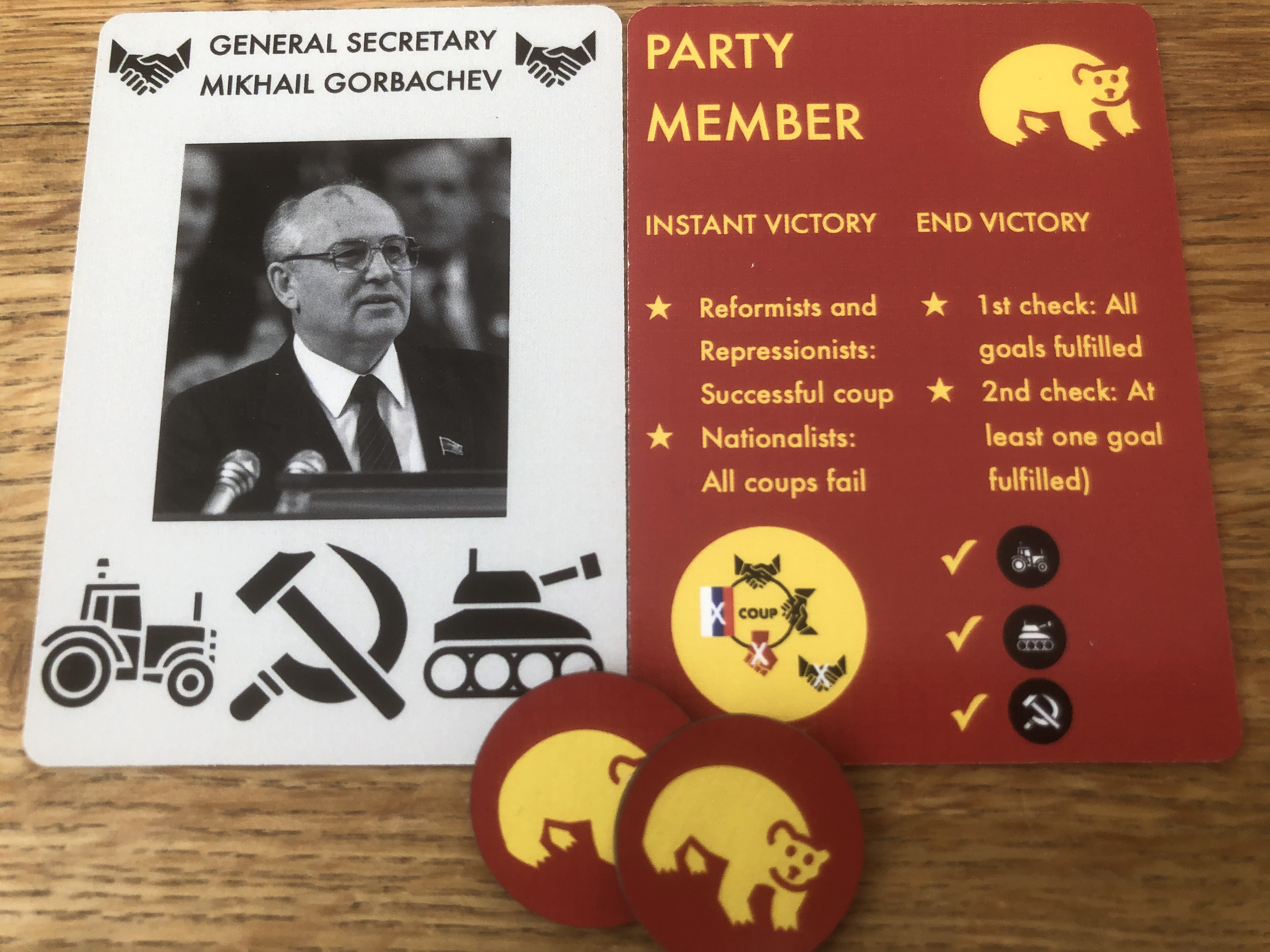
This setup would give each role an opportunity to gain up to 3 VP but wouldn't it be too difficult for the leaders? With all 3 areas repressed (or reformed), several other players would likely bash the leader. Also, if the minions would aim for both repressions and reforms, wouldn't it be too difficult to deduce their objectives? An alternative setup would be to only give the minions 2 VP opportunities. This would make the roles' objectives more distinct - either you're a represser or a reformer. But wouldn't this make it too easy for the leaders to win, since any combination of 2 repressions/reforms would be enough for a shared victory? At this point, it felt like I was going in circles and indeed I was! I had forgotten that it was the teams' objective - the coup - that was the interesting part and that the players' objective only aimed at giving the players incentives and clues regarding their team. Thus, I should detail the teams' objectives first and only then detail the players' objectives. The overall idea was already clear. A coup, and a counter coup, would be triggered if all three areas get the same resolution (Repress or Reform). A team would instantly win by identifying all other team members, no more, no less. If no team would succeed before the end of game, the players' objective would be used to determine the winner(s). But given this, why would a player play for team victory instead of personal victory? The "traitor" Yeltsin gave me the answer. Why not let the third team, called the "Nationalists", win if too many coups fail - similar to what happened in the Soviet Union? The Nationalists would then have an interest in spreading confusion and trigger coups that will fail. This still doesn't anwer the question why the Repressers and the Reformers would want to trigger coups but it helped me realize how the players' objectives could be aligned to the teams' objectives. By simply awarding each player a maximum of 2 VP, 1 if at least 1 objective is fulfilled and 2 VP if all are, most players would have an incentive to break the status quo as the example below shows: Example: Economy and Military repressed, Security reformed
With this, I finally felt that I had a testable game design. The focus on teams' objectives also gave support to the game idea from Gulag: an unknown number of team members. With players' objectives, a lonely Reformer would get a very difficult game, but with teams' objectives, it would suddenly be easier to identify all Reformers and win! Again, test would have to tell but the game was now ready to move on from design to test.
Game components
|
Annotated gamesIf you like those game mechanisms, I can also recommend: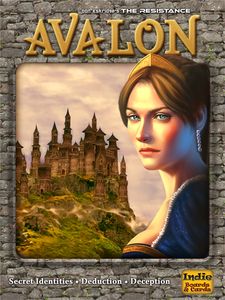

|