
 |
Home | Game | Rules | Theme | Strategy | FAQ |  |







|
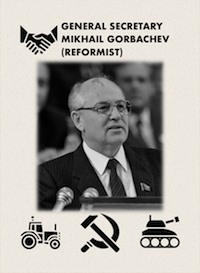
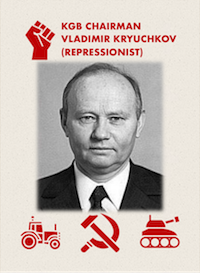
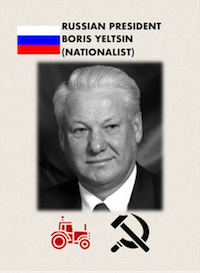
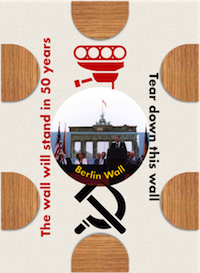
The 1991 Soviet coup d'état attemptThe theme of a totalitarian regime is a suitable setting for a game of hidden identities, where different sides try to promote their own secret agendas. The inspiration to Glasnost came from the 1991 Soviet coup d'état attempt, where the failed attempt by the hard-line members of the Communist Party (the "Repressionists") to depose Gorbachev (the "Reformist") destabilized the Soviet Union so that it was eventually dissolved (a victory for the "Nationalists"). All the characters in Glasnost are based on the actual characters involved in the coup. Mikhail GorbachevMikhail Gorbachev was General Secretary of the Communist Party from 1985 until 1991. He aimed at reforming the Soviet Union through glasnost ("openness") and perestroika ("restructuring") but faced internal opposition, leading first to the failed 1991 Soviet coup d'état attempt and later to the dissolution of the Soviet Union. Anatoly LukyanovAnatoly Lukyanov was Chairman of the Supreme Soviet of the Soviet Union 1988-1991. He was an early political ally of Mikhail Gorbachev, supporting his efforts in issues such as the fight against corruption and the start of reforms in the economy. Eduard ShevardnadzeEduard Shevardnadze was Minister of Foreign Affairs of the Soviet Union 1985-1990. He was responsible for many key decisions in Soviet foreign policy during the Gorbachev Era including reunification of Germany. Alexander YakovlevAlexander Yakovlev was Head of the Propaganda Department of the Communist Party of the Soviet Union from 1985 to 1986. He was called the "godfather of glasnost" as he is considered to be the intellectual force behind Mikhail Gorbachev's reform program. Vladimir KryuchkovVladimir Kryuchkov was Chairman of the Committee for State Security (KGB) 1988-1991. During the 1991 Soviet coup d'état attempt, he initiated the State Committee on the State of Emergency which arrested President Mikhail Gorbachev. Valentin PavlovValentin Pavlov was Prime Minister of the Soviet Union 1991. He called for a transfer of power from the President of the Soviet Union to the Prime Minister and the Cabinet of Ministers and when it failed he joined the plot against Gorbachev. Boris PugoBoris Pugo was Minister of Interior 1990-1991. He was a member of the State Committee on the State of Emergency and committed suicide after its failure. Dmitry YazovDmitry Yazov was Minister of Defence 1987-1991. He was a member of the State Committee on the State of Emergency and was also responsible for the violent crackdowns on civilians in Azerbaijan, Latvia and Lithuania. Boris YeltsinBoris Yeltsin was Head of Government of Russia as President of the Russian Federation 1991-1992. Initially a supporter of the perestroika reforms, Yeltsin later criticised them as being too moderate and was instrumental in the formal dissolution of the Soviet Union. Zviad GamsakhurdiaZviad Gamsakhurdia was President of Georgia 1991-1992. During the 1991 Soviet coup d'état attempt, he first appealed to the population to remain calm and later appealed to international leaders to recognize the republics (including Georgia) that had declared themselves independent of the Soviet Union. Leonid KravchukLeonid Kravchuk was President of Ukraine 1991-1994. He resigned from the Communist Party after the 1991 Soviet coup d'état attempt and promoted the Declaration of Independence of Ukraine. Nursultan NazarbayevNursultan Nazarbayev was President of Kazakhstan 1990-2019. He supported Russian President Boris Yeltsin against the State Committee on the State of Emergency and maintained the close economic ties between Kazakhstan and Russia after the dissolution of the Soviet Union. Stanislav ShushkevichStanislav Shushkevich was Chairman of the Supreme Soviet of the Republic of Belarus 1991-1994. When Supreme Soviet chairman Mikalay Dzyemyantsyey was ousted for his support of the 1991 Soviet coup d'état attempt, Shushkevich was voted as his successor, and presided over Byelorussia voting to secede from the Soviet Union. Levon Ter-PetrosyanLevon Ter-Petrosyan was President of Armenia 1991-1998. He became the de facto leader of the Karabakh Committee and later chairman of the Pan-Armenian National Movement, organizations which paved the way for the Armenian independence. The Soviet CrisesNaturally, the 1991 Soviet coup d'état attempt didn't itself cause the dissolution of the Soviet Union but was merely one of many events (or "crises") that led to the inevitable (?) end of the Communist Regime. Some of those crises were met with Reforms while others were met with Repression. Glasnost has picked some of the events of the Soviet Union's last decade to represent crises that call for resolutions ("reform" or "repress"). The risk of getting purged if you didn't adhere to the Party's "democratic decisions" was present throughout the history of the Soviet Union and the 1991 Coup was just one of many such examples. AfghanistanThe Soviet-Afghan War derives from a Communist Coup in 1978. Rebellions and internal rivalries led the Soviet Union to intervene in 1979 and install a loyalist as a President. Fierce resistance from the guerillas resulted in a bloody war and during 1988-1989, the Soviet Union withdrew their forces and 3 years later the Soviet-backed government collapsed. Baltic IndependenceThe freedom of Glasnost released long suppressed national feelings in the Baltic States. Demonstrations and calls for autonomy eventually led to declarations of independence in Estonia (1988), Lithuania (1989) and Latvia (1989). The Soviet Union first attempted to negotiate and then to send in troops to Lithuania and Latvia in 1991, killing dozens of civilians, but all attempts failed. After the unsuccessful 1991 Soviet coup d'état, the collapse of the Soviet Union was inevitable and the Baltic Independence was recognized. Berlin WallThe Berlin Wall was built in 1961 as an "Anti-Fascist Protection Rampart" to prevent defections from the DDR. The Revolutions of 1989 eventually led to the fall of the Berlin Wall and in spite of opposition from Western politicians, fearing a unified Germany, the Soviet Union didn't intervene. Brezhnev DoctrineThe Brezhnev Doctrine was outlined in 1968 and proclaimed that "when forces that are hostile to socialism try to turn the development of some socialist country towards capitalism, it becomes not only a problem of the country concerned, but a common problem and concern of all socialist countries". It justified the invasion of Czechoslovakia in 1968 and retroactively the invasion of Hungary in 1956. It ended when Mikhail Gorbachev refused to use military force when Poland held free elections in 1989. ChernobylThe Chernobyl Disaster was a nuclear accident that occurred in 1986. The accident wasn't publicly acknowledged until radiation levels set off alarms in Sweden over 1,000 kilometres from the Chernobyl plant and even then the Soviets initially denied it. Common European HomeThe Common European Home was a concept created by Mikhail Gorbachev. He declared that the Soviet Union was against the division of the continent into military blocs. Analysts interpreted it as a belief that reforms in Eastern Europe could be controlled and that any loss of authority there would be offset by increased influence in Western Europe. GlasnostGlasnost means "openness" and was adopted by Mikhail Gorbachev to encourage criticism of system problems. The goal was to make the Soviet Union's management transparent and circumvent the narrow circle of bureaucrats who controlled the economy but the era also saw greater freedom of information and contact between Soviet citizens and the Western world. GulagThe Gulag was the government agency in charge of the Soviet forced-labour camp-system. 18 million were sent there 1930-1953, of which 1.5 million perished. The last labor camp was Perm-36, which was closed in 1987. PerestroikaPerestroika means "restructuring" and was a political movement to restructure the Soviet political and economical system. The reforms did decentralize the economy but didn't improve it and by 1990 the government had virtually lost control over economic conditions. Pope John Paul IIJohn Paul II was elected pope in 1978. On his visits to his native country Poland, he supported the Solidarity organization, something which is believed to have contributed to the collapse of East European Communism. An assassination attempt was made in 1981 and some claim that the Soviet Union was behind it in retaliation for the pope's support of Solidarity but no evidence have substantiated this. Star WarsThe Strategic Defense Initiative, nicknamed "Star Wars", was a proposed missile defense system. It was announced by US President Ronald Reagan in 1983 and was perceived as a threat by the Soviet Union. The Soviet Union worried that a defensive arms race would further cripple the economy but did threaten a variety of other military countermeasures. Strategic Arms Reduction TreatyThe Strategic Arms Reduction Treaty (START I) was a bilateral treaty between the US and the Soviet Union. It was initiated by US President Ronald Reagan but delayed due to the Strategic Defense Initiative. When it was eventually signed in 1991, it resulted in a removal of 80% of all strategic nucelar weapons. |
|