
 |
Home | Game | Rules | Theme | Strategy | FAQ |  |












































|
Version History
The complete rules are available in the PDF file to the right. In the following sections, I will describe how they came to be. Implemented RulesThe BoardA common (and difficult) decision for a board is whether it should be static or modular. Both have their advantages and disadvantages but for a civilization game, the modular board was an easy decision. This would allow the creation of an unknown board (tiles turned face down at start) and a dynamic board (tiles turned up and down). The distribution between "useless" tiles (wastelands) and "valuable" tiles (foundations and resources) was simply a matter of testing to find the proper balance. The UnitsThere are two types of units in the game: explorers (who make tiles available) and barbarians (who make tiles unavailable). In spite of their opposite natures, the player is allowed to act with any of them in a turn but not both in a turn. Why any? Why not simply let some players play explorers and some play barbarians as in a traditional game? First, because I wanted to make a different game. Rather than force the players to play in a certain way (settle vs plunder), I wanted to give them the ability to choose their playing style. Second, because I wanted to create a varying gameplay. With no barbarians, the game would be straight path towards a settled world (or, with no explorers, a straight path towards a desolated world). With two teams, the game would be a slow and boring downfall for one team once the other team got the upper hand. Instead, I wanted to give the players the creative freedom to influence the gameplay and create the "Golden Ages of Exploring" and the "Dark Ages of Barbarians" themselves. Why not allow the players to act with both units in a turn then? The reason for this was more of a mechanic nature. If the players would be allowed to act with both in a turn, they would most likely sit in each corner and run perpetual scorings of build, destroy and rebuild. By forcing them to choose one per turn, one player's build effort could be countered by another player's destroy action, leading to an interactive and unpredictable game. The ActionsThere are two basic actions in the game: Act with a unit (explore/exploit) and act with a settlement (expand/expel). Since they are related (an expand/expel action requires a tile change that can only be caused by an explore/exploit action) it is necessary to allow a player to perform both in a turn, otherwise the exploring/exploiting player would only pave the way to the expanding/expelling player. Let's look closer at how the different units use those actions. Explorers expand by moving and looking and exploit by standing and turning. Why not combine them in one action? I agree that it would streamline the gameplay but it would also lose the uncertainty of what is hidden beneath the tiles too quickly. The current rule not only keeps tiles unknown to the non-exploring players but also gives the exploring players unique knowledge about the yet unturned tiles. Furthermore, it adds a decision point: should you spend an action to exploit a tile (turn it) or to move to another tile and explore it (look at it)? Barbarians on the other hand may both move and turn tiles with their exploit action. This was a more difficult decision. A more logical rule would have been to mirror the explorer action and let them either explore (move) or exploit (turn). Mechanically and thematically it was more problematic. Why would a barbarian want to lose an action standing still on a tile and turning it? He would more likely hurry towards the settlements and resources, leaving other tiles unturned and removing the dynamic aspect of tiles being turned up and down. And why would only some tiles be plundered (turned) and not others? Wouldn't a trail of turned tiles be a better representation of the raging barbarians? Nevertheless, the barbarians do have an exploit action when removing settlers and settlements. In this case, they do have an incentive to stand still on the tile and remove a settler or a settlement. If, on the other hand, they were allowed to move to a tile and remove a settler or a settlement in the same turn, they would be too powerful. The rule that the explore action allows barbarians to turn tiles without settlers while the exploit action is required to turn tiles with settlers is a good balance. In addition, the other players get an opportunity to bring in explorers to defend the tile and initiate a battle, which further adds to the interaction and unpredictability of the game. The expand/expel action is more mirrored; one action adds a settler and increases the settlement while the other removes a settler and decreases the settlement. This gives explorers and barbarians an equal chance to place settlements. The BattleAs hinted above, one reason for the battle rule was to add a lead time between a barbarian movement and a settler removal and make the clash more interesting. But why have a lead time between explorer and barbarian movements? Why lock all units in a tile until the turn returns to the LAST player entering the tile rather than executing the battle once two units of different kinds meet? One reason was to allow different outcomes. Initially, battles were simply determined by the number of units with barbarians winning at ties. With the rule of the turn returning to a player, both sides would be able to bring units to the battle. Another reason was to give players incentives to enter battles. Without the rule of the turn returning to the LAST player, another player than the last player would get the opportunity to act with the unit surviving the battle. With the rule, the last player would be certain to act. Finally, the rule of locking units in the tile was introduced to prevent units from endless chases across the board or even switch tiles without fighting. |
Rules (Video)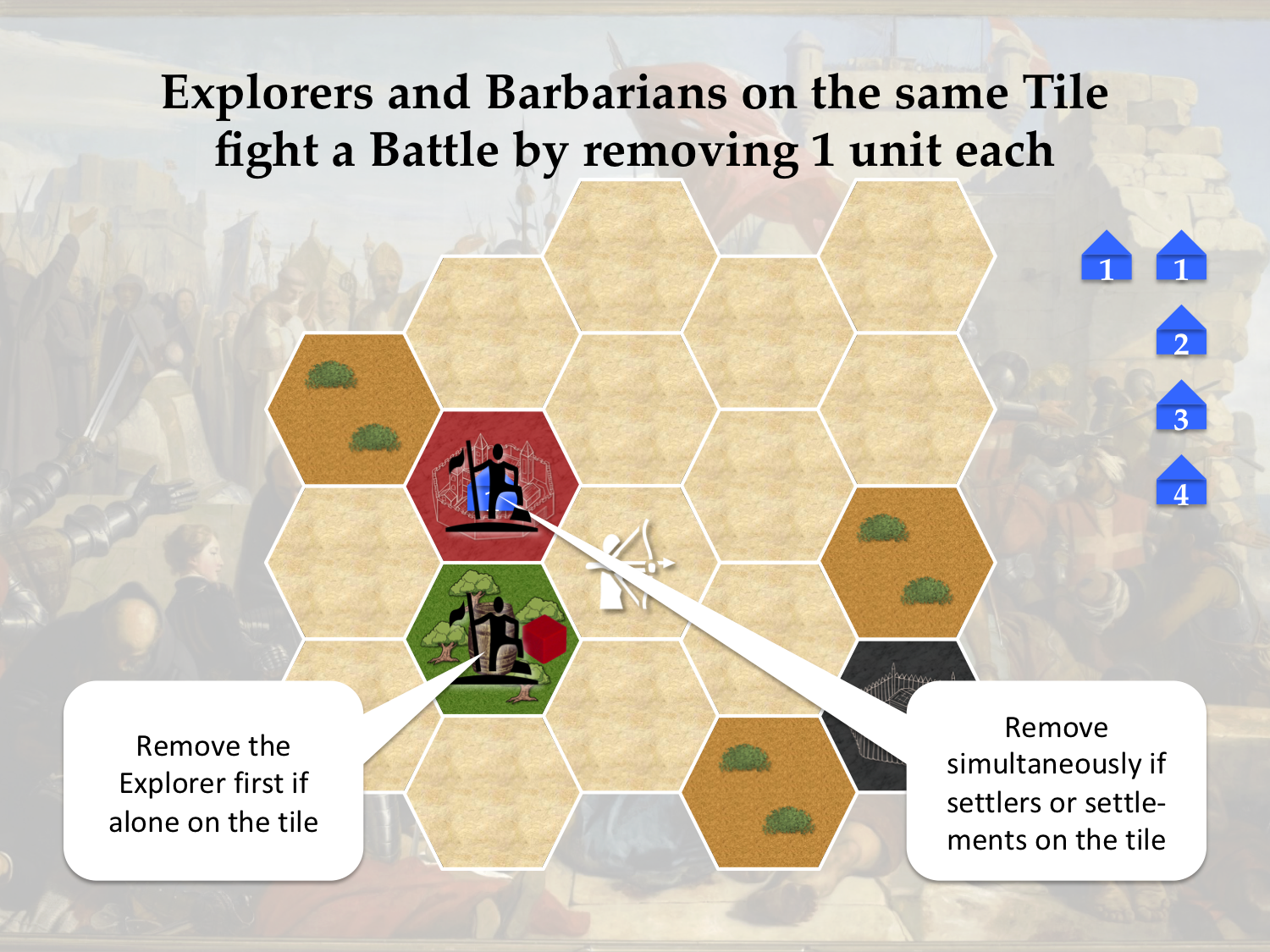
Rules (PDF)
... and Rejected RulesThere are of course also ideas that will be rejected and here I will explain why. |