 |
Home | Game | Rules | Theme | Strategy | FAQ |  |









































|
Game designThe originThe origin of Dyce is traceable to several sources of inspiration. One is my long term idea to create an epic city/empire building game, where the events of the Swedish empire would shape the rise of Stockholm as a commercial center for the empire's supply and demand. The end of the game would see a complete city where the streets and the buildings would have found their places not through central big decisions but through the "invisible hands" of the players' individual small decisions, similar to how real cities grow. This city-building aspect is also something I liked in Lisboa and highlighted in my review. This part of the game focuses on commercial aspects by encouraging similar stores to be placed close to each other. A third source is The Game Crafter's Contest Game Pieces Only Challenge, where only non-printed components are allowed. A natural idea was to use the only "printed component" allowed, namely the die, which holds both a color and a number. Translated into an economic game, the color would represent a good and the number would represent a price. Additional sources are the games Alchemist, where cubes of one color are converted to cubes of another color, and Kairo, where the customers' movements between shops are simulated. Finally I had so much inspiration that I couldn't help but putting it all together. I tried to convince myself that I really only wanted to test a mechanic in a smaller game for the contest to see if it could work in a bigger game. The truth is probably that I simply couldn't resist the temptation of designing yet another game. As often in my design process, the first ideas were quickly scribbled down on the nearest piece of paper I could find. 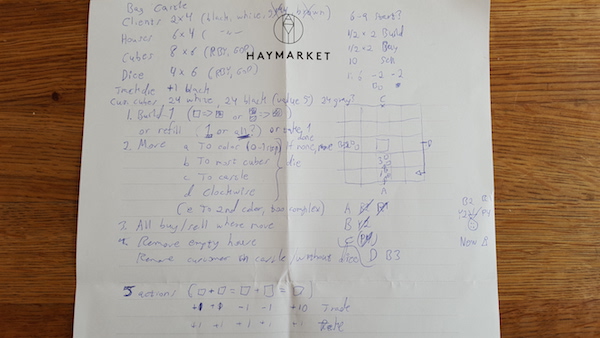
The requirementsOne of the requirements of the contest was to make the game so simple that the players wouldn't have to consult the rules too much. Such a requirement excluded complex conversions between goods so it was natural to use the commonly known rules of color mixing, e.g. blue+yellow=green. The first level of goods could then be blue, red and yellow and the second level of goods could be green, orange and purple. Later on, I added a third level as well: black for mixing all three first level colors. In most resource conversion games, it's the players themselves that move or build routes to trade the necessary resources. For this game, however, I wanted the players to build static trading points in a city to attract suppliers and customers. Hence, I connected the dice to non-player merchants, moving around in the city according to preferences dictated by their dice. A merchant with a yellow die followed by a purple die would first be looking to sell yellow for a price according to the first die and then buy purple for a price according to the second die. In the case where a good would be offered by more players, additional rules were added to create "artificially intelligent" merchants (move to the closest, move to the best offer etc.). The settingHaving reached this far, it was time to decide on a setting. Given the components, trading in dyes felt appropriate so why not call the city Dyce (dyes+dice)? I made a quick Google search to find out if this was a real name and it turned out to be the name of an Aberdeen suburb. Unfortunately, Scots are not known for dyes but they are known for whisky and whisky is often blended. Why not simply let the players trade and mix whiskies instead? 
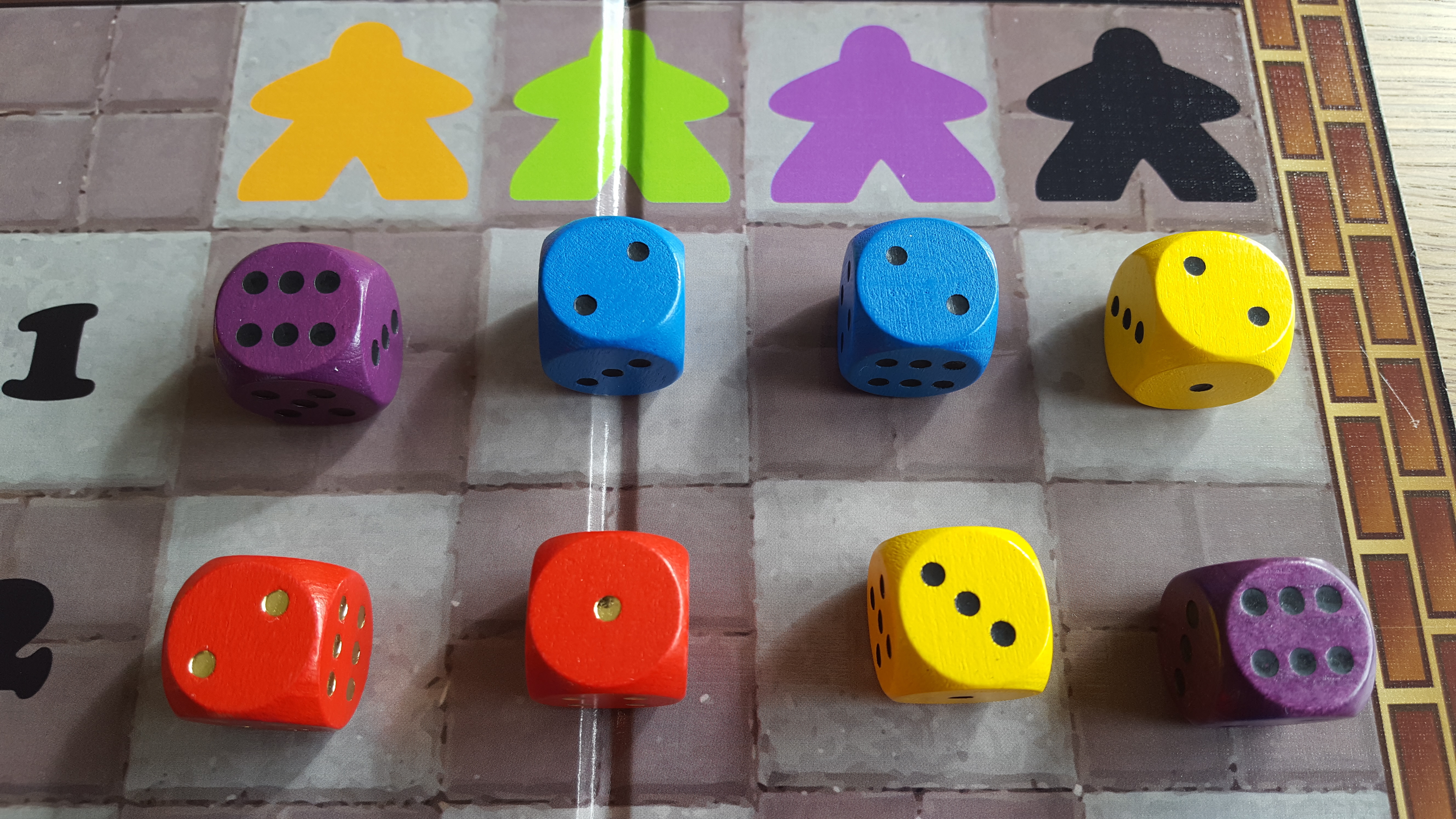
The componentsWith that, I felt that I had enough to build a game on. Since I couldn't have a physical game board, I set up an "imaginary grid" of 5x5 spaces around a central castle (which worked good in the Scottish setting as well) and surrounded it by the dice. Since each "space" would hold a house component with a number of cubes representing whiskies and meeples representing the merchants, it should be easy enough to see and play on such a grid. Next, I started looking at the necessary components, partly to ensure that the game cost would be below the contest limit and partly to have some indicative numbers to start balancing. For the dice, I needed to balance the different colors so that there wouldn't be too few or too many of a certain level, otherwise there would be "useless" dice in the game that might cause the game to drag. This mix would have an exact match between first level colors and higher level colors:
However, I feared that such a combination would be too scripted, since there would most likely be enough first level colors for all higher level colors. To introduce some more competition, I added 1 purple+1 green+1 orange. With this mix, a player would no longer be able to go for black dice and rely on getting the necessary lower level dice, since another player may use them for other blended colors. The above figures were also used to assess the value ranges of the whiskies. Since six sided dice are used, a range of 1-3 for the first level dice and a range of 4-6 for the higher level dice was suitable. Then an input of 2+2 on average would return an output of 5+5 on average. Bear in mind that it takes three turns to accomplish this so the profit of six pounds must be reduced by the alternative cost of three pounds for simply passing three turns. The same applies to the black die with input 2+2+2 for output 5+5+5 - a greater return but a higher risk. For the number of shops, I first calculated with four players and six shops each - enough for each player to place one shop per color in the 24 squares of the city. When the black die was introduced, the players would be one shop short but I decided to keep the number anyway as an interesting restriction. The cubes (representing whiskies) were trickier to calculate, since I hesitated whether limited cubes would make the game more challenging or just frustrating. In the end, I went for the middle way. The competition would be more fierce and fun if there were just about enough cubes for all players to enter a whisky market. In that way, the players could either play "friendly", and leave cubes for everybody, or aggressively, and disrupt the balance by taking more cubes than needed to exclude others from a market. With one cube to place in a shop (to mark which color it trades with) and one cube to trade with per player and color, eight cubes of each color would be enough. Later, I reduced the higher color cubes to four of each color, since the player could simply turn first level cubes into money directly without turning them into higher level cubes inbetween. For the money cubes, I went with 48 white (12 per player), which hopefully should be enough, and for the victory point cubes, I went with 12 clear (3 per player). Why clear? Because ice go well with whisky. The colors of the players and the merchants would unfortunately have to be the same as the dice due to the limited color availability. Here I used the first level colors of blue, red and yellow (and white) for the players and the higher level colors of black, green, purple and yellow for the merchants. 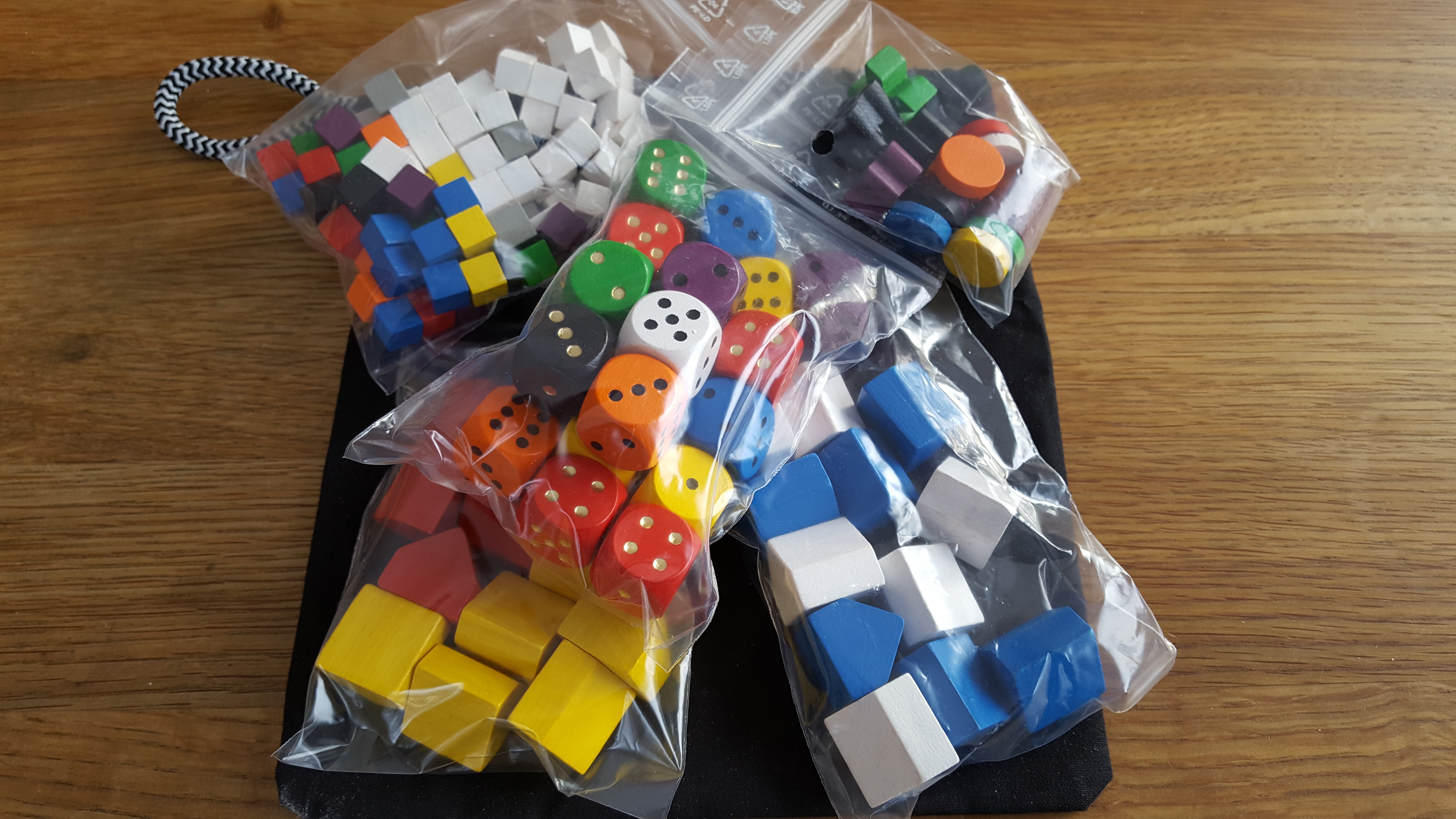
The turns and roundsThe initial iterations were done in Excel. First I tested "small turns" where one player action would be followed by one merchant actions, but the decisions became too obvious (attract the merchant currently due to move). The game became better with "big rounds", where all players would act followed by all merchants, but this was quite unforgiving to players that failed to attract a merchant in the first rounds. Next improvement was to give the players several turns to either act (and improve their offers to attract the merchants) or pass (and earn money while waiting for better opportunities), similar to games like Amyitis. 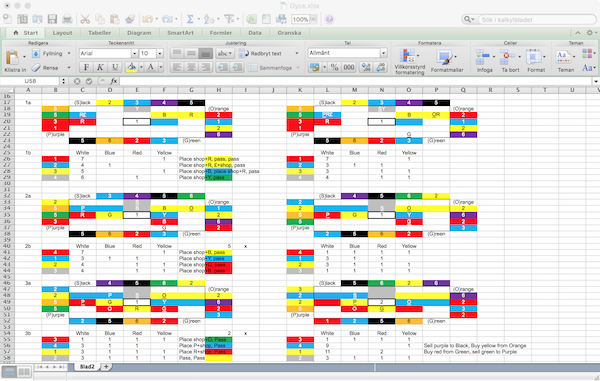
The solo versionThe solo version of Dyce turned out to be quite interesting. I've added it in previous games, where the solo game can be played with the same rules as the multi-player game. In those cases, the human opponents have been replaced by an objective that must be accomplished before the game ends but the strategy has basically been the same. Dyce uses an idea similar to Find the Treasure! - the Card Game, in the sense that you still place pieces on a board to find objects (whether it be treasures or whiskies). The lack of opponents makes it easier to find what you want on the one hand but it drives the games faster towards the end on the other hand. If no player (you!) offers a color that a whisky baron wants, his die will be removed and the game clock will move one step forward. You can't stop this since you can't offer all colors all the time by yourself. The result is that you must use a completely different approach in the solo game compared to the multi-player game. Instead of placing shops close to the whisky barons to get whiskies as soon as possible (before your opponents), you have to place some shops far away from the whisky barons to delay getting some whiskies. This will keep the whisky barons' dice in the game and prolong the game long enough to accomplish the objective. You still need a strategy about when and where to get whiskies but the realization of this strategy will be different. Putting it all togetherWith this, the foundation of the game was completed. Since no printed components were needed, I could order everything I needed for my prototype from Spielematerial and start testing! The initial testing gave mixed but very useful results. One player simply didn't get the idea, which I consider a compliment since I want my games to be fairly unique. Those who did get the idea enjoyed the inventive mechanics and the rewards for planning ahead. Another player played poorly and thus revealed how unforgiving the game was. I considered this as a feature rather than a bug but did introduce victory points instead of money to prevent the runaway leader problem where richer players will be able to outbid the poorer ones. The first complete test game unveiled a very tense game: 9 rounds with the end score 25-25-24-23! 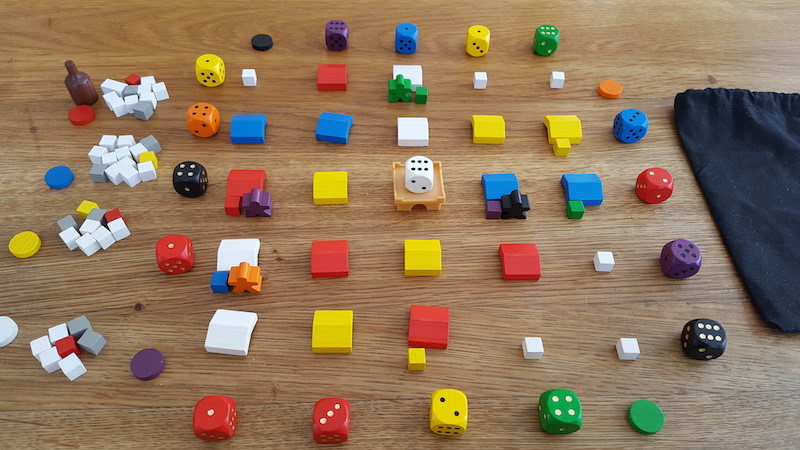
Game components
|
Annotated gamesIf you like those game mechanisms, I can also recommend:
|