
 |
Home | Game | Rules | Theme | Strategy | FAQ |  |










































|
Version History
The complete rules are available in the PDF file to the right. In the following sections, I will describe how they came to be. Implemented RulesThe die linesThe die lines are the central part of Dyce. The die rolling adds randomness to the game but since the dice are arranged in dice lines, the players can see the future values and predict when and where they will enter the game. Thus, the players are faced with a random environment but keep the control and can adapt their strategies accordingly. The setupDyce features a chronological resource conversion from blue/red/yellow to green/orange/purple and potentially black. Thus, it's necessary to add early needed dice early in the game to mitigate the risk of a waiting game if only later needed dice are available at the start or, even worse, a runaway leader if there are not enough early needed dice for all players. The simple solution was to arrange the initial order of the dice and place the early needed dice first in line. The bagThe bag serves two functions in Dyce. First, it lets the dice be drawn at random, ensuring a variable setup. Second, only 16 of the 20 dice are in play at the same time so each time a die has been used and removed from the game, a new die may enter the game, ensuring variability during the game. The move prioritiesThe movement of the whisky barons had to be simple and intuitive to keep the game quick while also ensuring a quick turnover of the dice to prevent the game from stalling. The proximity rule, where a whisky baron moves to the closest shop, fulfilled all those criteria. The castle rule, where a whisky baron moves towards the castle, make some city spaces more valuable than others and besides being thematic, it rewards long-term strategies, where the players pick central city spaces instead of the spaces that the whisky baron reach first when they enter the city. The clockwise rule, where a tied whisky baron moves left, captures all remaining cases. But how to introduce competition between shops? One idea was to compete with volumes, letting shops with more goods be more attractive. However, if the game would be so long that the players could start building inventories of many whiskies, it would probably overstay its welcome. Price competition is better, where the players can place pounds on the shops to make them more attractive. Incidentally, it also serves as an interesting balance between engine and catch up, as players can use pounds gained to be more competitive but at a price. Nevertheless, the competition priority was placed second after proximity, to prevent whisky barons from moving back and forth, causing the game to stall. For the same reason, a whisky baron with nowhere to move simply discards the current die and lets through a new die rather than waiting for a shop that may never appear. The roundsThe predictable moves of the whisky barons also make shop placements predictable. If you need a certain whisky, simply place a shop in the space that the whisky baron will move to next, meaning that the first player has an advantage. The addition of the competition priority let the players place shop in alternative spaces and add pounds to beat the closer shops, meaning that the last player has an advantage. To avoid this, the players may take several turns in a round (or pass and earn pounds), introducing a balance between actions and money. The shopsThere are many possible rules for shops. Should they be temporary or permanent? Should they trade all whisky colors or just one? Should trades be optional or mandatory? Should failures to trade be punished? The decision to make them permanent and single-colored encourages a long term strategic placements instead of short term tactical placements. If you place a blue shop in an area, you'll have to take into account its prospects in the future turns as well. You may get a blue whisky this turn but what if all other blue whiskies will be sold in future turns? The decision to make trades mandatory on penalty of a lost shop is more controversial but is linked to the two first decisions. You must think in the long term and place shops that give neither too little whisky, nor too much. The punishment to lose not only the shop but also any pounds placed on it may sound harsh but such punishments are necessary to prevent the player scores to be too balanced. The victory pointsFirst I wanted to keep the victory condition simple and let it be money. However, as money gets abundant, the tension from never having enough disappears. In addition, the whole idea of predicting the other players' preferences and adapting your own strategy also disappears as all players will go for everything. The solution was to reward blending partially with money and partially with victory points (worth 5 pounds, i.e. the average of a high value die). The endA game should end when it's most fun. It should also end in a way that the best player wins rather than the player that happen to be in the lead. As Reiner Knizia expresses it, the players should be able to focus on the goal (blending whisky) throughout the game, not the winning (earning pounds should be a resultat of blending whisky well). However, a race to a certain number of pounds would result in weird optimization end games, as players start passing to earn short term pounds instead of investing in long term pounds. The same would happen if the game would end when all dice have been used. Instead, the first criteria was accomplished by ending the game after a certain number of rounds with blending (not a certain number of blends). Also, the second criteria was accomplished by valuing not only pounds but also unblended whiskies and pounds still on the board. This means that all players can potentially end the game with a blend, or at least be rewarded for their attempts to do so, and are thus encouraged to blend to the very end. |
Rules (Video)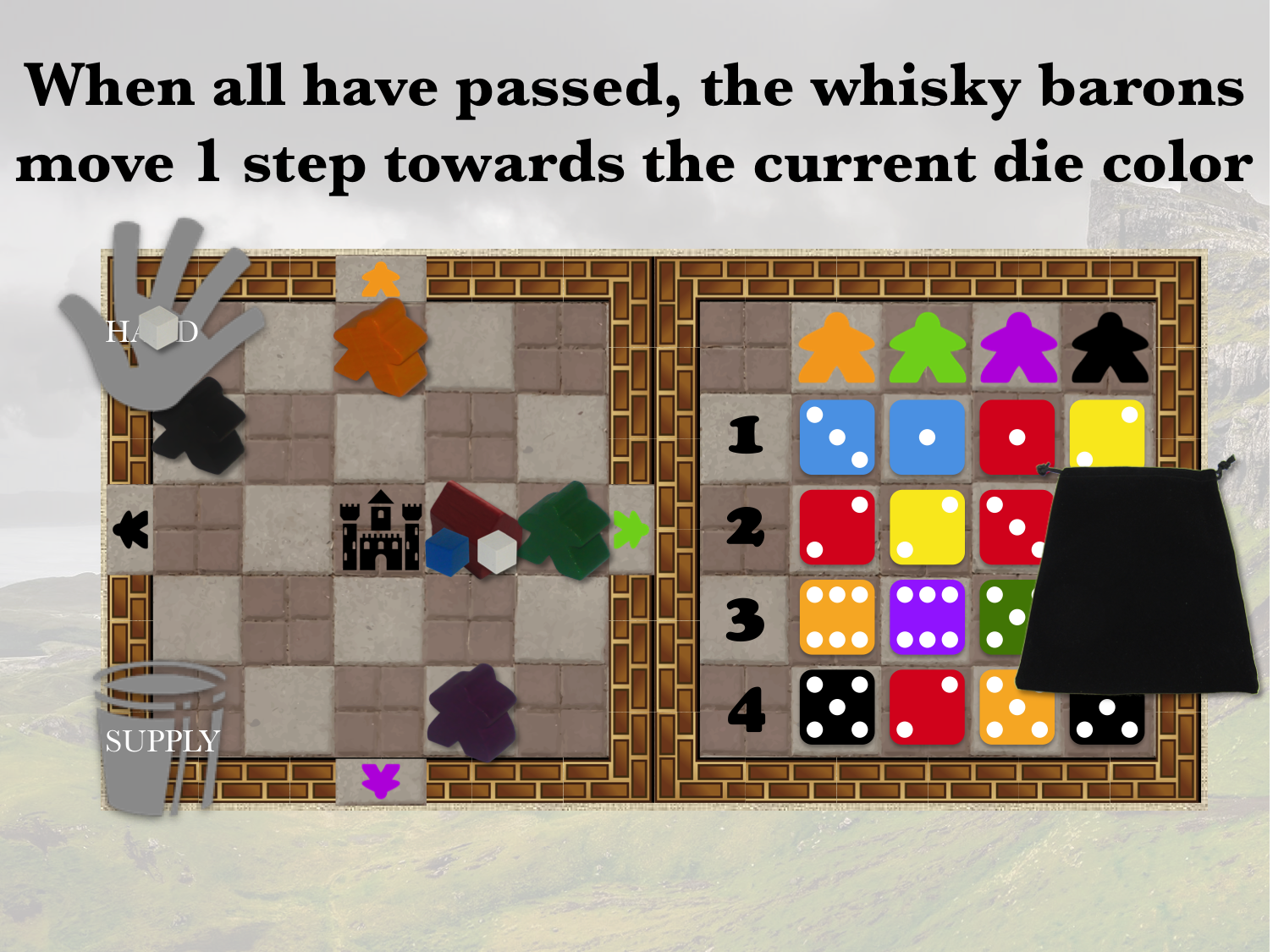
Rules (PDF)
... and Rejected RulesThere are of course also ideas that will be rejected and here I will explain why. Location vs BiddingThe priority order for whisky baron movements is proximity first and pounds second. This values location higher than bidding. But what if pounds would have the highest priority? Then they would have to move directly to the shop instead of one square at the time or they would risk moving back and forth as bids increase and never reach their goal. Mechanically, this would also work but the game would be more about bidding than location and the spatial element would be diminished. Eventually I decided that Dyce was a game about location first with bidding only as a tie-breaker. Slow vs Fast MovementsShould the whisky barons move directly to a shop rather than one space at the time? This may sound like a way to speed up the game but much of the spatial game would then be lost. Paradoxically, it would even make it more difficult to attract whisky barons at other parts of the board. The fast movement will always benefit shops in a whisky baron's immediate vicinity. The slow movement on the other hand allows players to start attracting whisky barons before they can blend a specific whisky, waging that they will have the necessary whiskies by the time the whisky baron arrives. Cube LimitsA player rarely needs more than one cube of a color on the hand, nor more than one cube of a color on the board. Thus, those limits were tested to ensure that all players would have enough cubes. However, not only did those limits add unnecessary rule overhead but they also added unnecessary restrictions, preventing players from preparing "big blends" or denying other players colors. |