
 |
Home | Game | Rules | Theme | Strategy | FAQ |  |




































|
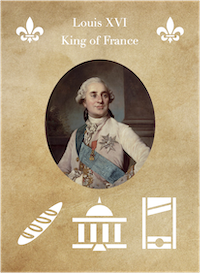
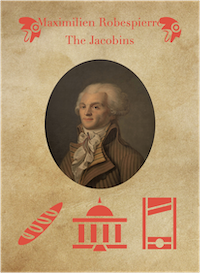
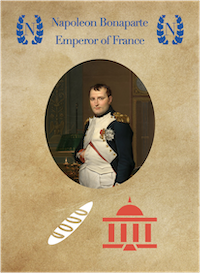
The French Revolution of 1789The theme of revolutions and counter-revolutions is a suitable setting for a game of hidden identities, where different sides try to promote their own secret agendas. The inspiration to move the predecessor Glasnost to 1789 France came from the futile struggle between monarchists and republicans, which ended in a loss for both as Napoleon Bonaparte seized the power. All the characters in 1789 are based on the actual characters involved in the French Revolution. Louis XVILouis XVI was King of France 1774-1792. He did attempt to reform France in accordance with the Enlightenment ideas but was opposed by nobility and turned more conservative. Eventually he was deposed, accused for high treason and executed. Marie AntoinetteMarie Antoinette was Queen of France 1774-1792. She became increasingly unpopular and the financial crisis was blamed on her lavish spending and her opposition to social and financial reforms. Following her husband's execution, she was also accused for high treason and shared his fate. Charles de CalonneCharles Alexandre de Calonne was Louis XVI's Controller-General of Finances (minister of finance) in the years leading up to the French revolution. He repeatedly attempted to pass financial reforms but met opposition from both the Parlement and the Assembly of Notables. In the end his reputation was so low that he was forced to leave the country shortly before the Revolution. Marquis de LafayetteGilbert du Motier, Marquis de Lafayette was a French nobleman and military officer who fought in the American Revolutionary War. Back in France, he was appointed to the Assembly of Notables, helped writing the Declaration of the Rights of Man and of the Citizen and tried to steer a middle course through the years of revolution. Maximilien RobespierreMaximilien Robespierre was was a French lawyer and statesman with radical ideas. He was a elected as a deputy of the National Convention and later appointed a member of the Committee of Public Safety, the organ that was primarily responsible for the Reign of Terror. Increasingly, members of the Convention turned against him and he was executed in the Thermidorian Reaction. Paul BarrasPaul Barras descended from a noble family. When the the French Revolutionary Wars broke out, Barras became commissioner to the French Army, and entered the National Convention. Subsequently he became one of the five Directors but was outmaneuvered by Napoleon and later exiled. Jacques Pierre BrissotJacques Pierre Brissot was a French journalist, abolitionist, and revolutionary leading the faction of Girondins. He advocated for war against European powers to spread the revolution but conflicts with Robespierre, who accused him of royalism, eventually brought about his downfall and he was executed in 1793. Georges DantonGeorges Danton was a lawyer who became Minister of Justice, supported the supported the foundation of a Revolutionary Tribunal and became the first president of the Committee of Public Safety. He later renounced his views on violence and convinced Robespierre to end the Reign of Terror but was accused for royalism shortly after and executed in 1794. Napoleon BonaparteNapoleon Bonaparte started as a military leader and supported the Revolution. He rose rapidly in ranks and eventually overthrew the Directory in the Coup of 18 Brumaire, establishing himself as First Consul. This effectively ended the French Revolution and replaced it with a military dictatorship. Napoleon crowned himself Emperor in 1804 and led a series of successful campaigns across Europe until finally defeated at Waterloo in 1815. Joachim MuratJoachim Murat was a French military commander and statesman who served during the French Revolutionary Wars and Napoleonic Wars. He played an important role in the Coup of 18 Brumaire, married Napoleon's sister Caroline and was named a Marshal of the Empire. Michel NeyMichel Ney was a French military commander who served during the French Revolutionary Wars and Napoleonic Wars. He was named was named a Marshal of the Empire and was lauded "the bravest of the brave" by Napoleon. Jérôme BonaparteJérôme Bonaparte was Napoleon's youngest brother. He reigned as Jerome Napoleon I, King of Westphalia, between 1807 and 1813. Joseph BonaparteJoseph Bonaparte was a French statesman, lawyer, diplomat and older brother of Napoleon. As a member of the Council of Five Hundred, he helped Napoleon to overthrow the Directory. He was King of Naples (1806–1808), and then King of Spain (1808–1813). Louis BonaparteLouis Bonaparte was a younger brother of Napoleon. He ruled over the Kingdom of Holland from 1806 to 1810. His youngest son Louis-Napoléon would later establish the Second French Empire in 1852, proclaiming himself Napoleon III. The Revolutionary EventsThe French Revolution was not a single event but rather a period of political and societal change where Monarchists and Republicans tried to reform France. The path from Louis XVI:s Ancien Regime to Napoleon's coup of 18 Brumaire was not a straight one and the Revolution could very well have ended in another way if key events had ended differently. 1789 has picked some of the events that challenged France and it's up to the players to decide their solutions and eventually the fate of France. Abolition of FeudalismThe Abolition of feudalism put an end to the old rules, taxes and privileges. Louis XVI wrote that "I will never consent to the despoliation of my clergy and my nobility" but the First Estate eventually agreed to the proposition. Abolition of MonarchyThe Abolition of Monarchy was a result of increasing conflicts between Louis XVI and the Assembly. When the commander of the allied Prussian and Austrian armies issued the Brunswick Manifesto, threatening vengeance if the Royal Family was harmed, the King's residence in the Tuileries Palace was stormed and the proposed abolition was met with little resistance. Ancien RegimeThe Ancien Regime was the political and social system of France prior to the Revolution. It was an absolute monarchy but efforts to centralize the state were met with resistance and frictions increased between aristocrats and the aspiring classes, influenced by the Enlightenment ideas. During the Revolution, a series of events moved the power from the monarchy and privileged-by-birth to more representative political bodies. The Catholic ChurchPrior to the Revolution, the Catholic Church was the largest landowner in the country and the clergy was the First Estate. Initially, the Church corruption and the higher clergy was attacked but during the Reign of Terror, the Catholic monarchy was abolished, the Church property was nationalized, 30 000 priests were exiled and hundreds of priests were killed. Even the Christian calendar was replaced. The civil status of the Church was not restored until the Concordat of 1801. Committee of Public SafetyThe Committee of Public Safety was the provisional government during the Reign of Terror. It was created in 1793 to protect the new republic against its foreign and domestic enemies but came to use its power to control and silence all opposition. 16,600 people were executed on charges of counter-revolutionary activity and another 40,000 may have been summarily executed or died awaiting trial. In 1794 the National Convention arrested the committee's members and restricted its power and one year later it ceased to exist. The DirectorateThe Directorate was a five-member committee established after a referendum in 1795 to replace the National Convention as the governing body of France. During its rule, France was in continual financial crisis and at war with foreign coalitions. It also faced a Jacobin uprising as well as a royalist uprising and had lost all political support when it was eventually overthrown by Napoleon Bonaparte in the Coup of 18 Brumaire. Economic DepressionPre-revolutionary France went through an economic depression and about one third of the population lived in poverty. The agriculture suffered from climatic problems and the industry couldn't compete with the cheaper and superior products of Britain. King Louis XVI was forced to permit radical reformes but they couldn't prevent the French Revolution, which swept away many of the constraints of the Ancien Régime, such as the guild system and the tax system. Nevertheless, industrial and agricultural output soared in 1790-1796 and the government's attempt to issue more paper money led to inflation. Napoleon's reforms and war production did stimulate the economy but only in the short run. The entrepreneurial achievements were undermined by a business crisis in 1810-1812 and lost altogether when the Bourbons resorted to tariffs and protectionism. Estates GeneralThe Estates General was the legislative and consultative assembly of the three estates clergy, nobility and commoners. In 1789 it was summoned for the first time since 1614. Louis XVI wanted to focus solely on taxes but the estates were more interested in debating (separately) the structure of the Estates General. The third estate eventually voted to declare themselves the National Assembly of the "people". Louis XVI tried to shut down the assembly but the third estate swore the Tennis Court Oath not to separate until France had a constitution and were joined by members of the other two estates. Flight to VarennesThe Flight to Varennes was an attempt of the royal family to escape from Paris to Montmédy and join with royalist troops for a counter-revolution. However, the were recognized, arrested and returned to Paris. The result of the failed escape was a more pronounced hostility not only towards the French Monarchy as an institution but towards the King and the Queen as individuals. It also provoked charges of treason and in 1793 Louis XVI was executed. Liberty, Equity, FraternityLiberté, égalité, fraternité is today the national motto of France. It may derive from Camille Desmoulins, who described citizen-soldier at a festival speech. It was later popularized by Maximilien Robespierre, although fraternité temporarily disappeared from the motto after Robespierre's execution. It was not until the 1848 February Revolution that the motto was officially adopted. National AssemblyThe National Assembly came to replace the old and non-representative Estates General in 1789. It later reconstituted itself as the National Constituent Assembly, which in turn was succeeded by the Legislative Assembly. Following the storming of the Bastille on 14 July, the National Constituent Assembly became the effective government of France. The Legislative Assembly provided the focus of political debate and revolutionary law-making. In 1795 the Legislative Assembly decreed the convocation of a National Convention to draw up a new constitution with no monarchy and the French First Republic was born. Revolutionary WarsThe Revolutionary Wars were a series of military conflicts resulting from the French Revolution between 1792 and 1802 and the shifting fortunes of war impacted the Revolution. The initial victories emboldened the Abolition of Monarchy, while the following defeats allowed the Jacobins to rise to power and impose the Reign of Terror to unify the nation. The wars also gave Napoleon Bonaparte the opportunity to rise in ranks and his campaign in Italy 1796 forced Austria to sue for peace, ending the First Coalition against the Republic. |
|