
 |
Home | Game | Rules | Theme | Strategy | FAQ |  |











































|
Version History
The complete rules are available in the PDF file to the right. In the following sections, I will describe how they came to be. Implemented RulesThere are many ideas that came to live in Find the Treasure!©. On this page, I would like to present some of them and explain the reasoning behind them. The game boardThe most important parts of the game board are the 9 crosses where the treasure may be hidden and obviously, those crosses must be accessible. A fixed game board would assure that but suffer from 2 risks. Firstly, there would be a risk that the limited movement options would create too little variation. Secondly, there is a risk that the game board does not get balanced enough and that some parts get better than others. But a modular game board suffers from other risks. A completely random setup of tiles may result in tiles without any connection and even crosses being inaccessible. The solution was a middle way: a modular game board with a number of proposed setups to choose from, without denying the players the option to spend time to create their own maps. The cursed treasureThere is a fine balance in the game between gathering maps and risk digging at an unknown cross. Without any risks at all, players would dig as much as possible and pure luck would determine the game (like in The Lost Diamond). With too high risks, players would not dig until they had enough maps, meaning that as soon as a player digs, all the other players will know what she has found and turn the game into a hunting game instead (which is not very exciting when a player can only move 1 tile). By introducing cursed black diamonds and giving them a negative score of 2, the following scenarios are possible:
Those scenarios give a game where players have several options and will never be sure what the others really have found ( and thus not be sure whether to take the risk of stealing it from them). A perfect balance for the kind of cat-and-mouse game I want. |
Rules (Video)
Rules (PDF)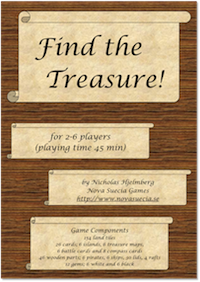
... and Rejected RulesThere are of course also ideas that did not make it and here I explain why. Heavy loaded piratesGames often need balancing mechanisms to slow down leaders so why not Find the Treasure! as well? A simple idea would be to let pirates with less load (as measured by having several lids left on hand) move extra fast. However, at one point of another, it will be obvious who has found the treasure and that pirate will find it impossible to escape several other players if they are faster than her. Sailing piratesThe ship is used to sail to any beach tile at the start of the game and in early versions, the ship could be used during the game as well. However, as mentioned above, pirates will eventually find out who has the treasure. Why then chase that pirate through the island if they can sit on their ships and wait to see which beach he will come out too. Realistic, yes, but fun, no! Instead, I forced the pirates to leave the ship within 1 turn and only return if either injured or to leave with the treasure. After all, the pirates cannot be expected to look to kindly to you if you return empty-handed, can they? |