
 |
Home | Game | Rules | Theme | Strategy | FAQ |  |






































|
Know when to be strategic and when to be tacticalA game of Turn of Time is not only a balance between seasons but also a balance between tactics and strategy. Tactically, you must play to maximize the result of each move in terms of adding your seasons and removing the other seasons. Strategically, you must play to optimize your position in terms of concentrating your seasons. Let's start with the tactical aspect. Tactical optionsIn Turn of Time, you have three options each turn: place a season, turn one area forward and turn all six areas backwards. Placing gives you one more season than your opponents while turning not only gives you more seasons but also gives one or more opponents less seasons. In addition, turning forward affects two hexes at the same time and turning backwards affect twelve hexes at the same time. Bear in mind, though, that turning may also benefit other players so you must take your net gain into account when choosing what to do. To summarize, your tactical options can be ranked as follow:
The first option is obvious; the more seasons you can gain without your opponents gaining anything, the better. Be particularly observant of opportunities to do "the great turn" where you turn all six areas backwards. But why is better to benefit your prior season if you have to choose? Because your seasons can replace your prior seasons so the more prior seasons on the board, the greater your chances to make net gains.
If you can't turn and replace (or if a turn will benefit other seasons more), it's better to place a season and get a net gain of 1. Where to place depends on your strategy (see below). If you can't place either, you should minimize the damage by turning with as few opponent gains as possible. Strategical optionsIf all players play only for tactical gains, you're likely to end up exchanging seasons with each other. To get the upper hand, it's necessary to play strategically as well. In Turn of Times, only one area is enough for victory (or two in the three player game). This means that you should establish dominance in three adjacent areas of the six available and more or less ignore the other three. Why three and why adjacent? Because you want to be able to replace seasons in the middle area by turning the two adjacent areas so you need presence in both areas. However, be cautious not to completely ignore the other areas. Let's assess some positions strategically:
ConclusionIn conclusion, you should strategically strive to replace your following seasons from an area to block them from it while avoiding being blocked from a area yourself. If you're left alone on an area with your prior season (like Winter in the fourth example above or Summer in the sixt), you have an excellent position to replace the prior season and dominate the area. While striving for this, you should tactically maximizing each action to get a net gain of seasons in relation to your opponents. |
Time
Seasons
|
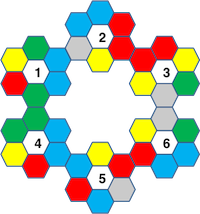 In the position to the right, Winter can turn area 5. Not only will she replace 1 Fall in area 5 with 1
Winter but she will also replace 1 Summer in area 5 with 1 Fall. Why is this good? Because Winter can't
replace Summer but she can replace Fall and now threatens to turn area 6 to do just that.
In the position to the right, Winter can turn area 5. Not only will she replace 1 Fall in area 5 with 1
Winter but she will also replace 1 Summer in area 5 with 1 Fall. Why is this good? Because Winter can't
replace Summer but she can replace Fall and now threatens to turn area 6 to do just that. Secured hex: Spring has no presence in the area but is the only season which may be placed in the empty
hex (after Winter and before Summer) so she's in no hurry to place a hex there.
Secured hex: Spring has no presence in the area but is the only season which may be placed in the empty
hex (after Winter and before Summer) so she's in no hurry to place a hex there. Contested hex: Both Spring and Summer can place in the empty hex. Since they have presence in the area
already, they may wait, but if any of the present seasons risk being replaced, they should hurry to
protect their presence.
Contested hex: Both Spring and Summer can place in the empty hex. Since they have presence in the area
already, they may wait, but if any of the present seasons risk being replaced, they should hurry to
protect their presence. Temporary blocked area: Only summer can place in the empty hex. Spring's only chance to place in the
area is to create an empty hex between Winter and Summer.
Temporary blocked area: Only summer can place in the empty hex. Spring's only chance to place in the
area is to create an empty hex between Winter and Summer. Permanently blocked area: Only Fall and Winter have presence in the area. Since Spring must be placed between
Winter and Summer and Summer between Spring and Fall, both Spring and Summer are blocked from the
area and will never be able to place or replace there.
Permanently blocked area: Only Fall and Winter have presence in the area. Since Spring must be placed between
Winter and Summer and Summer between Spring and Fall, both Spring and Summer are blocked from the
area and will never be able to place or replace there. Note that the concept of blocked area is slightly different in the three player version. With three
seasons, two seasons in a area will always be prior and following to the third seasons and there are no
opposing seasons that both can be removed. To block a
season from an area, there must thus either be two seasons filling all hexes or one season being the only one
on the area.
Note that the concept of blocked area is slightly different in the three player version. With three
seasons, two seasons in a area will always be prior and following to the third seasons and there are no
opposing seasons that both can be removed. To block a
season from an area, there must thus either be two seasons filling all hexes or one season being the only one
on the area. In the fifth example to the right, Fall can still place in the area between Summer and Spring while in
the sixth, only Spring can place in the empty hex. In this area, Summer has the upper hand, since she
can replace Spring with a forward turn while Spring can only replace Summer with a backward turn.
In the fifth example to the right, Fall can still place in the area between Summer and Spring while in
the sixth, only Spring can place in the empty hex. In this area, Summer has the upper hand, since she
can replace Spring with a forward turn while Spring can only replace Summer with a backward turn.