
 |
Home | Game | Rules | Theme | Strategy | FAQ |  |











































|
Version History
The complete version of the rules are available in the PDF file to the right. In the following sections, I will describe how they came to be. Implemented rulesBasically, Turn of Time has only two rules: place a token or turn an area with tokens. Without any restrictions, the players would be able to dispose of all their tokens independently of each other, resulting in a game with little interaction. The challenge of the rules was thus not to specify what the players were allowed to do but to specify what they were not allowed to do. Starting tokensAll games need to remove unnecessary parts. If Turn of Time would have started with all hexagons empty, the first actions would all be about populating them before the fun part starts - the turning of the areas. To shorten this part of the game, evenly distributed tokens was a simple solution. Spring and Summer start with one token less than Fall and Winter in the 4 player game but since they start the game, the winning chances remain fairly equal. One token in each hexagonWith only one token in each hexagon, there will be a scramble for the empty hexagons. Once placed, they are not easily moved again so the players must carefully decide which hexagons they want for their seasons and which they want to deny other seasons. Seasonal orderSeasonal order is important in two aspects: the order within areas and the order that seasons beat each other. The order within areas was introduced to make placement of tokens more difficult. If you manage to occupy strategic hexagons in an area or remove other players' tokens from, you should be able to benefit from the gaps rather than letting all other players in. The order that seasons beat each other was introduced to create transparent and predictable fights. If you challenge another season, it should be your tactical skills rather than a die roll that determines the outcome. Two-edged outcomesIf each action would affect one token only, the game balance would remain the same through-out the game. However, with two adjacent hexagons in each area, there will be two outcomes of turning an area. They will still be predictable but a player managing to find actions that gives him or her double benefit (or at least minimize benefits for other players) will have an advantage. Non-repeatable outcomesIf players could simply turn back areas, the positions would always be able to restore. At the same time, the idea of turning back an area (i.e. turning back the time) with considerable impact was intriguing. The solution was simply to force ALL six areas to be turned back at the same time. This would add an interesting tactical opportunity to completely overthrow the game board and, with good tactical skills, determine the game in one's own favor. Blocked seasonsWith equally skilled players, the balance between the seasons should be fairly stable with one season being replaced one turn will return the next. To disturb the balance, a rule was needed that gradually excluded some seasons from areas and increased the victory chances for the other. The solution was the blocked season rule, that made it difficult for a season to return to an area once it is out of it. That was also a two-edged weapon, since the exclusion of a season benefits not only the own season but also the other seasons remaining in an area. Is the risk worth taking? Only tactical skills can answer that question! Victory conditionsA game with only one victory condition runs a greater risk of problems with strong leaders or limited strategic positions. Too many victory conditions on the other hand where "everything" earns victory points may lead to pure accounting games. Two victory conditions is a good compromise that forces players focusing on one victory path to monitor the other without getting over-whelmed by too many victory paths. The exhaustion of tokens is often good way to end a game as this puts a limit to how many tokens that may enter the game. The dominance in one area was a good second condition as this can be pursued by several players in different areas. Should you go for victory in "your" area or do you have to prevent a victory in another area first? Again, tactics is your answer!KingmakerThe seasonal order scoring, where players get a fixed amount of points for other players' victories, decreases the kingmaker risk. A player with no chance of winning can still fight for the second place but can only make one specific player king, not choose freely. In addition, the rule that a player can win only in her turn makes it difficult for a player to prevent another player from winning by turning areas so that a third player wins. |
Boardgame Rules (Video)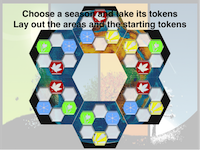
Boardgame Rules (PDF)
Cardgame Rules (Video)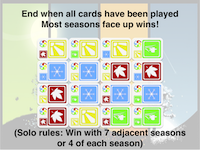
Cardgame Rules (PDF)
... and Rejected RulesThere are often ideas that do not make it to the game but Turn of Time was designed as a simple game. Complex rules were never considered and thus there were none to reject. |