
 |
Home | Game | Rules | Theme | Strategy | FAQ |  |












































|
Version History
The complete rules are available in the PDF file to the right. In the following sections, I will describe how they came to be. Implemented RulesRules and ThemeMost of the rules are rooted in the theme to provide a feeling of the everyday work of a Systembolaget store. The game board depicts a store, through which the items flow (stock, buffer, shelf, checkout), and the actions taken by the players are based on actual store assignments across this item flow. Thus, the rules were carefully chosen to provide interesting decisions without losing the theme. The ItemsItems earn CSI in two ways: directly by moving items in shortage (rewarding the adding to empty shelves and penalizing the removal of the last items from shelves) and indirectly by ensuring that items matching your customers are available in the store. This results in a kind of semi-cooperative gameplay where players have to think of which opportunities they open or close for their opponents and which outcome their decisions will get in short and long term. The JobsThere are many ways to turn actions into interesting decisions. The choice of action cards (instead of, say, free actions, action points or worker placement) is not only thematic to represent job rotation but also give the players the freedom to link their actions and plan forward.
The Game ClockThere are hourly and daily variations in a store so it was natural to use those as a basis for variability during the game. The hour before opening gave the players time to contribute to the game setup before the customers arrive and items get removed. The rush hours added more of the fun moments of the game: the matching of items and customers. The sale stops added some asymmetry to the game as items similar to the sale stopped items would see increased demand. |
Rules (Video)
Rules (PDF)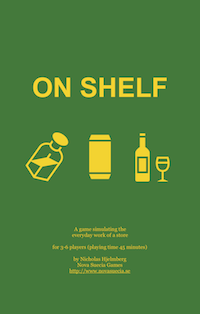
... and Rejected RulesThe Tear ActionWhen a pallet arrives to a stock, it has to be "teared", whereby the packaging is removed and the items moved to smaller and more portable pallets. An initial idea was to let this take place in a specified area with room for only two of the three item types. This additional obstacle was interesting when the game was solely about getting "your" items out first. However, as the game got additional job cards and got the extra dimension of "working where needed", this was deemed an unnecessary step in the item flow. The Buffer SpacesStores usually have stock spaces for newly arrived items and buffer spaces for items that don't fit on the shelves. Initially, this was implemented in the game to provide a spatial challenge whereby one player could stack items tactically to "force" other players to move "their" items first. There was even a difference between beer buffers (stored in stacks of similar brands) and other buffers (stored on mixed pallets). However, the rules about moving items by stacks (and returning items that don't fit to the buffer) were both complicated to learn and complex to play. A first attempt to simplify was to replace the stack rules with a rule that stock items are taken "from the side" and buffer items "from the top" but this didn't help much. Eventually, the buffer spaces were removed completely and the stock spaces linked to colors instead, from which the players may take any items. Less realistic perhaps but more focus on the more interesting decision of the game: the card management. The Point SystemThere are many important tasks in the game, such as timely stocking of items and filling of shelves. Thus, every single action was valued based on how "important" it was for the store. Players scored for every item movement with an extra bonus for stocking items missing in the store and filling empty shelves. They also scored for less for selling items if a shelf was emptied. However, this added a lot of mathematics to the game and got particularly cumbersome when evaluating different options. The simpler solution of rewarding stocking and filling with customer cards removed the mathematics but also removed too many incentives. Eventually, a smaller version of the stocking/filling bonus was returned. |