
 |
Home | Game | Rules | Theme | Strategy | FAQ |  |












































|
Version History
The complete rules are available in the PDF file to the right. In the following sections, I will describe how they came to be. Implemented RulesThere are many ideas that came to live in Vasa Regalis - the Board Game©. On this page, I would like to present some of them and explain the reasoning behind them. The shipI like the idea that the players must cooperate to achieve a common goal but in Nova Suecia, but the colony balance was a bit obscured by other game components. A ship balance is literally more comprehensive, if it is not balanced it won't sail. Each player must thus contribute to the ship to enable it to sail while still keeping as much as possible for themselves. But unlike Nova Suecia, where big contributions gave other advantages, the ship theme gave me a more intriguing game idea. The real Vasa ship failure was followed by a trial so why not let the same thing happen in the game and this promote players who did NOT keep as much as possible for themselves? Perfect! But how then will you know whether to spend or to save? You have to answer that yourself to win. The goods and the rolesThe goods were fairly simple to come up with. Wood, cloth and iron goes without saying from the theme. Sculptures were added since I needed four goods to achieve balance (4 procurers generate goods to the 2 craftman and tailor/blacksmith, who generate goods to 1 trader and 1 builder and 1 saver). The value levels were a bit more tricky. Too few gives less guessing game when they are placed on the ship and too many give a too long lead time before they can actually be placed. I finally settled with the magical number 3. In this way, there is always a good reason to place a value 1, 2 eller 3. Take for example the tight 3 player game. A part needs a total value of 7 to sail. A player have a reason to place a value 3 good if he or she thinks that the other players will place a 1 and a 2. The ship will fail but the player will end up having spent the most on that part and win the game. How about placing a value 1 then? Simple, if the other players guess that a 1 is placed, they will both want to place a 3 there to win. However, if they do so, the ship will sail and the player placing 1 will benefit, since he spent less than the other two. So why not always play safe and go for the middle value (2). Because that is not enough if all the others do the same. The winner will then be the one who places more on other parts. But again, if the others do the same, the ship will not fail and the winner will instead be the one who places less on other parts. We are back on square 1 - you must outguess the other players to win. The individual roles and actionsA guessing game needs some "cheat" mechanisms to make them more flexible. In Christina Regina, the actions of persuasion, agitation and manipulation were used to change the game board. In Vasa Regalis, this is achieved by the individual action that allows players to peek on the other players builds and by the Admiral role that allows them to adjust their own builds. However, the latter action come at the cost of not getting the benefit from an ordinary action. |
Boardgame Rules (Video)
Boardgame Rules (PDF)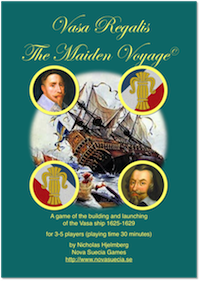
Cardgame Rules (Video)
Cardgame Rules (PDF)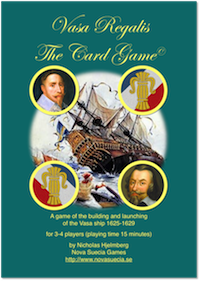
... and Rejected RulesThere are of course also ideas that did not make it and here I explain why. WorkersAnother role-based game like Puerto Rico relies on worker placement to allow production. It is a good idea but it can't be used on its own. No, I would have to add worker spots (procurement contracts and craft workshops?) and make the game much more complicated. In Puerto Rico it is OK, since the objective of the game is to make money (and turn them into victory points) but not so in Vasa Regalis. Following the rule to remove everything unnecessary, workers thus disappeared. Gold and victory pointsSome role-based games have a dual relation between gold (good in the beginning to buy victory point generating items) and victory points (good in the end). I thought of having gold in the game as an element to restrict player actions. ("Should I sell a good to get money or use it to build the ship?"). However, my initial test showed that this added an unnecessary transaction that just prolonged the game and obscured the game idea, to guess how other players dispose of their goods. |