
 |
Home | Game | Rules | Theme | Strategy | FAQ |  |












































|
Version History
The complete rules are available in the PDF file to the right. In the following sections, I will describe how they came to be. Implemented RulesThe Maze TilesWhen making a maze game, there is a decision between multi-ended paths (like the typical dungeon crawler, where the player may choose direction) and single-ended paths (like Tsuro, where there is only one forced direction). Given that Mice in a Maze is less about finding the way and more about forcing the way, the decision was easy. The more intersections there are, the more difficult it will be to force players in unwanted directions (or wanted, depedning on the perspective). For the same reason I rejected dead ends - either you get where you want or where you don't want, there is nothing inbetween. This left only two types of maze tiles: double curves (where both paths to the tile make a turn) and crosses (where the paths to the tile cross each other at different levels) but still enough variation for the maze. The NestsWith only private nests, the game would be all about getting to your nest and blocking all other nests. This may lead to an intense game of opening and closing paths but more likely to a stalemate as no path ever stays open. The solution, inspired by Indigo, was the semi-cooperative shared nest, allowing to players to score for the same cheese. With this rule, players may temporarily cooperate to score and it's perfectly possible for a player to win solely by putting cheese in shared nests. The reason why the shared corner nests have two entrances compared to the single entrance of the shared edge nests is simply to compensate for the longer path to the corner. The Turn OrderThe turn order of moving BEFORE placing maze tiles may feel backward. How can you plan your moves if all the other players get to place maze tiles before you move? Well, that's what makes the game different from games like Tsuro and Indigo. You have to be attentive to other players' paths, negotiate to bring cheese to shared nests, set up redundant paths or even lure their mice into your nest! What you lose in control, you hopefully gain in gameplay. The MarblesThe marbles are not strictly necessary for the game (and thus excluded from the basic game) but adds variation and tactical options. How do you remove the marbles best? Can you use the marbles to remove your opponents? Besides, seeing a path open that allows a marble to roll through the maze and remove several mice on the way is truly in line with the take that mechanisms. The Every Second Turn RuleYou are not allowed to replace open tiles two turns in a row. Why not? Simply because that would risk a recurring gameplay where the same tile gets replaced over and over again. The rule forces new tiles to regularly be placed in the maze until no more new tiles can be placed, after which the game uninevitably ends. As a bonus, this also removes a potential last-player advantage as any player may become the last player to place a maze tile. |
Rules (Video)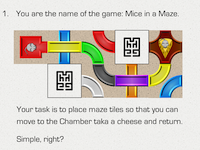
Rules (PDF)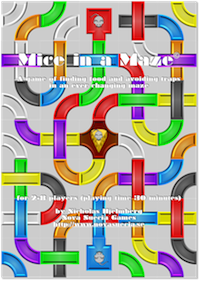
... and Rejected RulesThere are of course also ideas that will be rejected and here I will explain why. Replace tiles after passed turnIf out of the maze turn 1 and replace a tile in the same turn, you may not replace a tile again turn 2 (when you pass) but not until turn 3. If you're unlucky, there is no path out of your Nest turn 3, forcing you to wait until turn 4 to move. So have you been penalized enough already and should you be allowed to count the passing turn as the turn when you aren't allowed to replace a tile? It made sense first but turned to break the end game. With that rule, players could deliberately move out of the maze to get a new opportunity to replace a tile, leading to a never ending end game. You'd better stay in the maze! Two tiles + move in first turnI had some concerns about the possibility to place a starting tile in front of another mouse that was unfortunate to draw a curve as the starting tile to make her move out of the maze lose a turn. Would this be an unfair advantage? To mitigate it, I tried to let the players play 2 tiles in the first AND move (contrary to the ordinary rule of move first and place 1 tile next). It was an ugly mechanism that just didn't feel intuitive. In addition, the rule that allows you to stay in the nest until you can safely go out already mitigated this. After all, this is a take that game so why not let players mess with each other already from the start? Replace tiles in front of other miceThe game was designed for a take that contest and what can be more take that than forcing other players' paths? However, this turned out to be too destructive for my taste so I allowed replacement of tiles only along the path of a player's own mouse (which, of course, may be along the path of another player's mouse as well...). |