
 |
Home | Game | Rules | Theme | Strategy | FAQ |  |







































|
Version History
The complete rules are available in the PDF file to the right. In the following sections, I will describe how they came to be. Implemented RulesPlanThe purpose of the Plan phase is to give the players interesting planning decisions while also considering speed and balance. One extreme would be to give the players fixed time cubes, something that would eliminate all decisions. The other extreme would be to let them draft all their time cubes, something that would prolong the Plan phase and run a risk of drawing too many or too few of certain colors from the cube. The logical balance was to give them three fixed cubes based on the iteration (more design in the early iterations, more test in the later ones) and three randomly drawn and drafted over only three turns instead of six. Similarly, the work item card could be either drawn or drafted. Since only one card is needed each iteration (in addition to the start card), drafting added another interesting decision, as the players may nove match both cubes and cards. By the way, the reasoning behind the start card was that it would be more interesting with two cards in play already at the game start. WorkThe purpose of the Work phase is simply to allocate resources (cubes) to work items (cards) as per the theme of the game. Without the work die, which may increase or decrease the cube cost, this would be a simple calculation exercise. The work die can also be considered thematic, as estimates are seldom accurate and mitigation often necessary. But what if players end up with cubes they cannot use if a card doesn't progress as expected? Well, they did take a risk and do have to pay for it but how? Losing all cubes is harsh while saving all to the next iteration doesn't matter much. A balanced solution was to let them save half the cubes. But what's the use of save cubes in the last iteration? None, so another "cushion rule" was necessary. The ability to exchange a work item card for a joker time cube was introduced to make use of remaining cards and cubes. CloseThe more a card progresses, the more victory point it earns. So far so good. But how to handle dependencies? They do make sense thematically, but what may happen in a competitive game? A player, knowing that other players are dependent on their card, could simply refuse to progress it and thus block them. This would be neither fun, nor thematical. For this reason, a generous scoring was added, where both completed cards and cards dependent on them earn victory point to encourage joint progress. Cooperative or not?Should an educational game like Find the Bug! be cooperative or not? Personally, I'm not a fan of cooperative games but it may make sense in this case. To give the players this option, both a semi-cooperative variant (the ability to exchange cubes) and a cooperative variant (the objective of completing as many high value cards as possible) were added. |
Rules (Video)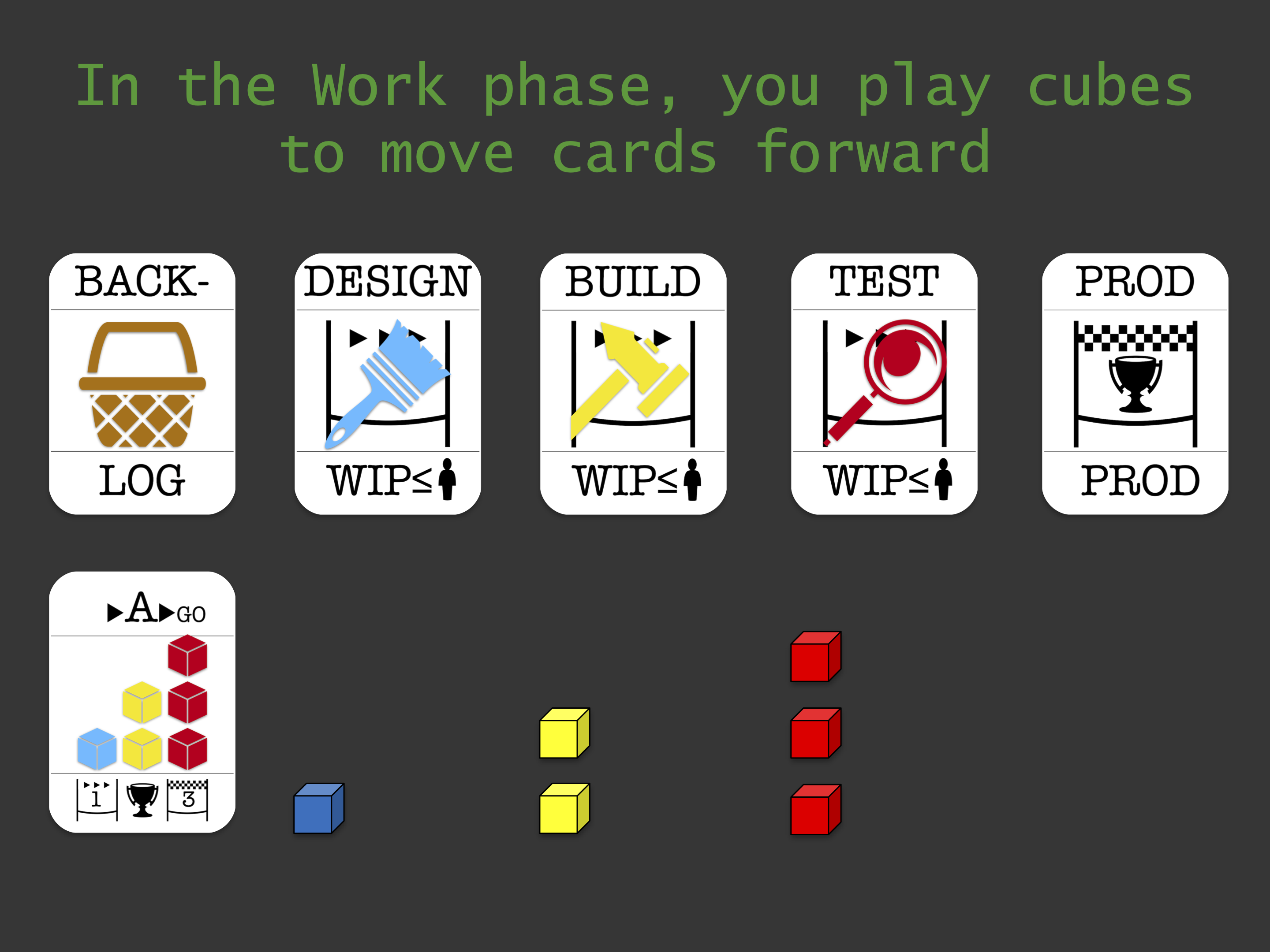
Rules (PDF)
... and Rejected RulesThere are of course also ideas that did not make it and here I explain why. The punishing work dieThe first version of the work die increased the cost by two cubes at a die roll of "6". This was needed to push the average cube cost higher than 6 and make risk mitigation required but a die roll of "6" could also be devastating (and not fun) for an unlucky player. By reducing the cost increase to one cube, the average cube cost would still be higher than 6 but the die would be less punishing. |