 |
Home | Game | Rules | Theme | Strategy | FAQ |  |










































|
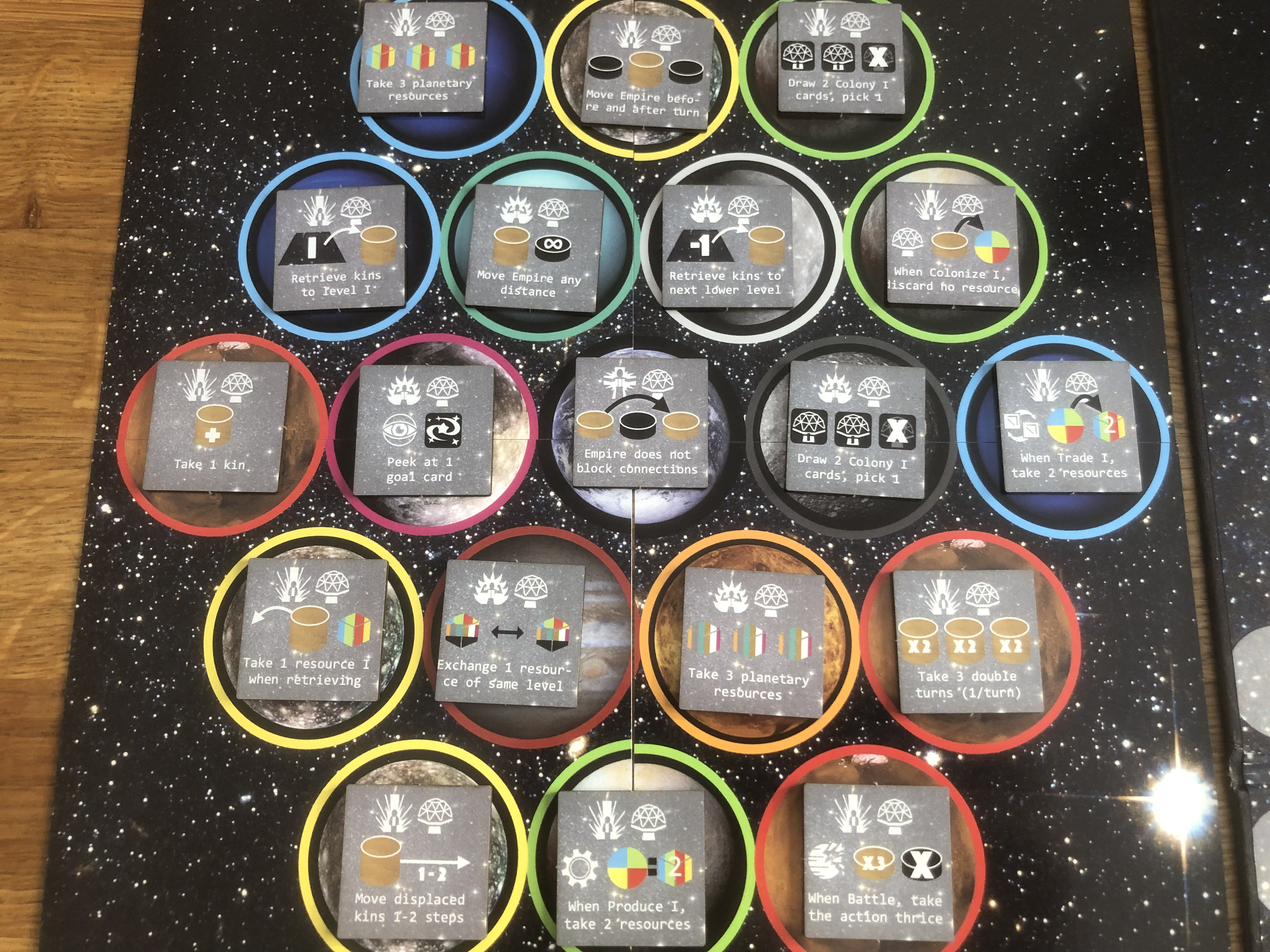
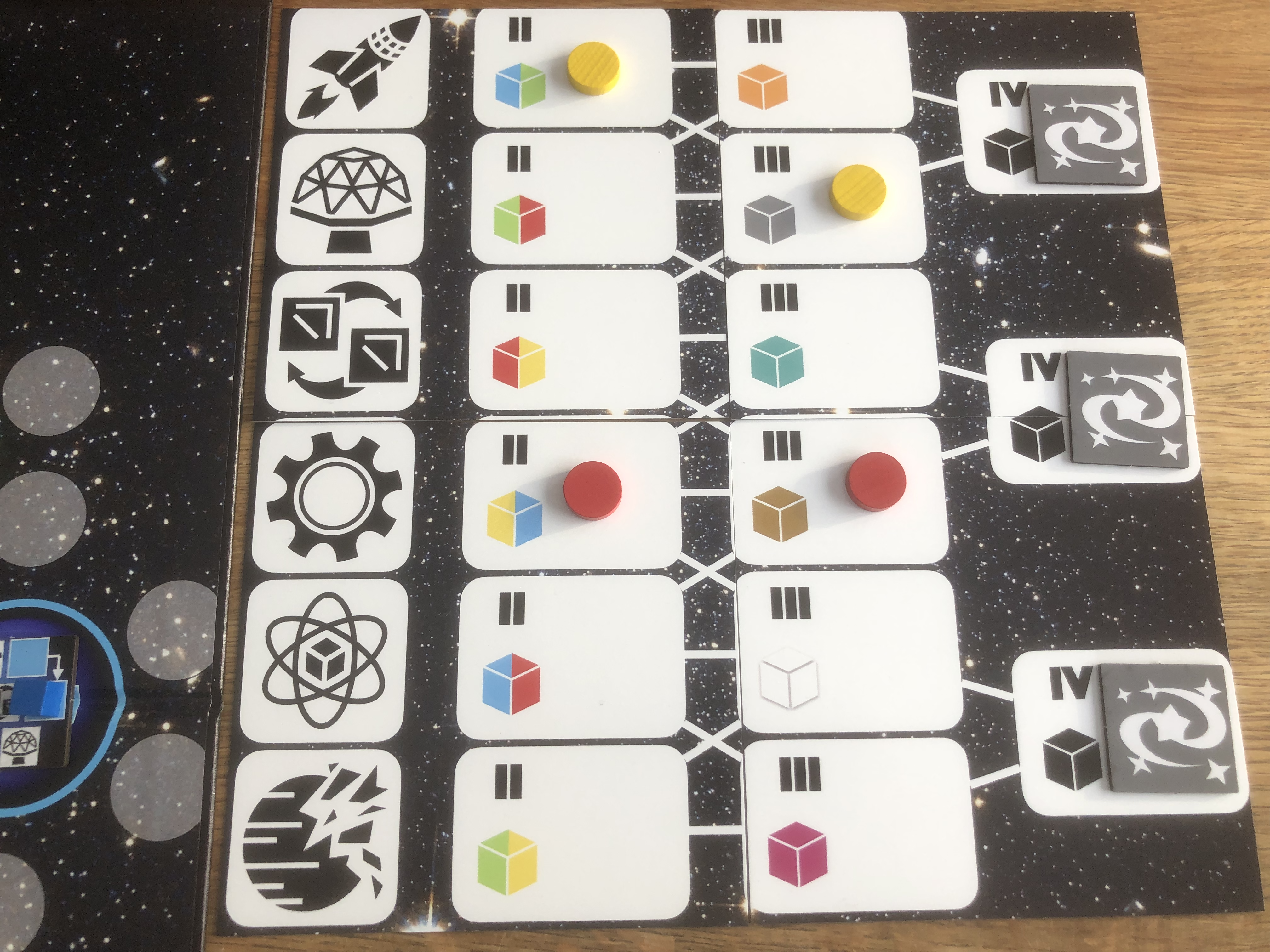
Game designThe inspirationThe inspiration to Foundation came from many sources. One was the wish to explore worker placement, a mechanic that I don't mind having in the games I play but find difficult to innovate in the games I design. Another was the wish to design a more "publishable" game through positive player interaction instead of my more punishing and confrontative designs. I've also found inspiration in games like Railways of the World and Beyond the Sun. In the former game, I liked the elegance of building networks and upgrading engines to deliver cubes longer distances but regretted that the cubes were only delivered once and then removed from the game. In the latter game, I liked the economy of balancing planetary resources to advance on a tech tree but would like to see the technological advancements translated into further expansion on the planetary map. The final impetus came from the Foundation TV Series, more specifically the way outer planetary systems expand at the expense of a crumbling central Empire, not through war but through trade and advanced technology. Surely there must be a game here? The game structure - what happens?My first ideas revolved around a connection between levels of actions, technologies, planets and resources. Workers could be placed on level 1 ("novice") and moved upwards to level 2 ("apprentice") and level 3 ("master") before being retrieved to trigger the action. Other players' workers may push your workers upwards and be rewarded through an automatic move upwards once you retrieve your worker. This would provide a thematic novice-apprentice-master relation, where the different workers help each other to grow. The higher level actions could be used to advance to higher levels on the technology tree, expand to higher levels on the planetary map and manage higher levels of resources. Eventually, a player has advanced enough on all those levels to reach the central Empire planet and trigger one of several possible victory conditions. Many elements of this game were already present in my previous games and ready to reuse. Cosmoclasm and Warring States have a system of inner and outer planets, controlled through surrounding battle stations (although the concept of area control was later abandoned in favor of surrounding trade links). Peoples - Migrations and Peoples - Civilizations have a system of levelled technology trees. Dyce, Suecia and Globalization have a system of tradable and upgradable resources. The "only" thing I needed to do was to put all this together into one game. The game board - where does it happen?The planetary map more or less designed itself. A central planet was given, as were the six surrounding bases to create "hexagonal" connections. Three planet layers seemed like a good number so six planets in the middle layer and twelve planets in the outer layers were added - all connected by six surrounding bases. Next came the resource hierarchy. To pair resources and get the number twelve required for the twelve outer planets, four basic resources were needed (each of which may be combined with the other three, i.e. 4x3). Those four resources may form six unique pairs (3+2+1), which was exactly what the six middle planets required. Any two such pairs could then be converted to the central planet's "super resource" required to unlock certain game goals. To illustrate with an example: a blue and a red resource from two outer planets may be converted into a purple resource on a middle planet, which in turn may be combined with another middle planet resource on the central planet. I have a weakness for this kind of numerology so this relation was enough to proceed with to test. The actions - what do the players do?With three planet layers and three resource levels, it was natural to have three action levels as well but which actions should I have? Some kind of connection action was given to place discs between the planets, similar to how tracks are laid in train games and thus the Space Travel action was born. The higher action levels could simply allow bigger "jumps" between bases. The Production and Trade actions also came naturally, the former to produce resources on planets and the latter to trade resources between planets - the higher the action level, the higher the resource level. A Research action to advance on the technology tree was also self-evident so the four first action also designed themselves. Which other actions would be needed, if any? Mechanically none, but thematically the aspect of exploration was missing, not to mention the struggle against the Galactic Empire. The former was solved by giving each planet a special ability and award it to the first player taking the Colonize action on it. In this way I also got a variable and expandable element, something that's often missing in my games. The latter was solved by adding an "AI Empire player" that may be fought against with the Military action. For both actions, higher levels could simply allow them closer to the center. The Empire - what does the non-player do?Regarding the Empire, I didn't want to create a military game of take that and bash the leader so I simply let the Empire discs act as connection blocks that are moved by the players themselves according to certain defined paths. In this way, the players may throw spanners in each others' works but not completely ruin their games. The cool factor - the action selection mechanicHow about the worker placement mechanic then? Did the idea of positive player interaction survive the test? The initial idea was inspired by Hansa Teutonica's brilliant "worker bumping", where players may bump each other from valuable spots but pay for it (or block valuable spots to get paid). My idea was to let the players block valuable actions to get bumped to higher levels. But although this works well on Hansa Teutonica's big map with plenty of interesting spots, the tests showed that it was too constrained on Foundation's smaller action board. Also, players who didn't get bumped early got a much worse start. Instead, the mechanic of private action boards and "double bumps" (upwards and sidewards) was devised. This let the players plan their actions and create chain reactions to set up powerful turns in a way I haven't seen in other games. Thus, Foundation still have a cool factor, only a bit different from what I thought it would be in the beginning. The planet and resource systems on the other hand worked very well and was kept more or less the same!
Game components
|
Annotated gamesIf you like those game mechanisms, I can also recommend:
|