
 |
Home | Game | Rules | Theme | Strategy | FAQ |  |











































|
Version History
The complete rules are available in the PDF file to the right. In the following sections, I will describe how they came to be. Implemented RulesThe rules of Cobweb originates from Politeia and their creation was a simple work of applying Knizia's principle to take away everything that can be taken away and still leave a good game. A second principle that emerged after some work was to choose the most "family-friendly" option when considering different rule options. ActionsPoliteia has four groups of actions, of which at least three seemed to be required for the game: place resources, get resources and remove resources for victory points. However, it turned out that even the latter could be removed, since the get and remove actions could be combined. This was actually inspired by the seemingly abstract theme: when a spider catches a prey, the cobweb usually has to be repaired so getting a resource to the hand also led to removing a resource from the board. Later, I changed this and went with the family-friendly option of simply moving the resource to the bottom of the stack. How about the fourth action group from Politeia then, the relocation action. I did consider leaving it out completely but it does add some tension to the stacked majority game, particularly since resources never leave the board but merely move to the bottom of the stack. Action to move them back to the top or to areas where they may be useful would definitely have a purpose in Cobweb as well without adding too much complexity. I hope Knizia would agree. Board movementsOne (of many) tricky rules of Politeia was the rule of presence and adjacency. It is needed there to strike a balance between the flexibility to spread across the map and the predictability to know where opponents may and may not come. But whereas Politeia's map is a complex web (pun intended) of paths between regions, Cobweb's map is more compact where all spaces are accessible within a few moves from each other. Again, the seemingly abstract theme brought the inspiration. Why not simply add a spider token and let all placements come from its movements? Simple and intuitive. But what if it reaches a space with another spider or a previous placement? Simply skip it and move to the next one! Action selectionAction tiles may be duplicated to get the optimal number of tiles to jump between but how many are "optimal"? Politeia's twelve actions are fine but the rule of diagonal jumping from the edges to give each tile four jump options confuses some players. Sixteen tiles and only orthogonal jumps seemed easier but would probably make the edge tiles less attractive, not to mention the corner tiles. The simple solution was the "round board", whereby players may move from one edge to the opposite edge. To make it even more intuitive, this and other rules could be synchronized with the board movement rules, such as skipping tiles with other players and moving to the next one. Simple and consistent! ScoringOne thing I really like with Politeia is the rubberband mechanic, whereby scored units are removed from the board and forces the scoring player to rebuild his or her engine. Not all players share my view so why not make Cobweb simpler by simply letting the units stay on the board after scoring. By moving them to the bottom instead, the engine will be merely interrupted, since the units will eventually (through own or opponents' actions) come back to the top again and earn income anew. In addition, since the spaces can't be emtpied, they can't be refilled either, forcing the players to optimize their movements and spread their units to other areas to maximize their victory points. Similar mechanics to Politeia but differently executed, resulting in different tactical and strategic approaches! |
Rules (Video)
To be published. Rules (PDF)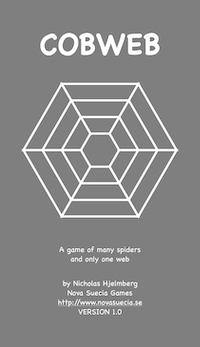
... and Rejected RulesTo be completed. |