 |
Home | Game | Rules | Theme | Strategy | FAQ |  |












































|
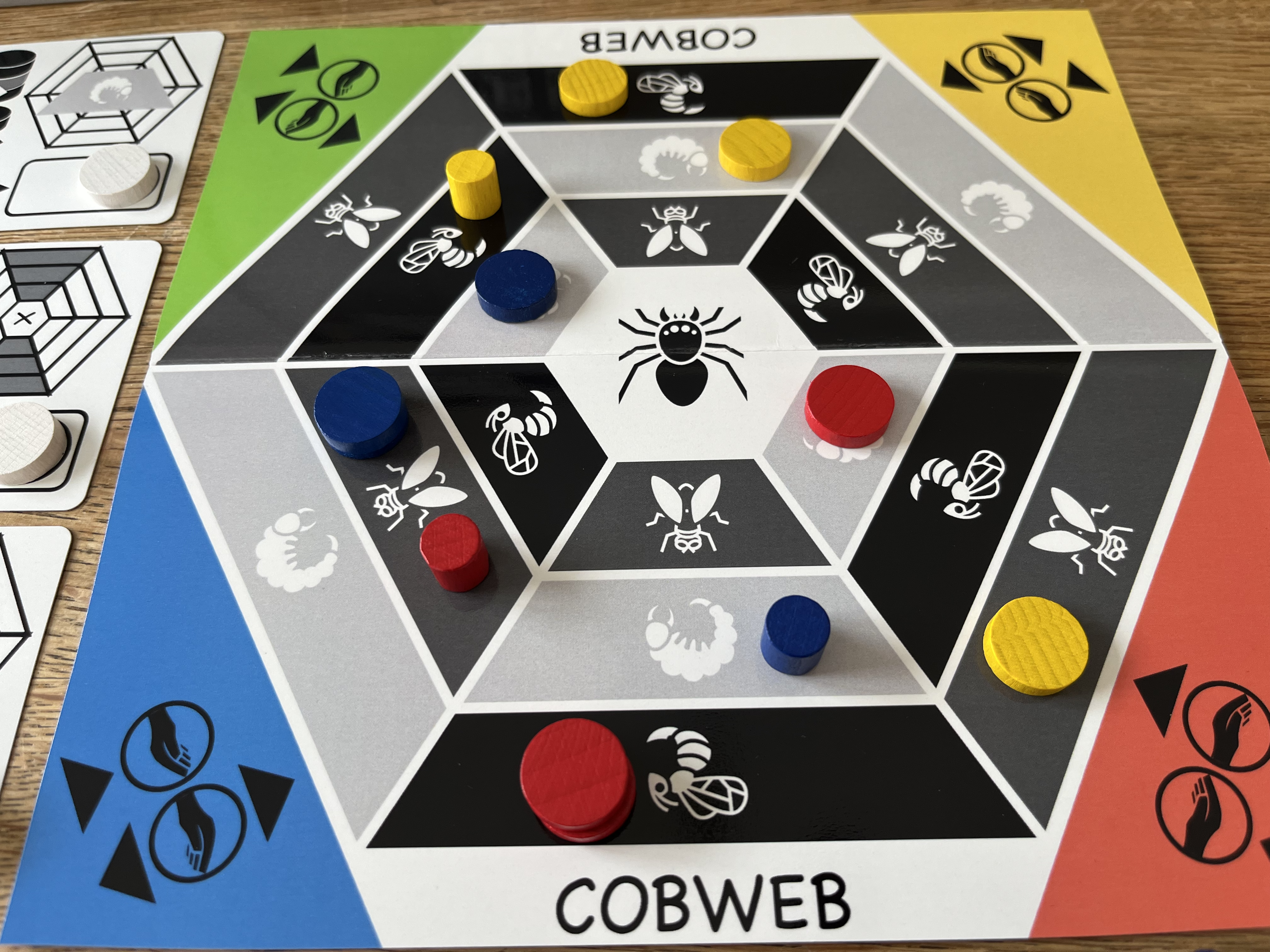
Game designA few years ago I designed Politeia, a game revolving around an innovative mancala mechanic for selecting actions. It consisted of an action board, on which the players picked up and dropped action discs on the selected actions. The action discs served a dual purpose. First, the number of discs picked up dictated the number of actions available - the more discs picked up, the more actions to drop them on. Second, the number of previous discs on an action dictated the action cost - the more popular an action was, the more action discs would end up on it and vice versa. This mechanic was very well received by testers and even earned the game an invitation to the well-reputed Danish game convention Fastaval. However, this mechanic was only a means to another end, namely an epic game set in Ancient Greece where the players played city-states competing for hegemony. This game added even more innovative mechanics. Multi-functional tokens served as resources (when on the players' hands), citizens (when on the board) and victory points (when removed from the board). Those tokens were moved to the cities (as income), between the cities (to spread to other cities) or within the cities (to take control of cities). There was also a market mechanic, where the players could produce and speculate in commodities, and a building mechanic, where the players could acquire certain abilities. Last but certainly not least there was an AI mechanic where Persian units would occasionally overrun the board, partly to bash the leader and partly to convert tokens to victory points by removing them to "Elysion". All this worked but was simply too much to absorb for new players. With this in mind, how should I proceed? Reiner Knizia once said that a game is finished when there is nothing more that can be taken away and still leave a good game. Could this design philosophy be applied to Politeia? Since the mechanics were so tightly linked to the theme, I found it difficult to remove any of them without making the rest too abstract. Well, why not free myself from Politeia and design a completely new abstract game instead, adding one mechanic at the time until nothing more was needed? This is how the work on Cobweb started. I started with the mancala mechanic, since this was the one that the testers had appreciated the most. What should those actions do? Convert resources to victory points of course so Politeia's multi-functional discs were also added where the players would have to collect discs and manipulate them on the board to convert them into victory points. Politeia used twelve different actions to accomplish this but what would be the minimum number of actions to do the same? An income action to get discs to the hand obviously. This would have to be followed by a placement action to get the the discs from the hand to the board. Once on the board, a movement action would be needed to use those discs. Use them for what? Area control of course, either by moving them to empty areas or on top other discs. This area control could then be the basis for the income action, thus completing the circle. How about the victory points then? Should discs ever be removed from the board to generate victory points, similar to Politeia? Not at all! Discs could simply remain on the board (but be moved to the bottom of the stack after the income action) and count as victory points where they were. Simpler than Politeia's "Persian solution" but keeping some of Politeia's ebb and tide flow, where a players sometimes has to take a step backwards to get forward. The next question was what the board should look like. The Politeia board was dictated by the theme: a central ring of city-states linked to an Eastern ring of city-states ("allies") and another Western ring of city-states ("colonies"). A bug/feature of this board was that it was possible to expand in one circle with one action and then get income from the same region in another action in the same turn. With an abstract theme, I had more liberty to design a "multi-dimensional" board where each area would have a unique coordinate similar to my previous game Apokalypsis: North/South/East/West and Central/Middle/Outer. Such a board could have a third dimension for income areas so that no similar income types would be adjacent to each other, thus avoiding the bug/feature of Politeia. The first draft of the board resembled a spider's web and why not? I had recently read the article Why so many games about trees and animals? so a spider theme was timely. This also inspired a new mechanic. Whereas new discs in Politeia were placed based on the action's region and adjacent cities, this game could have a player piece (a spider) that moved around and built its web by leaving discs in its track. Simpler and more thematic! It was also at this time that I decided on the name: Cobweb (since Arachnophobia sounded less family-friendly). 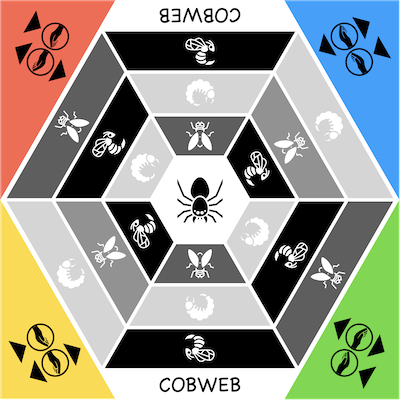
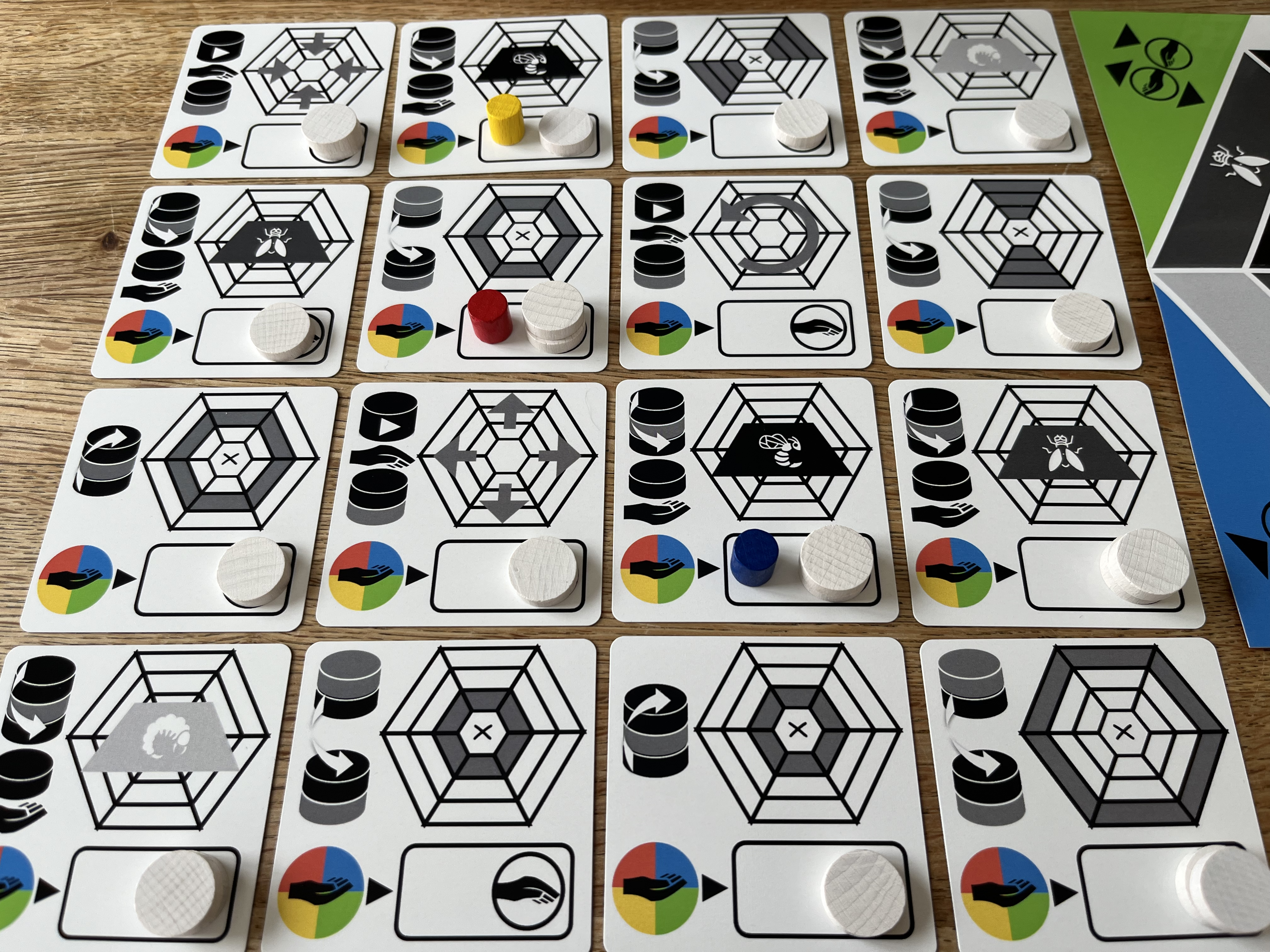
The basic gameplay was now ready. The players would take the simple actions of move spider+locate discs, relocate discs horizontally, relocate discs vertically and earn points for top discs (and relocate them to the bottom). "Expansion actions" would be linked to "geographical areas" like in Politeia whereas "income actions" would be linked to "prey areas" that were scattered across the board. In this way, the players would be forced to strike a balance between spreading in one geographical area (and have many small income actions) and spreading to specific prey areas (and have a few big income actions). 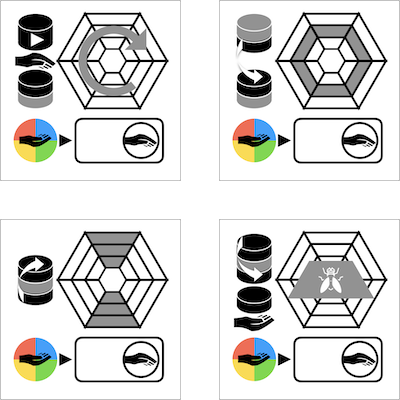
The components were so simple that the first draft literally only took a couple of hours to complete. The initial tests did show that the extra "meat" of Polietia does serve both a strategic and a thematic purpose but the main conclusion was that Knizia's famous principle that a game is finished when there is nothing more that can be taken away and still leave a good game did apply to Cobweb! Game components
|
Annotated gamesTo be completed. If you like those game mechanisms, I can also recommend:

|