
 |
Home | Game | Rules | Theme | Strategy | FAQ |  |








































|
Version History
The complete rules are available in the PDF file to the right. In the following sections, I will describe how they came to be. Implemented RulesThere are many ideas that came to live in Bake the Cake!©. On this page, I would like to present some of them and explain the reasoning behind them. The blocking elementsThe essence of Bake the Cake! is to move ingredients from one place to another. However, without any blocking elements, players would not do much more than baking their own cakes without any interaction. That called for blocking elements:
Eat ingredientsThe possibility to eat ingredients was first tested as a "take that" mechanism but turned out to be a good way to disturb other players' strategies. However, it also had to be balanced to prevent players from using it too much and stop all the game's progress.
Throw away ingredientsThe possibility to throw away ingredients was introduced to decrease (but not remove completely) the risk of the entire game to be blocked. Without this rule, dependency chains may very well arise where player 1 waits for player 2's tool, player 2 waits for player 3's tool and player 3 waits for player 1's tool. |
Rules (Video)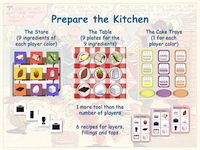
Rules (PDF)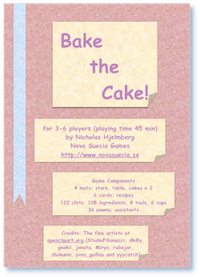
... and Rejected RulesThere are of course also ideas that did not make it and here I explain why. 1 cake per playerWouldn't it be great if each player was to bake her own cake and try to make it as optimal as possible (i.e. have as many other players engaged in it as possible)? Indeed, but given that a cake requires the move of 9 ingredients first to the table and then to the recipe and finally 3 parts to be moved to the cake (excluding ingredients eaten on the way!), such a rule would require over 100 moves for all the cakes to completed and simply be too repetitive. After all, there will only be 1 cake left after the contest anyway and 2 cakes are enough for a contest. If more time does not add more variation, there is simply no need to add it. |