 |
Home | Game | Rules | Theme | Strategy | FAQ |  |































|
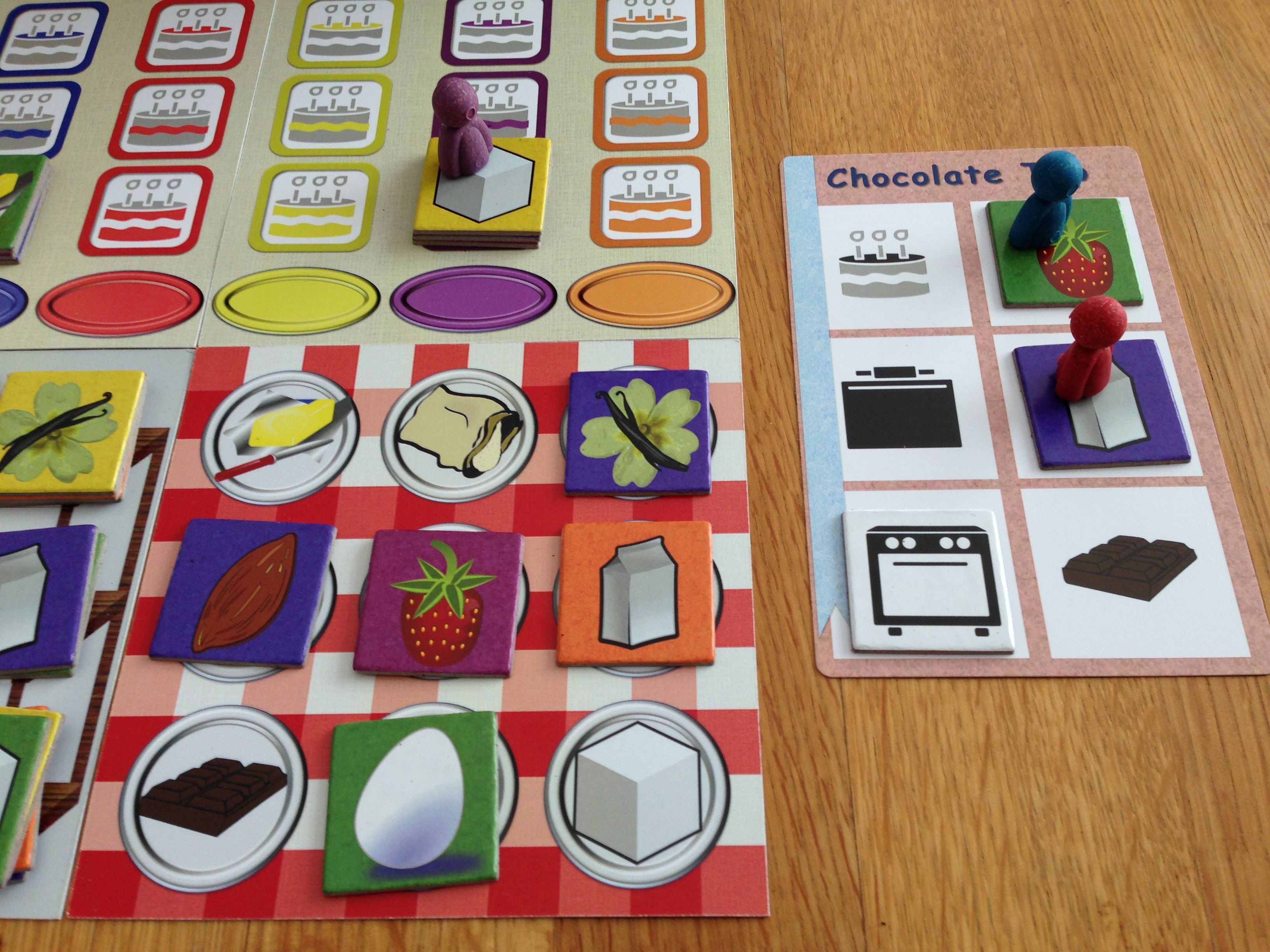
Game designWhen I started designing games, I made a joke about how irrelevant the theme is for a game and how a game about acquiring goods to build a colony just as well could be made into a game about acquiring ingredients to bake a cake. Later on, my attention was captured by another contest at The Game Crafter about games to a younger audience, which may serve to introduce them to heavier board games. However, although I love the 17th century theme of my early games, I don't expect 8-year-old kids to do the same. So why not return to the cake idea? The idea was to create a game that, both figurely and literally, was messy, just like a kitchen full of young bakers. The ordinary value chain of acquire-refine-build, familiar from many other games, would be presented in a playful way but to add an extra dimension, I would allow the players to take what they need from each other. As an additional "take that" mechanism, I would even allow the players to eat each others' ingredients! With the game foundation established, I began to work out the details. 3 is a good game number so I organized the game elements in sets of 3:
The actual "production" was kept simple so instead of allocating workers or paying gold, the players simply take what they need, 1 at the time. However, I did introduce kitchen tools in the middle of the value chain (for the preparations of parts) as a limited resource and a way to block each others' progress. Finally, and as an extra twist to the end, I introduced the "Reiner Knizia" style scoring of a cake contest where only the cake where most players have points is used in the final scoring. This created a game where a player who tries to add too many points to a cake will get nothing in the end, just like the famous Pythagorian Cup! For the art, I used free clipart images from Openclipart together with bright colors to create a comic style to the game. My old art of simple symbols and old paintings worked well for my historical games but certainly not for a cake game and I can't deny that my art skills are far inferior to that of the many good artists at Openclipart. However, I did add some extra flavor (pun intended) to the rules and the box and made then in the style of recipe book and a cake. I even wrote the rules as if told by a grandmother to her grandchildren! This was fun and, I hope, an improvement compared to my previously rather formal rules. The rest of the game design was simply testing and tuning to get the optimal number of ingredients per person (2), number of kitchen tools (1 more than the number of players) and number of cakes to be baked before the game ends (2 to get a reasonable playing time of 30-45 minutes). The end result was game which looks simple on the surface but with a surprisingly huge tactical depth. I honestly don't know how to play best to win this. Game components
|
If you like those game mechanisms, I can also recommend:
|