
 |
Home | Game | Rules | Theme | Strategy | FAQ |  |







































|
The HistoryThe Swedish Empire refers to the time period when the Kingdom of Sweden controlled most of the Baltic Region and the Baltic Sea was more or less a Swedish lake. Its start is usually taken to the accession to the throne by King Gustavus II Adolphus 1611, its peak to the peace of Roskilde 1658, when Sweden reached its height, and its end to 1721, when most of the territorial gains were lost following the Great Northern War. There is plenty of literature on the topic but Wikipedia is a good start. The Swedish Military Book Club (SMB) has produced a series of books about the wars around the Baltic Sea and the book The Adventure of Sweden covers economic and social aspects of the era. The provincesEstonia asked for Swedish protection from Russia already 1561 while Ingermanland was captured 1617. Livonia was captured from Poland 1629 and Jämtland, Got-land and Ösel from Denmark 1645. The Westphalian peace 1648 awarded Sweden Pomerania. After another war against Denmark, Sweden reached its height in 1658 when Scania, Halland, Bohus-län, Trondheim and Bornholm were acquired. The noblesAt Alsnö meeting 1279 it was stated that the mounted fighting class would enjoy tax freedom. The so called nobility letter was given by the King, often for military services.
The Riksdag of the EstatesThe Swedish Riksdag of the Estates originates from the 15th century and consisted of the classes nobility, clergy, burghers and peasants. In 1612, the Riksdag gave the nobility the right to hold all higher offices of government. It was the highest authority next to the King. The land and sea routesSea routes were more important than land routes at this time. The sea of Åland between Sweden and Finland was easier to cross than the forests of Småland on the border to Scania. In the war between Sweden and Denmark 1611-1613, the battles were fought mainly around the sea port of Kalmar in Småland. The fleets, armies and fortsIn 1544, King Gustav Vasa created a national conscripted army. The navy was important to secure the overseas trade but was long inferior to the Danish navy. The early forts were defensive, such as Kalmar in Småland and Älvsborg in Västergötland. During the Thirty Years’ War, forts like Stralsund were used offensively like bridgeheads. The Swedish army developed standardized equipment to facilitate mass production, training and maintenance. The navy was transformed from light escort and patrol ships to heavy warships with double gun decks. With the advent of the artillery, the forts had to be strengthened with angled walls and round towers. The Swedish tactic often relied on swift and sudden movements, not allowing the enemy to withdraw and regroup. Commanders like Johan Banér were ruthless and let their soliders pillage freely after the victories. The losers were often the civilians, whose crop was stolen and houses burnt down. The production, trade and warThe farmers suffered from the war and often revolted, such as during the maul war in Finland 1596-1597. Gustavus II Adolphus' used this as argument to go to war in Germany rather than waiting for the war from to come to Sweden. The motives of many wars were conflicts regarding trade from the Russian rivers and through the Danish Sound. |
Axel Oxenstierna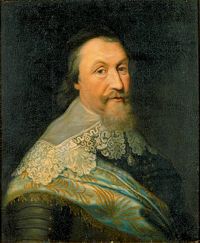
Per Brahe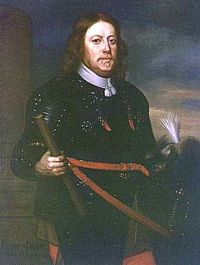
Johan Banér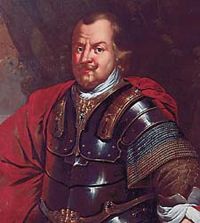
Jacob De la Gardie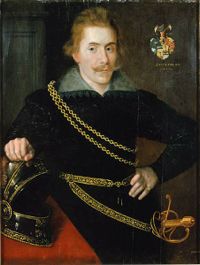
|