
 |
Vision | Projects | Blog | Articles | Reviews | Order | |













































|
ArticlesLearning by GamingThis article was published at LinkedIn 15 Aug 2014. Does gaming facilitate learning? Well, as a gamer, teacher and tester, there is only one way to find out: test by designing a game that teaches testing. But let us start from the beginning. My name is Nicholas Hjelmberg and among my many labels are tester and game designer. I have over 10 years of experience in the testing and quality field and have developed more than 10 board games. The idea of a test game was born when I gave test lectures to newly hired colleagues. Many IT professionals have a perception of testing as a simple and straight-forward task where technical knowledge of the solution is enough to test it. The exercies used in my corporate training did nothing to correct this perception. Instead, they focuesed on mechanic memorizing of concepts and rewriting requirements and design specifications into actions and expected results. Where was the curiosity and creativity? Where was the passion for quality? To become a good tester, you need to have a quality mindset:
Obviously, a quality mindset is nothing that is created over a day but something that requires experience, own or others. Nevertheless, with the right pedagogical tools, the foundation of a quality mindset can be set and this where gaming comes into the picture. There are many reasons why games are great for teaching:
One recent example of a successful IT teaching game is Robot Turtles a game introducing programming concepts to children. Testing concepts are just as important! If programming concepts can be learnt from a game, can testing concepts be that as well? Of course! After all, testing is not very different from gaming with a hidden objective (unknown bugs) and different ways to achieve it (test strategy). 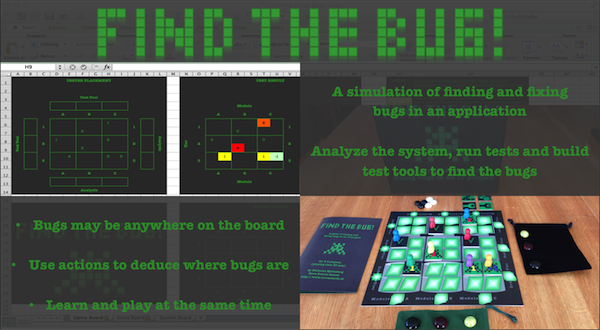
The idea of a test game was thus born but it had to be nurtured and raised before it could mature. My continuous work with junior testers helped me identify knowledge gaps and my work with Nova Suecia Games helped me develop various game mechanisms that might be used to bridge those gaps. Finally I had everything I needed to design a test game: Find the Bug! Find the bug! is a board game for players of all ages who want to learn IT testing in a fun way. Children will enjoy the thrill of picking tiles and see whether they contain a bug or not. Students will learn to analyze a system and plan their testing accordingly. Teachers will have concrete examples of testing concepts such as risk-based testing and regression testing. All of them will learn that testing is fun! Find the Bug applies several testing concepts. The players represent test leads, responsible for assigning testers to analysis, design, test and automation tasks. The game board simulates a multitier architecture with 3 tiers and 3 modules. Using the principles of risk-based testing, the players must assess the business criticality and technial complexity of the solution and plan the tasks accordingly to find as many bugs as possible. In just half an hour, the players will have experienced an entire test project! Find the Bug! does not claim to cover the entire testing area. There are many more things to learn and even the most experienced tester will still find new things to learn. However, used in a training context it may help students to understand the meaning of basic test terms and how they apply in a real test project. Hopefully they will have fun as well! Find the Bug! is my way of giving something back to the testing community and help building and developing our profession. If you believe in the idea of learning testing by gaming, you are more than welcome to contribute to the journey, either by giving advice on the way or by backing the crowdfunding campaign at FundedByMe. You may also follow the progress at Twitter at #NovaSuecia. Remember that this is game is designed for you and as a tester, I want to make everything possible to satisfy your requirements. If this first "test" is successful, there are many more testing concepts waiting to be turned into games! Recommended further reading: |
Articles
Please leave a comment on the games or contact me directly at nicholas.hjelmberg@gmail.com. |