
 |
Home | Game | Rules | Theme | Strategy | FAQ |  |












































|
Version History
The complete rules are available in the PDF file to the right. In the following sections, I will describe how they came to be. Implemented RulesThere are many ideas that came to live in Politburo©. On this page, I would like to present some of them and explain the reasoning behind them.
PlanThe plan phase could have been replaced by the general secretary simply select which ministry to score. However, a vote is a good way to engage all players each turn (and have them hinting their interests). But why would the other players want to vote for a ministry proposed by the general secretary and help him or her to attain an objective? Simply because several players may have an interest in that ministry. Some may want it to score positively, some to score negatively and some perhaps only want to see the following execution to fail. And since there is a limited number of ministries to propose, the rule that the third and last ministry proposed always succeed will ensure an end to the plan phase. ExecuteWhile the plan phase engage all players, the execution phase is all about putting selected players against each other and eventually, using the process of elimination, deduce their interests. This is similar to the voting and deduction mechanism of Avalon with the addition of a general secretary with the power to replace players and have another go. Is this addition necessary? Yes, while Avalon has simple two-dimensional objectives and actions (good/evil, pass/fail), a Politburo player choosing to score a ministry positively may do so for several reasons; to maximize the value of that specific ministry, to maximize the value of all ministries in general, to prevent the ministry from getting a value at all and so on. One attempt would be too random whereas a new attempt will help the general secretary to do some triangulation to find players willing to comply with his or her objectives (but with the risk of giving away too much information on them). PurgeThe two first phases with their many coinciding and colliding objectives are probably enough for a voting and deduction game so is the purge phase necessary? Yes and no. Without it, Politburo wouldn't be much different from other games. The purge does not only fits the theme very well but also adds another dimension to the voting and deduction. Do you dare voting in favor of your interests and risk a purge? Perhaps you want a purge to take place to bring down another player? The depth added by this rule is most intriguing! |
Rules (Video)
Rules (PDF)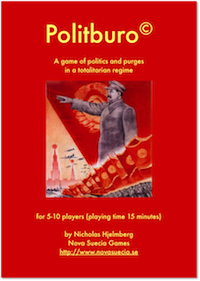
... and Rejected RulesAbsolute ScoringThe scoring is relative, meaning that a ministry may win by for example having the highest level, rather than absolute, meaning that a ministry win by having a high level. The difference may seem insignificant but does have a major impact in the player incentives. With absolute scoring, players are simply interesting in voting to execute their own ministry and maximing its level while keeping the others around 0. Once a ministry goes below 0, it will be difficult to turn it positive again, making the game less interesting for player with this objective. With relative scoring on the other hand, the players may attain their objectives either by increasing their ministries or by decreasing competing ministries and even a ministry with level -1 can be the highest if the others have -2. This makes it more interesting throughout the game. |