
 |
Home | Game | Rules | Theme | Strategy | FAQ |  |












































|
Version History
The complete rules are available in the PDF file to the right. In the following sections, I will describe how they came to be. Implemented RulesThere are many ideas that came to live in Tre Kronor Infernum - the Board Game©. On this page, I would like to present some of them and explain the reasoning behind them. The game boardThe game board is symmetric but each hall is unique to add a labyrinth feeling to the castle. The placement of wells in the corners forces the combine their servants into chains to reach the halls. The hall have 2-4 entrances, into which water can be thrown but also out of which the fire can spread. Except the courtyard, all squares adjacent to halls are unsafe as they may be reached by the fire. The human chainThe cooperative aspect of the game was emphasized through the human chain where each player participating in a chain (no matter if they actually extinguish a fire or not) score. Once a chain is started, each player is more or less forced to join the chain to get their share of the scoring. The save/steal markersThe cooperation to save the castle has both a cooperative and a competitive element. The cooperation is the extinguishing of the fire while the competition is the saving or stealing from the halls, which give the players opposite objectives; saving scores if the hall is rescued and stealing scores if the hall burns down. How should the other players react? It depends on whether they guess the that player's strategy. What if one player saves and one player steals? Well, then we have an interesting conflicting strategy. The double save/stealConnecting a servant to a hall only earns you point if you can get to place a save/steal marker there. Why then be the last to do so and let the other players save/steal, not to mention connection more than one servant? Initial ideas to solve this included both carrots (points for connecting to rescued rooms) and sticks (crowded entrances limiting other players' ability to place save/steal markers). However, a much simpler idea was to allow players with more connected servants to place more save/steal markers. The fire spreadThe idea to let the fire spread when the fire spread markers placed by the players contain more than one letter or number accomplish several things. First and most important, the fire will spread unpredictably. Second, the fire will spread with slightly more than 1/2 fire marker per turn. After the first marker, it is 50% chance that the second will be of a different kind, in which case only one fire marker will be placed. If not, it is 25% chance that the third will be of a different kind, in which case two fire markers are placed. (The exact calculation is 0,5*1/2+0,25*2/3+0,125*3/4+0,0625*4/5+0,03125*5/6 and so on, giving a result of about 0,61). This is good balance since the players may choose either to extinguish a fire or to do a strategic action such as placing a servant or saving/stealing a possession. Third, and perhaps most elegant, this works perfectly well with any number of players. Even if there are many players to extinguish the fire, they will not have more time to place more servants than few players would have. The burn down lossAll games in the Nova Suecia series have a potential end where all players lose and that applies to Infernum Tre Kronor as well. If all players choose the stealing strategy, they will lose and to be fair, I think they deserve it. |
Rules (Video)
Rules (PDF)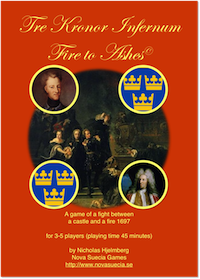
... and Rejected RulesThere are of course also ideas that did not make it and here I explain why. Points depending on remaining possessionsFor a while, I considered letting the scoring for human chains depend on the possessions actually left in the hall. The idea was that the players in the chain would have to decide whether to continue extinguishing the fire (hoping that the savers/stealers stole) or leaving to the others to do it (hoping that the savers/stealers saved). However, this would make the scoring complicated and would actually not even be necessary. The incentive for the players in the chain is not to score in any case (since each player usually has at least one servant in the chain anyway) but to cross the savers'/stealers' plan. Alternative scoring opportunitiesInitially, I thought additional scoring was required to give the players incentive to place servants and extinguish fires rather than only save or steal. Such ideas included rewarding players in successful chains and players with most extinguished fires. However, with the limited number of save/steal markers and the necessity to save the castle to prevent a loss for all players, such incentives weren't necessary and only made the game unnecessary complex. Place and extinguish for the cooperative objective and save and steal for the competitive objectie - nothing else is needed. Crowded entrancesWith limited space in each hall, there was a poor incentive to be the last player to connect to a room, since the other players would get a chance to save/steal before you. One idea was "crowded entrances" to prevent two players in a row from placing save/steal markers and increase the likelihood of free spaces when it's your turn again. However, the ability to place more markers removed this issue and hence the rule became redundant. |