 |
Home | Game | Rules | Theme | Strategy | FAQ |  |













































|
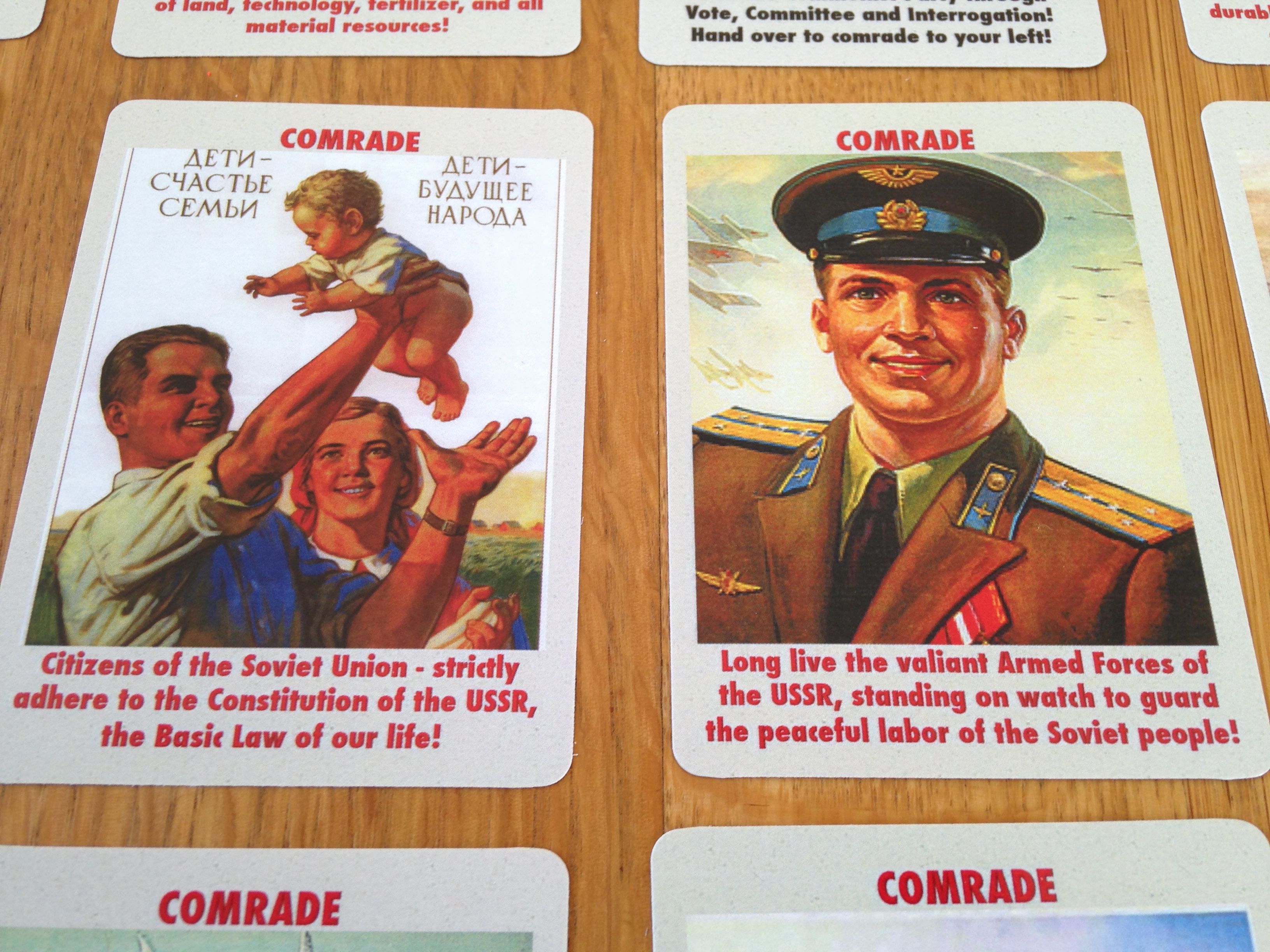
Game designThe inspiration to Comrade came mainly from The Resistance: Avalon. I like the uncertainty that is the core of the decuction games and have already used similar mechanisms in Christina Regina, where the players balance between moving a Queen towards their colors and keeping their colors hidden. However, the predefined roles may also limit the tactical options and the player interaction as the roles more or less force the players to play in a certain way. To avoid this, I wanted to add another dimension for a more dynamic gameplay but what? Somehow the idea of opposite objectives came to me. Rather than just playing out your role through voting (like in Avalon) or moving (like in Christina Regina), you could actually have one player trying to influence the other players (the dissident) in addition to the traditional mechanism of one player trying to reveal another player (the informer). It would be a bit like Old Maid with two maids moving from hands to hands, one chasing the other and one avoiding the other. This would also give a good thematic ending to the game - once enough players are influenced there is nothing more to play about. But wouldn't this be boring for the passive non-dissident and non-informer players? The answer came almost immediately. Why not let the roles be shifted during the game? This answer actually accomplished several things. First, the players would get the opportunity to try several roles during one gameplay. Second, even non-dissident and non-informer players will have a decision to either avoid the critical cards (if they are afraid to lose) or to acquire them (if they think they can use them to win), effectively eliminating the distinction between "active" and "passive" players. As an additional bonus, less cards would be needed as the "role card" and the "tradable card" is the same and it turned out that the 18 card Microgame Contest limit of 18 cards would still be enough for up to 10 players! The rest of the design was simply a matter of polishing the rules and the theme. The rules were created to give the desired gameplay in every little decision (vote to give clues about who plays who and about how many that are influenced, committee to determine whether the players have seen the dissident card or not, and interrogation to exchange cards in a way that lets all players take active decisions). The theme was used to give a colorful background to the roles played by the players and make the decisions intuitive (dissident wanting to be spread to other players, informer wanting to find the dissident card and so on). The result was, I hope, a game that pleases both the brain and the eye. Game components
|
Annotated gamesIf you like those game mechanisms, I can also recommend:
|